Physical Address
304 North Cardinal St.
Dorchester Center, MA 02124
Physical Address
304 North Cardinal St.
Dorchester Center, MA 02124


Learn why Haiti's transitional government must be replaced and the path forward for the country.
Haiti is facing a severe political crisis, with its transitional government being a major point of contention. The current administration has been deemed unconstitutional, sparking widespread debate and calls for reform.
The situation in Haiti is dire, with political instability hindering progress and development. The need for a democratic governance system is more pressing than ever, as the country struggles to achieve stability and prosperity.
A change is necessary to address the root causes of Haiti’s problems and pave the way for a more stable and democratic future.
The Haitian people are suffering through a severe crisis marked by political instability, gang violence, and significant humanitarian challenges. This multifaceted crisis has deep roots, affecting various aspects of Haitian society and its governance.
The political landscape in Haiti is currently characterized by heightened instability and an increase in violent incidents. Gang violence has become a pervasive issue, with various groups vying for control over different territories. This has led to a breakdown in law and order, further exacerbating the crisis.
The table below illustrates the rise in violent incidents over the past few years, highlighting the escalating nature of the crisis.
| Year | Number of Violent Incidents | Percentage Change |
|---|---|---|
| 2020 | 500 | – |
| 2021 | 700 | +40% |
| 2022 | 1000 | +43% |
The humanitarian consequences of the crisis in Haiti are dire. The population is facing significant challenges, including food insecurity, displacement, and lack of access to basic services like healthcare and education. The ongoing violence has also led to a psychological trauma among the population, further complicating the humanitarian response.
The international community has expressed concern over the situation, with various organizations calling for immediate action to address the humanitarian needs and restore stability in the region.
Understanding Haiti’s current governance issues requires a look into its past, where a pattern of political instability has been a recurring theme. Since gaining independence in 1804, Haiti has faced numerous challenges that have shaped its political landscape.
Haiti’s history is marked by a cycle of political upheaval, with various regimes rising and falling over the years. Political instability has been a persistent issue, often resulting from power struggles and conflicts between different political factions. This instability has hindered the country’s ability to establish a stable and effective government.
Haiti has experienced several transitional governments in the past, each with varying degrees of success. Previous transitional governments have often been established in response to crises, but their outcomes have been mixed. Some have managed to stabilize the country temporarily, while others have failed to address the underlying issues, leading to further instability.
The historical context of Haiti’s governance challenges highlights the need for a stable and legitimate government. By understanding the patterns of political instability and the outcomes of previous transitional governments, it is possible to identify potential pathways to improving Haiti’s governance.
In the wake of President Jovenel Moïse’s assassination, Haiti found itself in a precarious political situation, leading to the establishment of a transitional government. This event marked a significant turning point in the country’s struggle with governance and stability.
The assassination of President Jovenel Moïse on July 7, 2021, was a pivotal moment that threw Haiti into chaos. The attack, carried out by a group of armed individuals, not only claimed the president’s life but also his wife, Martine Moïse, who was injured in the process.
The aftermath of the assassination saw a power vacuum, with various political factions vying for control. This period was marked by intense political maneuvering as different groups sought to assert their influence over the governance of Haiti.
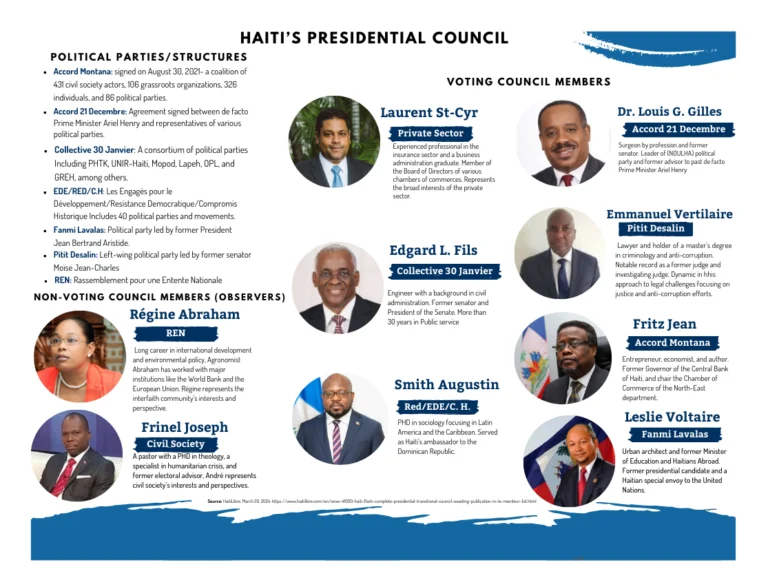
The current transitional government is characterized by a complex power structure, with several key figures playing crucial roles. Understanding the dynamics between these individuals is essential to grasping how the government operates.
The interplay between these figures and the distribution of power within the government will significantly impact Haiti’s path towards stability and democratic governance.
The legitimacy of Haiti’s current transitional government is under scrutiny due to its failure to adhere to the country’s constitutional requirements. A thorough examination is necessary to understand the constitutional implications of the government’s actions.
Haiti’s constitution outlines specific requirements for governance, including the establishment of democratic processes and the protection of human rights. The constitution mandates that government officials be elected through free and fair elections, ensuring that they have the mandate of the people.
The current transitional government has been accused of several legal violations, including procedural irregularities in its formation and operation. Specifically, the government was not established through the constitutional processes, raising concerns about its legitimacy.
The process leading to the establishment of the current government deviated from constitutional norms, lacking the necessary electoral mandate and parliamentary approval.
The transitional government was not elected by the people, undermining its claim to legitimacy. The absence of an electoral mandate means that the government lacks the democratic credentials required by Haiti’s constitution.
The constitutional analysis clearly indicates that the current transitional government in Haiti operates outside the legal framework established by the country’s constitution. This situation calls for a reevaluation of the government’s legitimacy and a push towards constitutional governance.
Governance issues and failed promises have characterized the tenure of Haiti’s current transitional government. Despite initial hopes for reform and stability, the administration has struggled to meet the expectations of the Haitian people.
The transitional government had pledged to address critical issues such as security, economic stability, and social justice. However, these commitments remain largely unfulfilled. For instance, the government has failed to effectively address the rising gang violence and provide adequate public services.
Administrative failures have plagued the government, with allegations of corruption further eroding public trust. A review of the government’s performance reveals significant shortcomings in transparency and accountability.
| Issue | Description | Impact |
|---|---|---|
| Unmet Commitments | Failure to address security and economic issues | Loss of public trust |
| Administrative Failures | Ineffective governance and lack of transparency | Increased corruption allegations |
The situation underscores the need for a more accountable and effective government. By examining the failures of the current administration, it’s clear that a new approach is necessary to restore public trust and address the pressing issues facing Haiti.
Replacing Haiti’s current transitional government is crucial for upholding democratic values and improving international relations. The existing government’s unconstitutional nature has far-reaching implications for the country’s political stability and global standing.
The current transitional government’s illegitimacy undermines democratic principles in Haiti. Without a legitimate government, the rights of Haitian citizens are compromised, and the rule of law is weakened. It’s essential to restore democratic governance to ensure the protection of individual freedoms and the promotion of social justice.
Democratic principles are fundamental to Haiti’s development and stability. The lack of a constitutionally mandated government hinders the country’s ability to address pressing issues such as poverty, inequality, and security.
Haiti’s unconstitutional transitional government also affects its international standing and relationships with other countries. The lack of a legitimate government makes it challenging for Haiti to secure foreign aid, negotiate trade agreements, and participate in regional organizations.
| Aspect | Impact of Unconstitutional Government | Potential Outcome with Legitimate Government |
|---|---|---|
| Foreign Aid | Reduced aid due to lack of confidence in government | Increased aid with a legitimate government |
| Trade Agreements | Difficulty negotiating agreements | Easier negotiation with a recognized government |
| Regional Participation | Limited participation in regional organizations | Full participation with a legitimate government |

The international community’s perception of Haiti is closely tied to its government’s legitimacy. By replacing the current transitional government with a constitutionally mandated one, Haiti can improve its international standing and strengthen its relationships with other nations.
The economic conditions in Haiti have deteriorated substantially since the establishment of the current transitional government. This deterioration is multifaceted, affecting various aspects of the economy and the lives of Haitian citizens.
The economic instability has led to a decline in living standards for many Haitians. Key economic indicators such as inflation rate, unemployment, and GDP growth have shown unfavorable trends. For instance, the inflation rate has increased, eroding the purchasing power of the Haitian gourde, while unemployment rates have soared, leaving many without a stable income.
| Economic Indicator | Pre-Transitional Government | Current Status |
|---|---|---|
| Inflation Rate | 5% | 10% |
| Unemployment Rate | 15% | 20% |
| GDP Growth | 2% | -1% |
The current political instability has also deterred foreign investment, a crucial factor for Haiti’s economic development. Moreover, the distribution of international aid has been hampered by governance issues and corruption allegations, further exacerbating the economic challenges.
The security situation in Haiti has significantly deteriorated under the current transitional government. This deterioration is marked by a surge in violent crimes and a breakdown in law enforcement.
Gang violence has escalated dramatically, with armed groups exerting control over larger territories. This has led to increased kidnappings, robberies, and other violent crimes, severely impacting the daily lives of Haitians. The gangs’ territorial control has fragmented the country, making it difficult for authorities to maintain order.
The transitional government has struggled to implement effective public safety measures. Law enforcement agencies are under-resourced and often unable to respond to security threats. The lack of trust in law enforcement, coupled with corruption allegations, has further exacerbated the security crisis. As a result, many communities live in fear, with some even forming their own vigilante groups to counter the gang violence.
The situation demands immediate attention and reform to restore stability and ensure the safety of Haitian citizens.
International perspectives on Haiti’s government are diverse, reflecting a broad range of interests and concerns among global stakeholders. The country’s governance crisis has significant implications beyond its borders, affecting regional stability and global diplomatic relations.
The Caribbean and Latin American regions have been particularly vocal about the situation in Haiti. Neighboring countries are concerned about the potential spillover effects of Haiti’s instability, including increased migration and security threats. Regional organizations, such as the Caribbean Community (CARICOM), have issued statements calling for a return to constitutional governance in Haiti.
Some countries in the region have taken a more proactive stance, advocating for diplomatic and economic measures to pressure the transitional government to relinquish power. For instance, Dominican Republic, which shares a border with Haiti, has expressed concerns about security and economic impacts, and has called for international cooperation to address the crisis.
The United States, the United Nations, and the broader global community have also been closely monitoring the situation in Haiti. The U.S. has expressed concern over the humanitarian and security implications of the crisis, and has worked with international partners to call for a peaceful and democratic resolution. The UN has similarly emphasized the need for a return to constitutional governance, highlighting the importance of Haitian-led solutions to the country’s challenges.
The global community’s stance is characterized by a mix of diplomatic pressure and support for humanitarian efforts. International actors are working together to address the immediate needs of the Haitian people while also pushing for long-term political reforms.
Haiti’s journey towards constitutional governance is fraught with challenges, but understanding the pathways to democratic transition can pave the way for reform. The country’s history of political instability and governance issues necessitates a comprehensive approach to achieving a legitimate democratic government.
A legitimate democratic transition in Haiti requires several key elements, including inclusive dialogue, free and fair elections, and respect for constitutional provisions. These elements are crucial for establishing a government that is representative of the people’s will.
Several models and frameworks can be considered for governance reform in Haiti. These include constitutional amendments, institutional strengthening, and decentralization. Each of these approaches has its advantages and challenges.
Countries that have successfully transitioned to democratic governance, such as South Africa and Chile, offer valuable lessons. Their experiences highlight the importance of national dialogue and institutional reform.
“The transition to democracy requires a deep understanding of the country’s history, culture, and the needs of its people.”
Adapting these lessons to Haiti’s unique context requires careful consideration of the country’s historical legacy, cultural diversity, and socio-economic challenges. A tailored approach that addresses these factors can help ensure a successful transition.
The push for a more constitutional government in Haiti is significantly driven by the country’s vibrant civil society. Haitian civil society organizations have been instrumental in advocating for political change and reform, often filling the gaps left by governmental failures.
Grassroots movements in Haiti have been pivotal in mobilizing the population against unconstitutional governance. These movements, often led by local community leaders and activists, have successfully organized protests and awareness campaigns, pushing for a government that is accountable to the people.
Key aspects of these movements include:
Building inclusive political processes is crucial for ensuring that all segments of Haitian society have a voice in governance. Civil society organizations are working to promote representation of marginalized groups, including women and the poor, in political decision-making.
A critical aspect of this effort is the promotion of transparent and participatory governance mechanisms. This includes supporting electoral reforms and advocating for policies that address the needs of the most vulnerable populations.
| Initiatives | Objectives | Outcomes |
|---|---|---|
| Grassroots Mobilization | Mobilize against unconstitutional governance | Increased public awareness and demand for change |
| Inclusive Representation | Promote representation of marginalized groups | More equitable political processes |
| Electoral Reforms | Support transparent and fair electoral processes | Credible and representative elections |
Haiti stands at a critical juncture, with the need for a legitimate government more pressing than ever. The current unconstitutional transitional government has failed to address the nation’s deep-seated issues, from political instability and violence to economic deterioration and security crises.
A democratic future for Haiti hinges on governance reform, requiring a transition that adheres to constitutional principles and reflects the will of the Haitian people. This involves not only replacing the current administration but also ensuring that the new government is inclusive, transparent, and accountable.
The path forward for Haiti is complex, but with the active engagement of civil society, the support of the international community, and a commitment to democratic principles, the country can move towards a more stable and prosperous future. Governance reform is essential to achieving this vision, enabling Haiti to realize its potential and provide a better life for its citizens.
Ultimately, Haiti’s path forward is rooted in its ability to establish a democratic government that serves its people, fostering an environment conducive to economic growth, security, and social justice.
The main issue is that it is unconstitutional, lacking the necessary electoral mandate and having been established through procedural irregularities.
The current government has led to deteriorating economic indicators, a decline in foreign investment, and challenges in aid distribution, ultimately affecting the living standards of the Haitian people.
The security crisis has escalated under the transitional government, with a rise in gang violence, territorial control by gangs, and failures in public safety measures and law enforcement.
The international community, including the Caribbean and Latin American regions, the United States, and the UN, has taken various stances on Haiti’s unconstitutional transitional government, with some calling for reform and others providing conditional support.
A legitimate democratic transition in Haiti requires adherence to constitutional requirements, inclusive political processes, and representation that reflects the will of the Haitian people.
Haitian civil society can play a crucial role in driving government reform through grassroots movements advocating for political change and building inclusive political processes and representation.
Yes, there are potential models and frameworks for governance reform that can be adapted to Haiti’s unique context, drawing lessons from successful transitions in other countries.