Physical Address
304 North Cardinal St.
Dorchester Center, MA 02124
Physical Address
304 North Cardinal St.
Dorchester Center, MA 02124


Explore how foreign actors, elites, and oligarchs profit from Haiti's fear and insecurity in the Insecurity Industry.
Haiti has long been plagued by instability and violence, creating a fertile ground for what can be termed the insecurity industry. This phenomenon involves various stakeholders, including foreign actors, local elites, and oligarchs, who capitalize on the country’s fear and insecurity.
The presence of these actors has transformed insecurity into a lucrative business, with various groups exploiting Haiti’s vulnerabilities for financial gain. Understanding this complex issue is crucial for addressing the root causes of Haiti’s problems.
Haiti is grappling with a severe security crisis, characterized by rampant gang violence and a fragile state apparatus. The situation on the ground is dire, with widespread reports of kidnappings, armed robberies, and violent clashes between gangs.
The current security crisis in Haiti has deep historical roots. Two significant factors have contributed to the nation’s vulnerability: colonial legacy and international interference, as well as political instability and governance failures.
Haiti’s history as a French colony has had a lasting impact on its development. The exploitation and oppression under colonial rule laid the groundwork for future instability. Furthermore, international interference, often in the form of foreign interventions and economic manipulation, has disrupted Haiti’s ability to develop a stable and self-sufficient governance structure.
Political instability has been a persistent issue in Haiti, with frequent regime changes, coups, and electoral disputes. Weak governance, characterized by corruption and inefficiency, has further eroded the state’s ability to provide security and basic services to its citizens.
The current security landscape in Haiti is marked by an unprecedented level of gang violence. Gangs have taken control of significant portions of the capital, Port-au-Prince, and other urban areas. The violence is not only a result of gang activities but also a symptom of deeper societal issues, including poverty, lack of opportunities, and a general sense of disenfranchisement among the youth.
The situation in Haiti is complex, requiring a comprehensive understanding of its historical and current dynamics to address the security crisis effectively.
The insecurity industry in Haiti is a multifaceted phenomenon driven by foreign actors, local elites, and oligarchs who exploit the nation’s instability for financial gain. This complex ecosystem thrives on the country’s persistent security crisis, creating a vicious cycle of fear, violence, and profit.
The term “insecurity industry” refers to the network of individuals, organizations, and governments that profit from conditions of instability and fear. In Haiti, this industry encompasses a broad range of actors, from private security firms to international aid organizations, and from local politicians to foreign governments.
As Mark Duffield notes in his work on the politics of humanitarianism, “The merging of development and security has created a new paradigm where insecurity is both a condition and a driver of economic activity.” This observation is particularly relevant in Haiti, where the insecurity industry has become a significant economic force.
The economics underlying Haiti’s insecurity industry are rooted in the creation and exploitation of fear and instability. This environment generates profit opportunities through various channels, including private security services, arms trafficking, and the manipulation of humanitarian aid.
Insecurity in Haiti creates a demand for private security services, ranging from personal protection to the securing of infrastructure. This demand is met by a supply of security providers, including local and international firms.
The cycle of crisis and exploitation in Haiti is self-reinforcing. Insecurity leads to a crisis, which in turn creates opportunities for exploitation by various actors. This cycle perpetuates the conditions that fuel the insecurity industry.
| Actor | Profit Mechanism | Impact on Haiti |
|---|---|---|
| Private Security Firms | Providing security services | Exacerbates inequality, creates dependency on external security |
| Foreign Governments | Influencing policy, providing “aid.” | Undermines sovereignty, fosters dependency |
| Local Elites | Manipulating aid, exploiting resources | Perpetuates corruption, widens wealth gap |
Haiti’s instability has created opportunities for foreign entities to advance their interests under the guise of assistance. This complex dynamic involves various actors, including international aid organizations, foreign governments, and multinational corporations, each with its own agenda.
International aid organizations and the NGO industrial complex play a significant role in Haiti’s landscape. While their primary goal is to provide humanitarian assistance, their presence also creates a multi-billion-dollar industry. This industry often perpetuates dependency rather than fostering self-sufficiency, as it focuses on short-term solutions to long-term problems.
Foreign governments intervene in Haiti with a mix of humanitarian and strategic interests. They often use aid as a tool for geopolitical influence, seeking to advance their own agendas under the guise of assistance. This can lead to a form of neocolonialism, where external powers dictate the course of Haiti’s development.
Multinational corporations are also drawn to Haiti’s instability, exploiting regulatory vacuums to further their interests. They often engage in extractive industries, such as mining and logging, without adequate oversight or regard for environmental and social consequences. This exploitation exacerbates Haiti’s problems, creating long-term challenges for the nation.
The interplay between these foreign actors and Haiti’s local dynamics is complex. Understanding this relationship is crucial to addressing the root causes of Haiti’s insecurity and finding sustainable solutions.
In Haiti, a powerful oligarchy has emerged, exploiting the nation’s fear and instability for financial gain. This phenomenon is characterized by a small group of influential individuals who control a significant portion of the country’s economy.
The economic elite in Haiti has established monopolies over key sectors, allowing them to dictate market trends and prices. This control enables them to maximize profits, often at the expense of the general population.
One of the primary means by which Haiti’s oligarchs maintain their economic stranglehold is through import-export control. By dominating the import and export markets, they can manipulate prices, further enriching themselves while leaving the average Haitian facing increased costs for essential goods.
Additionally, these oligarchs engage in real estate speculation, particularly in areas affected by crises. They purchase land at depressed prices during times of instability, only to sell at significantly higher rates when conditions improve, thereby accumulating wealth.
The oligarchs also forge political-business alliances, creating networks of corruption that permeate various levels of Haitian society and government. These alliances facilitate their ability to manipulate policies and regulations to their advantage.
| Mechanisms | Description | Impact |
|---|---|---|
| Import-Export Control | Dominating import/export markets to manipulate prices | Increased costs for essential goods |
| Real Estate Speculation | Buying land at low prices during crises and selling high | Accumulation of wealth among oligarchs |
| Corruption Networks | Forming alliances to manipulate policies and regulations | Perpetuation of corruption and inequality |

Haiti’s oligarchs have developed a complex system to profit from the country’s ongoing crises, perpetuating a cycle of insecurity and economic disparity. Understanding these dynamics is crucial to addressing the root causes of Haiti’s challenges.
The security apparatus in Haiti has become a lucrative business, with various actors profiting from the country’s instability. This complex industry involves multiple stakeholders, including private security firms, arms traffickers, and those operating protection rackets.
Private security firms have mushroomed in Haiti, offering services to those who can afford them. These firms commodify safety, creating a two-tiered system where the wealthy are protected, and the poor are left vulnerable. The wealthy elite often rely on these private security firms to safeguard their assets and families, further exacerbating social inequalities.
Arms trafficking is a critical component of the security apparatus, fueling gang violence and militarization. The influx of weapons not only intensifies conflicts but also transforms gangs into more sophisticated armed groups. This militarization is often linked to external factors, including international arms trafficking networks.
| Aspect | Description | Impact |
|---|---|---|
| Private Security Firms | Offer protection services to the wealthy | Exacerbates social inequality |
| Arms Trafficking | Supplies weapons to gangs | Intensifies gang violence |
| Protection Rackets | Extorts money from businesses and individuals | Creates a culture of fear and dependency |
Protection rackets are another facet of the security apparatus, where individuals and businesses are forced to pay for “protection” to avoid violence or damage to their property. This creates an economy based on extortion, further entrenching the cycle of violence and fear.
“The extortion economy thrives on the fear of violence, creating a vicious cycle that is difficult to break.”
By understanding these components of the security apparatus, it becomes clear how violence has become a business model in Haiti, perpetuating instability and suffering for its citizens.
In Haiti, economic extraction mechanisms have become intricately linked with the country’s ongoing instability. The interplay between economic exploitation and insecurity has created a vicious cycle that perpetuates Haiti’s vulnerability.
Disaster capitalism has emerged as a significant economic extraction mechanism in Haiti. Following natural disasters, such as hurricanes and earthquakes, foreign companies and local elites have exploited the situation to profit from reconstruction efforts. This includes inflating prices for construction materials and services, as well as securing lucrative contracts for rebuilding infrastructure.
Examples include the aftermath of the 2010 earthquake, where billions of dollars in aid were pledged, but much of it was mismanaged or siphoned off through corrupt practices.
Resource exploitation and land appropriation are other critical mechanisms through which economic extraction occurs in Haiti. The country’s natural resources, including gold, copper, and timber, are highly valued on the global market.
Mining concessions have been granted to foreign companies, often under dubious circumstances and without adequate regulatory oversight. This has led to environmental degradation and local displacement.
Agricultural land grabs by foreign investors have also been on the rise, contributing to food insecurity among local populations. The focus on export-oriented crops has undermined Haiti’s ability to produce food for its own people.
| Economic Activity | Impact on Haiti | Key Players |
|---|---|---|
| Mining Concessions | Environmental degradation, displacement | Foreign mining companies |
| Agricultural Land Grabs | Food insecurity, loss of livelihoods | Foreign investors, local elites |
| Disaster Capitalism | Inflated reconstruction costs, corruption | Foreign companies, local contractors |
Behind the statistics and reports, real people are suffering due to Haiti’s insecure industry. The lives of millions of Haitians are affected by the human cost of this industry, which perpetuates a cycle of fear and instability.
The insecurity industry has led to forced displacement, with many Haitians being forced to flee their homes due to gang violence and other security threats. This displacement has given rise to a refugee industry that often prioritizes profit over people, exacerbating the suffering of those displaced.
The economic impact of the insecurity industry is also severe, leading to economic deprivation and the creation of dependency on external aid. This not only undermines the local economy but also perpetuates a cycle of dependency that is difficult to break.
Furthermore, the insecurity industry has caused significant social fragmentation, eroding community structures and social cohesion. The resulting collective trauma affects not only individuals but also the fabric of Haitian society as a whole, making it challenging to rebuild and recover.
The human cost of Haiti’s insecurity industry is a pressing concern that demands immediate attention and action. It is crucial to address the root causes of this issue and work towards creating a more stable and secure environment for the Haitian people.
As Haiti navigates its complex security crisis, local solutions are emerging as beacons of hope. The resilience of the Haitian people is a testament to their ability to resist and rebuild in the face of adversity.
Grassroots security initiatives are gaining momentum, with community members coming together to create safe zones and neighbourhood watches. These efforts are not only enhancing security but also fostering a sense of community solidarity. For instance, local organizations are implementing community-based programs that focus on violence prevention and providing support to vulnerable populations.
“The power of community is our greatest asset in times of crisis.”
Civil society organizations are playing a crucial role in advocating for the rights of Haitian citizens and pushing for international accountability. They are working tirelessly to ensure that foreign interventions are transparent and beneficial to the local population. A key aspect of their advocacy is promoting policies that support Haitian-led development and security initiatives.
| Initiative | Description | Impact |
|---|---|---|
| Community Patrols Neighbourhood | d watches organized by residents | Reduced gang violence |
| Youth Programs | Initiatives providing education and job training | Decreased youth involvement in gangs |
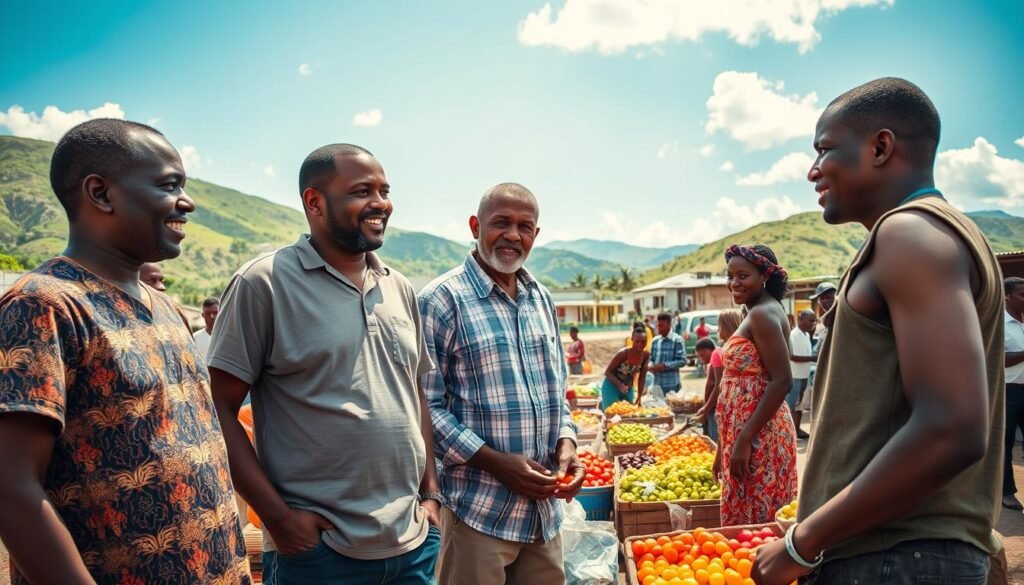
The path forward for Haiti lies in supporting and amplifying these Haitian-led solutions. By doing so, we can help create a more secure and prosperous future for the Haitian people.
Haiti’s security crisis is a complex issue, deeply intertwined with the interests of foreign actors, elites, and oligarchs. To address this, it’s crucial to understand the mechanisms that perpetuate the insecurity industry.
The path forward involves dismantling the systems that profit from fear and instability. This requires a multifaceted approach, focusing on Haitian-led solutions and community-driven initiatives that prioritize the needs and safety of the Haitian people.
By supporting grassroots security initiatives and advocating for international accountability, it’s possible to create a more stable and equitable environment. The goal is to break the cycle of violence and economic exploitation, paving the way for sustainable development and peace in Haiti.
Dismantling the insecurity industry is a critical step towards achieving this goal, ensuring that the benefits of security and stability are shared by all, rather than being exploited for the gain of a few.
The insecurity industry refers to the complex network of foreign actors, elites, and oligarchs who profit from Haiti’s instability and fear.
Haiti’s colonial legacy has played a significant role in shaping its vulnerability to security crises, with historical factors such as foreign interference and exploitation contributing to ongoing instability.
International aid organizations, while often well-intentioned, can sometimes perpetuate the insecurity industry by creating dependencies and fueling corruption, rather than addressing the root causes of instability.
Haiti’s oligarchs profit from insecurity through various means, including monopolies, import-export control, price manipulation, and real estate speculation, often in alliance with foreign interests.
Disaster capitalism refers to the practice of profiting from catastrophic events, such as natural disasters or economic crises. In Haiti, disaster capitalism can lead to exploitation of resources, land grabs, and further instability.
Private security firms can contribute to Haiti’s insecurity by commodifying safety, often for the wealthy, while leaving the majority of the population vulnerable to violence and insecurity.
Haitian-led solutions include grassroots security initiatives, community solidarity, and civil society advocacy, which aim to address the root causes of insecurity and promote accountability, both locally and internationally.
International actors can support Haitian-led solutions by promoting international accountability, providing non-exploitative aid, and recognizing the agency and autonomy of Haitian communities and organizations.