Physical Address
304 North Cardinal St.
Dorchester Center, MA 02124
Physical Address
304 North Cardinal St.
Dorchester Center, MA 02124


Explore the shocking betrayal that led to the assassination of Haitian revolutionary leader Jean-Jacques Dessalines on October 17, 1806.
On a fateful day in Haitian history, Jean-Jacques Dessalines, the leader of the Haitian Revolution, was assassinated, marking a pivotal moment in the struggle for Haiti’s Independence.
Dessalines played a crucial role in the Haitian Revolution, fighting against French colonial rule and paving the way for Haiti to become the first independent black nation in the world.
The assassination of Dessalines was a betrayal that shocked the nation and had significant repercussions on the future of Haiti.
The story of Jean-Jacques Dessalines is one of transformation, from an enslaved person to a military commander who played a crucial role in shaping Haiti’s history. His journey is a testament to his leadership skills and strategic importance in the fight for Haiti’s independence.
Dessalines was born around 1758 in Guinea, West Africa, and was later enslaved in the French colony of Saint-Domingue (present-day Haiti). He worked on a plantation in the Artibonite region, where he suffered under the harsh conditions of slavery. After joining the slave revolt in 1791, Dessalines quickly rose through the ranks due to his bravery and tactical skills. He became a trusted lieutenant under Toussaint Louverture, another prominent leader of the Haitian Revolution.
Dessalines played a pivotal role in the Haitian Revolution, leading military campaigns against French colonial forces. His leadership was instrumental in several key victories, including the Battle of Crête-à-Pierrot in 1802. When Louverture was captured and imprisoned by the French in 1802, Dessalines continued the fight, eventually leading to the declaration of Haiti’s independence on January 1, 1804. As a military commander, Dessalines’ strategic decisions were crucial in securing Haiti’s freedom.
Haiti’s journey to independence was marked by fierce resistance against Napoleon’s forces. The Haitian Revolution, which began in 1791, was a complex and multifaceted struggle that ultimately led to the establishment of Haiti as a sovereign nation.
Napoleon Bonaparte’s attempt to maintain French control over Haiti was met with fierce resistance. The Haitian people, led by figures such as Jean-Jacques Dessalines, fought bravely against the French army. The turning point came when the Haitians successfully defeated Napoleon’s forces, paving the way for independence.
On January 1, 1804, Haiti declared its independence, becoming the world’s first black republic. This milestone marked a significant shift in world history, as it challenged the prevailing systems of slavery and colonialism. Haiti’s independence served as a beacon of hope for enslaved people around the world.
| Year | Event | Significance |
|---|---|---|
| 1791 | Haitian Revolution Begins | Start of the struggle for independence |
| 1804 | Haiti Declares Independence | Establishment of the world’s first black republic |
As Emperor Jacques I, Dessalines sought to solidify Haiti’s independence and establish a robust governmental framework. His ascension to the imperial throne marked a significant phase in Haitian history, characterized by efforts to consolidate power and ensure the country’s sovereignty.
Dessalines’ coronation took place on October 6, 1804, in a grand ceremony that reflected his imperial ambitions. The event was a demonstration of his commitment to establishing a strong, centralized government. His imperial title was not merely symbolic; it represented his determination to protect Haiti from external threats and internal strife.
Dessalines’ governance style was characterized by a mix of authoritarianism and populist measures. He implemented policies aimed at strengthening the economy and military, while also addressing social issues. His leadership was marked by a pragmatic approach to governance, balancing the needs of different segments of Haitian society.
One of Dessalines’ most significant achievements was the promulgation of the 1805 Constitution. This document defined the principles of the Haitian state, including its sovereignty, the structure of government, and the rights of its citizens. The Constitution was a cornerstone of Dessalines’ efforts to establish a legal framework for the newly independent nation.
One of the most significant challenges Dessalines faced was the growing opposition due to his controversial policies. As Emperor Jacques I, he implemented various decisions aimed at consolidating power and ensuring the economic viability of Haiti. However, these policies often had the opposite effect, creating widespread discontent among different segments of the population.

Dessalines’ approach to land distribution was a major source of conflict. After independence, the redistribution of land was a critical issue, with many expecting a more equitable allocation. However, Dessalines’ policies favored the military and the elite, leading to tensions among the general population. This perceived injustice fueled opposition, as many felt disenfranchised by the new leadership.
The labor practices implemented by Dessalines were another contentious issue. To maintain agricultural production, he enforced a strict regime that required laborers to work on plantations under close supervision. While aimed at economic stability, these practices were often seen as too harsh, reminiscent of the colonial era. This led to growing resentment among the workforce, who felt their freedom was being curtailed.
Dessalines’ policy towards former French colonists also generated significant opposition. His decision to expel or harshly treat those who remained in Haiti created tension, particularly among the mulatto elite who had connections to the French. This policy, while aimed at asserting Haitian sovereignty, alienated potential allies and created divisions within the country.
In conclusion, Dessalines’ controversial policies, including those related to land distribution, labor practices, and the treatment of former French colonists, played a significant role in the growing opposition against him. These issues, while complex and multifaceted, ultimately contributed to the challenges he faced as emperor.
Behind the assassination of Dessalines lay a complex web of conspirators driven by personal and political ambitions. The betrayal was not the act of a single individual but a coordinated effort involving key figures within Haiti’s early independence movement.
Alexandre Pétion, a prominent figure among the mulatto elite, played a significant role in the conspiracy against Dessalines. The mulatto elite had growing concerns about Dessalines’ authoritarian rule and his policies, which they perceived as threatening their status and power. Pétion’s involvement was crucial as he was able to rally support among other disaffected groups.
Henri Christophe, another key figure in Haiti’s struggle for independence, was also deeply involved in the conspiracy. Christophe, who commanded significant military power in the north, was dissatisfied with Dessalines’ leadership and felt underappreciated for his role in the revolution. His military resources were instrumental in the execution of the assassination plot.
The conspiracy against Dessalines was a multifaceted operation involving various factions with different grievances. The key conspirators included:
October 17, 1806, was a day of betrayal, a day when the hero of Haiti’s independence, Jean-Jacques Dessalines, was assassinated. This event marked a pivotal moment in Haitian history, leading to a period of instability and division.
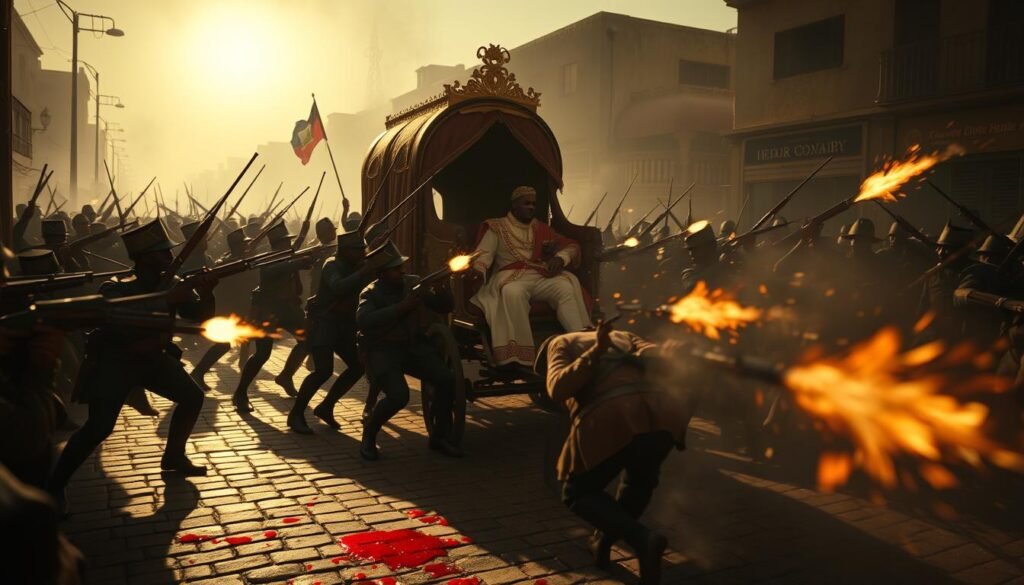
Dessalines embarked on a journey to quell the southern rebellion, a task that had become increasingly urgent. The southern region was in turmoil, and Dessalines saw it as his duty to restore order. As he traveled, he was accompanied by a contingent of soldiers, though their loyalty would soon be tested.
The journey was not without its challenges; the terrain was difficult, and the weather was harsh. Despite these obstacles, Dessalines pressed on, driven by his determination to stabilize the region.
As Dessalines and his troops approached Pont Rouge, they were met with an ambush orchestrated by conspirators. The attack was sudden and brutal, catching Dessalines off guard. The once-mighty leader was quickly overwhelmed by the sheer number of assailants.
The ambush at Pont Rouge was a carefully planned event, with the conspirators using the terrain to their advantage. Dessalines, known for his bravery, fought valiantly but was ultimately betrayed by those he trusted.
Dessalines’ final moments were marked by intense violence and betrayal. Despite being wounded, he continued to fight, but he was eventually overpowered. The exact details of his last moments remain a subject of historical debate, but it’s clear that his death was a result of the treachery that surrounded him.
The assassination of Dessalines on October 17, 1806, at Pont Rouge marked the end of an era for Haiti. It led to a period of division and instability, with long-lasting consequences for the nation.
The brutal murder of Dessalines had far-reaching consequences for the young nation of Haiti. The event triggered a chain reaction of power struggles, instability, and social upheaval.
After being assassinated at Pont Rouge on October 17, 1806, Dessalines’ body was subjected to brutal treatment. His corpse was left exposed, symbolizing the end of his reign and the beginning of a new era of uncertainty. The handling of his body reflected the deep-seated animosity towards him from certain factions.
The immediate public reaction to Dessalines’ assassination was mixed. While some viewed him as a tyrant and celebrated his death, others mourned the loss of a leader who had fought for Haiti’s independence. The diverse reactions underscored the complex legacy of Dessalines.
Dessalines’ family suffered greatly following his assassination. His wife and children faced persecution, and some were even forced into exile. The fate of his family members became a poignant reminder of the personal costs of political turmoil.
The aftermath of Dessalines’ assassination set the stage for Haiti’s future challenges, including political instability and social division. Understanding this period is crucial for grasping the complexities of Haitian history.
Dessalines’ demise initiated a civil war that split Haiti into rival factions, setting the stage for a period of political instability and conflict.
The division was primarily between two leaders: Henri Christophe in the north and Alexandre Pétion in the south. This division not only reflected the geographical split but also the underlying tensions between different groups within Haitian society.
Henri Christophe, who had been a key military leader under Dessalines, declared himself King Henri I of Haiti in the northern part of the country. He established a monarchy with a rigid social hierarchy and focused on building infrastructure, including fortifications, roads, and public buildings.
Christophe’s rule was marked by authoritarianism, but he also invested in education and the arts, promoting a sense of national identity.
In contrast, Alexandre Pétion established a republic in the southern part of Haiti. Pétion’s government was more liberal, and he is remembered for his land distribution policies, which aimed to provide land to former slaves and veterans of the revolution.
However, Pétion’s rule was also characterized by political infighting and challenges in maintaining stability.
| Characteristics | Christophe’s Kingdom | Pétion’s Republic |
|---|---|---|
| Form of Government | Monarchy | Republic |
| Leadership Style | Authoritarian | Liberal |
| Economic Focus | Infrastructure, Agriculture | Land Distribution |
The betrayal that led to Dessalines’ assassination set off a chain reaction of events that would destabilize Haiti for generations to come. This pivotal moment in Haitian history had far-reaching consequences that continue to impact the nation today.
Following Dessalines’ death, Haiti plunged into a period of political instability. The division between the northern kingdom under Henri Christophe and the southern republic led by Alexandre Pétion created a fractured political landscape. This instability made Haiti vulnerable to foreign interference, as various powers sought to exploit the country’s weakened state. The lack of a unified government hindered Haiti’s ability to assert its sovereignty and develop effective governance structures.
The economic repercussions of Dessalines’ assassination were equally significant. The political instability that followed his death discouraged investment and hindered economic development. Haiti’s economy struggled under the weight of internal conflict and external pressures, including the hefty indemnity paid to France in exchange for recognition of its independence. This financial burden stifled economic growth and contributed to the country’s long-term economic challenges.
In conclusion, the long-term consequences of Dessalines’ assassination have had a lasting impact on Haiti, contributing to both political instability and economic hardship. Understanding these historical events is crucial for grasping the complexities of Haiti’s current situation.
In contemporary Haiti, the memory of Dessalines is a complex and multifaceted phenomenon. His legacy is celebrated and contested, reflecting the diverse perspectives on his role in Haitian history.
Dessalines is viewed by many as a national hero, revered for his leadership in the fight for Haiti’s independence. His determination and military prowess are seen as crucial elements in the establishment of the world’s first black republic. However, others perceive him as a controversial figure due to his authoritarian governance style and the harsh policies implemented during his rule.
The debate surrounding Dessalines’ legacy is reflective of broader discussions about Haitian identity and the country’s historical narrative. While some emphasize his role in achieving independence, others critique his methods and the impact on different segments of Haitian society.
Dessalines is commemorated in various ways across Haiti. Monuments, cultural events, and educational curricula often highlight his significance. For instance, October 17, the anniversary of his assassination, is observed as a day of remembrance.
In addition to official commemorations, Dessalines has been the subject of numerous cultural representations, including literature, art, and music. These works often explore the complexities of his character and the historical context in which he lived.
The ongoing commemoration and representation of Dessalines in Haitian culture underscore his enduring importance. As Haiti continues to navigate its history and identity, the figure of Dessalines remains a pivotal element in the national narrative.
The assassination of Jean-Jacques Dessalines on October 17, 1806, cast a long shadow of betrayal over Haiti, a nation he helped liberate from French colonial rule. This event marked a turning point in Haitian history, leading to a period of civil war and political instability that would plague the island for years to come.
Dessalines’ legacy is complex, reflecting both the heroic efforts he made to secure Haiti’s independence and the controversial policies he implemented during his rule as Emperor Jacques I. Understanding Dessalines’ story is crucial to grasping the broader narrative of Haiti’s struggle for sovereignty and the challenges it faced in the aftermath of colonialism.
The shadow of betrayal that followed Dessalines’ assassination continues to resonate in modern times, influencing Haiti’s political landscape and cultural identity. As Haiti navigates its complex history and looks towards the future, the lessons of Dessalines’ life and death remain an essential part of the nation’s ongoing story, shaping its path forward.
Jean-Jacques Dessalines was a Haitian military leader and the leader of the Haitian Revolution, who declared Haiti’s independence in 1804 and became its first ruler.
Dessalines played a crucial role in the Haitian Revolution, serving as a military commander and leading the fight against French colonial forces, ultimately defeating them and securing Haiti’s independence.
Dessalines was assassinated on October 17, 1806, due to growing opposition against his rule, fueled by his controversial policies, including land distribution conflicts, harsh labor practices, and the treatment of former French colonists.
The key conspirators behind Dessalines’ assassination included Alexandre Pétion and Henri Christophe, who were dissatisfied with Dessalines’ rule and played a significant role in his betrayal.
Dessalines’ assassination led to a period of civil war, dividing Haiti into Christophe’s kingdom in the north and Pétion’s republic in the south, resulting in long-term political instability, foreign interference, and economic repercussions.
Dessalines is remembered as a national hero and a symbol of Haiti’s independence, with commemorations and cultural representations celebrating his legacy, although some view him as a controversial figure due to his policies and governance style.
The 1805 Constitution, implemented during Dessalines’ rule, was a significant document that established Haiti as a sovereign state, outlining its governance structure and laws, and reflecting Dessalines’ vision for the newly independent nation.
Dessalines’ governance style, marked by authoritarian tendencies and harsh labor practices, contributed to growing opposition against his rule and ultimately led to his assassination, having a lasting impact on Haiti’s development.