Physical Address
304 North Cardinal St.
Dorchester Center, MA 02124
Physical Address
304 North Cardinal St.
Dorchester Center, MA 02124
Explore the legal void in Haiti's transitional governance and the lack of legitimacy in this in-depth article.
Haiti is currently facing a severe governance crisis, characterized by a transitional governance system that lacks the necessary legitimacy to effectively govern the country.
The existing legal void has led to a situation where the current governance structure is not grounded in a robust legal framework, exacerbating the crisis.
This situation has significant implications for Haiti’s stability and development, making it imperative to address the legal void and establish a legitimate governance framework.
Following President Moïse’s assassination, Haiti is grappling with a severe crisis in its governance structure. The country’s political instability has been exacerbated by governance challenges that have been ongoing for years.
The immediate aftermath of President Moïse’s assassination saw a significant power vacuum. Emergency measures were put in place to stabilize the situation.
In the days following the assassination, the government implemented emergency measures to maintain order. These included:
As the government struggled to assert its authority, various factions began to make competing claims to leadership. This further complicated the political landscape.
Haiti’s democratic institutions have been on the brink of collapse. The lack of political legitimacy has eroded trust in government.
The collapse of these institutions has had severe consequences, including:
Haitians face numerous challenges daily, from lack of security to economic hardship. The governance challenges have directly impacted their quality of life.
The situation on the ground remains dire, with many calling for immediate action to restore stability and legitimacy to Haiti’s governance.
Understanding Haiti’s current governance crisis requires a look into its past. The country’s history has been marked by significant challenges that have shaped its governance structures and contributed to the political instability it faces today.
Haiti’s governance issues began with its post-colonial history. After gaining independence in 1804, Haiti struggled to establish a stable governance system. The early governance structures were influenced by the country’s fight for independence and the leadership styles of its early rulers.
Since 1986, Haiti has experienced a pattern of political instability, marked by coups, protests, and short-lived governments. This period has seen the rise and fall of various political leaders, each contributing to the country’s governance challenges.
Haiti has had several transitional governments in the past, each with its own set of challenges and outcomes.
One notable example is the transitional government that was established in 2004 following the ousting of President Jean-Bertrand Aristide. This period was marked by international intervention and attempts to stabilize the country.
Despite previous experiences, Haiti continues to face similar governance challenges. The lack of effective governance structures and the failure to learn from past experiences have contributed to the ongoing crisis.
The historical context of Haiti’s governance challenges highlights the need for a more stable and effective governance system. Understanding the past is crucial to addressing the country’s current governance crisis.
The 1987 Constitution of Haiti is a foundational document that outlines the principles of governance, but its limitations have become apparent during periods of political instability. This Constitution was a significant step towards establishing a democratic government after the fall of the Duvalier regime.
The 1987 Constitution includes several key provisions aimed at promoting democracy and human rights. It establishes a semi-presidential system, where the President serves as head of state, and a Prime Minister is responsible for government operations. Separation of powers is a cornerstone, with an independent judiciary and a bicameral legislature.
One of the significant limitations of the 1987 Constitution is its lack of clarity on presidential succession. In the event of a President’s incapacitation or death, the Constitution does not provide a clear line of succession, leading to potential power vacuums and political crises.
In 2012, Haiti introduced constitutional amendments aimed at addressing some governance issues. However, these amendments have been disputed, with debates surrounding their legitimacy and impact on the political process.
During crisis situations, legal interpretations play a crucial role. The Constitution grants certain powers to the President and the legislature, but ambiguities in its provisions often lead to conflicting interpretations, exacerbating political tensions.
The constitutional framework of Haiti, while foundational, faces significant challenges. Addressing these limitations is crucial for establishing a stable and legitimate government. The interplay between constitutional provisions, legal interpretations, and political realities underscores the complexity of Haiti’s governance issues.
Haiti’s governance crisis is deeply intertwined with issues of legitimacy and legal authority. A significant issue in Haiti’s governance is the lack of legitimacy, stemming from a legal void in its transitional leadership. This void has led to a complex situation where the government’s authority is questioned.
Political legitimacy refers to the acceptance of a government’s authority by the governed. Legal legitimacy, on the other hand, pertains to the adherence to established laws and constitutional provisions. In Haiti’s case, both forms of legitimacy are under scrutiny.
The current transitional government lacks an electoral mandate, having not been elected through a popular vote. This absence of democratic validation undermines its legitimacy and effectiveness.
Various power centers, including political factions and armed groups, are vying for influence. Each has its claims to legitimacy, often based on different interpretations of the legal and political landscape.
Public perception plays a crucial role in determining the legitimacy of Haiti’s transitional governance. The populace’s trust in the government’s ability to address their needs and ensure security is critical.
| Legitimacy Factor | Description | Impact on Governance |
|---|---|---|
| Electoral Mandate | Absence of popular vote | Undermines legitimacy |
| Legal Framework | Lack of clear legal provisions | Creates legal void |
| Public Perception | Trust in government’s ability | Influences popular legitimacy |
The interplay between these factors highlights the complexity of Haiti’s governance crisis. Addressing the lack of legitimacy will require a multifaceted approach that includes legal reforms, electoral processes, and efforts to regain public trust.
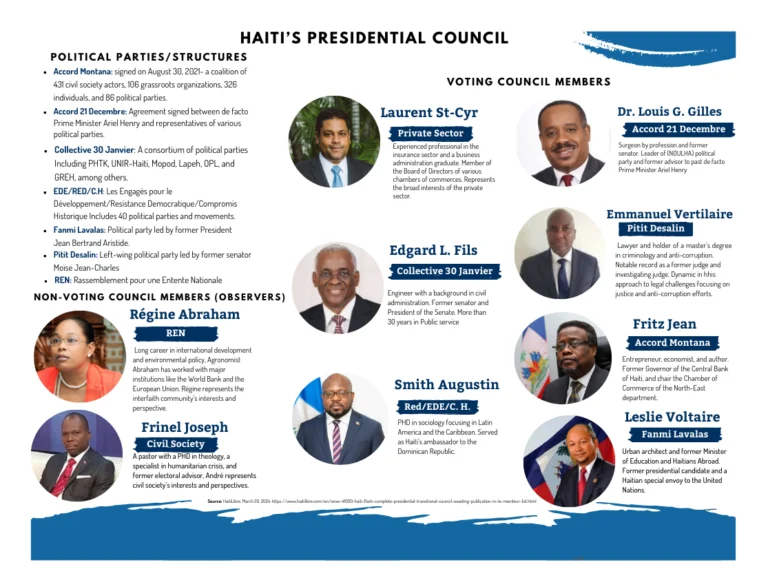
Amidst the political vacuum following President Moïse’s assassination, the Transitional Presidential Council has emerged as a key player in Haiti’s governance. This council represents a significant attempt to address the country’s deepening governance crisis.
The formation of the Transitional Presidential Council involved complex political negotiations among various stakeholders. These negotiations were crucial in determining the council’s composition and its mandate. The process was marked by disagreements and compromises, reflecting the diverse interests and agendas of the parties involved.
According to
“The council’s establishment is a testament to the efforts of various political actors to find a collective solution to Haiti’s governance challenges.”
The negotiations were facilitated by international partners, who played a crucial role in brokering an agreement among the contending parties.
The Transitional Presidential Council comprises representatives from different political parties and civil society organizations. However, the representation has been a subject of controversy, with some groups arguing that their interests are not adequately represented.
| Representative Group | Number of Representatives | Selection Process |
|---|---|---|
| Political Parties | 5 | Negotiation among party leaders |
| Civil Society Organizations | 3 | Selection by civil society networks |
| Other Stakeholders | 2 | Appointment by consensus |
The legal basis of the Transitional Presidential Council is a subject of ongoing debate. Constitutional questions have been raised regarding its legitimacy and authority. Critics argue that the council’s establishment lacks a clear constitutional mandate, potentially undermining its effectiveness and legitimacy.
The decision-making process within the Transitional Presidential Council is designed to be consensus-based. However, deadlocks have occurred due to differing opinions among its members. This has hindered the council’s ability to make timely and effective decisions, further complicating Haiti’s governance challenges.
In conclusion, the Transitional Presidential Council faces significant challenges in its structure and operations. Addressing these challenges will be crucial to the council’s success in stabilizing Haiti’s governance.
International intervention in Haiti’s transitional governance has raised both hopes and concerns. As the country navigates its complex political landscape, the role of external actors has become increasingly significant.
The United Nations Security Council has played a crucial role in addressing Haiti’s governance crisis through various resolutions. These resolutions have focused on providing humanitarian aid, supporting political stability, and enhancing security measures.
The impact of these resolutions has been multifaceted, with some arguing that they have helped stabilize the situation, while others contend that they have not addressed the root causes of the crisis.
The United States has been a key player in Haiti’s governance, with its policy toward the transition being closely watched. The U.S. has provided significant financial support and security assistance.
The financial aid provided by the U.S. comes with certain conditions, aimed at promoting democratic governance and economic stability. However, these conditions have sometimes been criticized for infringing on Haiti’s sovereignty.
Security assistance has been another critical aspect of U.S. policy, with initiatives aimed at strengthening Haiti’s law enforcement capabilities. While these efforts have shown some positive results, the overall security situation remains precarious.
Regional organizations such as the Caribbean Community (CARICOM) and the Organization of American States (OAS) have also been actively involved in Haiti’s governance. Their efforts have focused on promoting regional stability and supporting democratic processes.
The extent of international involvement in Haiti’s governance has raised important questions about sovereignty and external influence. While external support is crucial for addressing immediate challenges, there is a risk that it may undermine Haiti’s autonomy.
Balancing the need for international assistance with the preservation of national sovereignty is a delicate task. It requires careful consideration of the terms and conditions of external support.
The security crisis in Haiti has reached a boiling point, with gang violence and governance failures intertwining to create a complex emergency. This situation has severe implications for the Haitian people and the country’s future.
Gang violence has become a pervasive issue in Haiti, with various gangs exerting control over different territories. This has led to a fragmentation of the country, making it challenging for the government to assert its authority.
According to recent reports, gangs now control approximately 60% of Port-au-Prince, the capital city, severely restricting movement and access to basic services for the local population.
The collapse of law enforcement capabilities has further exacerbated the security crisis. The Haitian National Police (HNP) is under-resourced and understaffed, making it difficult to counter the gang violence effectively.
The humanitarian impact on civilians has been devastating. With gang violence on the rise, many Haitians are caught in the crossfire, facing displacement, injury, or death.
“The situation is catastrophic. People are living in fear, and the humanitarian needs are vast,” said a UN official, highlighting the gravity of the crisis.
There is a clear nexus between governance failures and the security crisis in Haiti. Weak governance structures have enabled gang violence to flourish, creating a vicious cycle that is difficult to break.
To address this, it is essential to strengthen governance and security institutions, ensuring that they are accountable, transparent, and effective in serving the Haitian people.
The path to legitimate governance in Haiti involves navigating the intricacies of electoral processes, constitutional amendments, and civil society initiatives. Achieving this goal requires a comprehensive understanding of the challenges and opportunities that lie ahead.
An electoral roadmap is crucial for restoring democratic legitimacy in Haiti. However, several challenges must be addressed, including ensuring the independence of the electoral commission, securing voter registration, and preventing electoral violence.
Constitutional reform is another critical aspect of achieving legitimate governance. Proposals for reform include revising the presidential succession laws, strengthening the independence of the judiciary, and enhancing the representation of marginalized communities.
Civil society plays a vital role in promoting legitimate governance. Initiatives include advocating for human rights, supporting community development projects, and fostering dialogue between different political stakeholders.
Building inclusive political consensus is essential for sustainable governance. This involves reconciling competing visions for Haiti’s future and ensuring that all political actors are represented in the decision-making process.
The Montana Accord represents one of the alternative frameworks for achieving political consensus. It emphasizes the need for a broad-based government that includes representatives from various political and civil society groups.
Reconciling competing visions requires dialogue and compromise among different stakeholders. This process is crucial for building a stable and legitimate government that represents the interests of all Haitians.
| Pathways | Key Elements | Challenges |
|---|---|---|
| Electoral Roadmap | Independent Electoral Commission, voter registration | Electoral violence, logistical issues |
| Constitutional Reform | Presidential succession, judicial independence | Political consensus, legal complexities |
| Civil Society Initiatives | Human rights advocacy, community development | Funding, political interference |
Haiti’s governance crisis has highlighted the need for a legitimate and effective government. The absence of a clear legal framework for transitional governance has exacerbated the power vacuum, leading to widespread instability.
The future of Haiti’s governance depends on establishing a legitimate government that represents the will of its citizens. This can be achieved through a combination of electoral reforms, constitutional amendments, and inclusive political dialogue. International support and cooperation will be crucial in this process.
A legitimate governance structure will enable Haiti to address its pressing security and humanitarian challenges. By prioritizing the needs of its citizens and promoting national unity, Haiti can begin to rebuild its institutions and move towards a more stable future.
The path forward will require sustained commitment and cooperation from all stakeholders. With a renewed focus on legitimate governance, Haiti can overcome its current challenges and create a brighter future for its people.
The main issue is the lack of legitimacy, resulting in a legal void that hinders effective governance.
The assassination created a power vacuum, leading to competing claims to leadership and exacerbating the governance crisis.
The 1987 Constitution outlines the framework for governance, including the separation of powers and the role of the president, but it has gaps, particularly regarding presidential succession.
The Transitional Presidential Council is a governance structure formed through political negotiations, but it faces challenges, including composition and representation issues, legal basis questions, and decision-making deadlocks.
The international community, including the United Nations, the United States, CARICOM, and OAS, has been involved through various means, such as financial support, security assistance, and policy guidance, but this involvement raises questions about sovereignty and external influence.
Governance failures have contributed to the security crisis, characterized by gang violence and the collapse of law enforcement capabilities, which in turn exacerbates the humanitarian impact on civilians.
Proposed pathways include an electoral roadmap, constitutional reform proposals, civil society initiatives, and building an inclusive political consensus, with the Montana Accord being one of the alternative frameworks.
The Montana Accord represents a so-called alternative framework for governance, aiming to address the current crisis by proposing a different approach to achieving legitimate governance and reconciling competing visions for Haiti’s future.
Achieving inclusive political consensus requires reconciling competing visions and engaging various stakeholders, including civil society, political parties, and the international community, to build a more legitimate and representative governance structure.