Physical Address
304 North Cardinal St.
Dorchester Center, MA 02124
Physical Address
304 North Cardinal St.
Dorchester Center, MA 02124


Justice, not intervention, is the key to resolving Haiti's manufactured insecurity, as this article explores.
The ongoing Haiti crisis has led to a surge in manufactured insecurity, prompting calls for intervention. However, this approach may not be the most effective solution.
Instead, judicial reform could be the key to addressing the root causes of the issue. By focusing on courtroom solutions, Haiti can work towards a more stable and just society.
The need for judicial reform is clear, and it is essential to prioritize this approach to address the Haiti crisis effectively.
Haiti is currently facing an unprecedented crisis, marked by escalating gang violence and deepening political instability. This complex situation has severe implications for the security, economy, and daily life of Haitian citizens.
The security landscape in Haiti is dominated by two major challenges: gang violence and political instability.
Gang violence has become a pervasive issue, with armed groups controlling significant portions of territory, including parts of the capital, Port-au-Prince. This control has led to increased lawlessness and fear among the population.
The political instability in Haiti has resulted in a governance vacuum, where the absence of effective leadership has exacerbated the security situation. This vacuum has allowed gang violence to flourish, further destabilizing the country.
The ongoing crisis has had a devastating impact on civilian life and infrastructure in Haiti.
The humanitarian consequences of the crisis are severe, with thousands displaced and in need of assistance. The lack of security has hindered the delivery of aid, exacerbating the humanitarian situation.
The economic impact of the crisis is also significant, with businesses shutting down and economic activity grinding to a halt. The paralysis of the economy has further reduced the government’s ability to provide services, creating a vicious cycle of instability.
| Challenge | Impact | Consequence |
|---|---|---|
| Gang Violence | Increased lawlessness, fear among population | Displacement, humanitarian needs |
| Political Instability | Governance vacuum, ineffective leadership | Exacerbated security situation, economic paralysis |
| Humanitarian Crisis | Thousands displaced, aid delivery hindered | Severe humanitarian consequences |
Understanding Haiti’s current situation requires a look into its historical context, particularly its journey from colonial rule to independence. Haiti’s history is marked by significant events that have shaped its sovereignty.
Haiti was a French colony, known as Saint-Domingue, before it became the first independent black nation in the world after a successful slave revolt. This transition to independence in 1804 was a pivotal moment in Haitian history, establishing its sovereignty. However, the legacy of colonial rule has had lasting impacts on Haiti’s development and political stability.
Throughout its history, Haiti has experienced numerous foreign interventions that have affected its sovereignty. These interventions have come in various forms, including military occupations and peacekeeping missions.
The United States occupied Haiti from 1915 to 1934, a period that significantly impacted Haiti’s political and economic structures. The occupation led to the establishment of a modernized military and infrastructure but also suppressed Haitian independence and self-governance.
Later, the United Nations has been involved in Haiti through various peacekeeping missions. While intended to stabilize the country, these missions have been controversial, particularly due to allegations of misconduct and the introduction of cholera, which led to a significant humanitarian crisis.
The historical context of Haiti’s struggle for sovereignty highlights the complexities of its current situation. Foreign interventions, while sometimes well-intentioned, have often undermined Haiti’s ability to self-govern and maintain its sovereignty.
“Manufactured insecurity” in Haiti refers to the deliberate actions and conditions that exacerbate the country’s security challenges. This concept is crucial for understanding the complexities of Haiti’s ongoing crisis.
External factors play a significant role in Haiti’s instability. Foreign policy decisions made by other countries, particularly those with significant influence over Haiti, can either stabilize or destabilize the region.
Decisions made by foreign governments can have far-reaching consequences. For instance, international sanctions or foreign military interventions can disrupt Haiti’s fragile peace, leading to increased insecurity.
Economic pressures, including dependency on foreign aid and international economic policies, can also contribute to manufactured insecurity. Economic instability can lead to social unrest and exacerbate security challenges.
Internal factors, including governance failures and power dynamics, are equally significant. Corruption and impunity are pervasive issues that undermine trust in government institutions.
Corruption within government and security forces not only erodes public trust but also directly contributes to insecurity. Impunity for crimes committed by those in power further exacerbates the problem.
The manipulation of insecurity for political purposes is a dangerous trend. Politicians and other actors may exploit insecurity to achieve their goals, further destabilizing the country.
The track record of foreign military interventions in Haiti is marked by controversy and unintended consequences. Despite numerous efforts to stabilize the country, the outcomes have often been disappointing, leaving Haiti in a state of prolonged instability.
Haiti has experienced several international interventions over the years, with varying degrees of success. One of the most notable was the United Nations Stabilization Mission in Haiti (MINUSTAH).
MINUSTAH was deployed in 2004 with the aim of restoring order and stability. However, its presence was marred by controversy, including allegations of sexual misconduct and the introduction of cholera, which led to a significant humanitarian crisis.
In recent years, there have been renewed calls for international military intervention in Haiti, citing ongoing security challenges and gang violence. However, given the historical context, such calls are met with skepticism.
The presence of foreign military forces in Haiti has led to several unintended consequences, including sovereignty concerns and the perpetuation of dependency cycles.
Foreign military interventions often raise concerns about the erosion of Haitian sovereignty. The presence of external forces can undermine the country’s ability to self-govern and make decisions in its best interest.
Moreover, reliance on foreign military aid can create dependency cycles, hindering Haiti’s ability to develop its own security capabilities. This dependency can perpetuate a cycle of instability, as local forces may not be equipped or empowered to maintain security.
In conclusion, the history of military interventions in Haiti highlights the need for alternative approaches to addressing the country’s security challenges. By understanding the pitfalls of past interventions, including the intervention trap, Haiti and its international partners can work towards more effective and sustainable solutions.
As Haiti grapples with manufactured insecurity, the need for effective courtroom solutions becomes increasingly evident. The country’s persistent instability demands a reevaluation of current strategies, focusing on judicial accountability and reform.
Legal accountability is crucial in addressing the root causes of Haiti’s insecurity. By holding individuals responsible for their actions, the judicial system can play a pivotal role in stabilizing the country.
Impunity has long been a significant factor in Haiti’s security challenges. Breaking this cycle through legal accountability can deter future violations and promote a culture of respect for the law.
When perpetrators are held accountable, it sends a powerful message that violence will not be tolerated. This can effectively deter future violence and contribute to a more secure environment.
Judicial mechanisms offer a sustainable approach to addressing the root causes of Haiti’s insecurity. By tackling corruption and state capture, the judicial system can help create a more stable political environment.
Corruption and state capture have undermined Haiti’s governance and contributed to its insecurity. Effective judicial mechanisms can help address these issues by prosecuting those involved in corrupt practices.
The rule of law is fundamental to sustainable security. By strengthening Haiti’s judicial institutions and ensuring that the legal system is independent and impartial, the country can achieve long-term stability.
In conclusion, courtroom solutions offer a viable path forward for Haiti. By focusing on legal accountability and judicial reform, Haiti can break cycles of impunity, deter future violence, and create sustainable security through the rule of law.
The effectiveness of Haiti’s judicial institutions is pivotal to addressing the country’s manufactured insecurity. A well-functioning judiciary is essential for ensuring that those responsible for crimes are held accountable, thereby contributing to a more stable and just society.
Haiti’s legal system faces significant challenges, including structural weaknesses and resource gaps. The judiciary lacks the necessary infrastructure, training, and resources to effectively administer justice.
The lack of adequate training for judges and court personnel, combined with insufficient infrastructure, hampers the efficient dispensation of justice. Moreover, corruption and political interference further erode the system’s integrity.
Despite these challenges, there are ongoing efforts to reform Haiti’s judicial system. These include initiatives to improve legal education, enhance court infrastructure, and promote judicial independence.
Successful judicial reform in Haiti can draw on models from comparable contexts as well as Haitian-led initiatives. These models provide valuable insights into effective strategies for strengthening judicial institutions.
Countries facing similar challenges have implemented various reforms, such as judicial training programs and the adoption of technology to improve court efficiency. These approaches can inform Haiti’s judicial reform efforts.
Initiatives led by Haitians are crucial for ensuring that reforms are contextually appropriate and sustainable. These initiatives often focus on community engagement and legal empowerment.

International law provides a robust toolkit for addressing the manufactured insecurity in Haiti. By leveraging various international legal mechanisms, Haiti can move towards a more stable and just society.
Haiti is bound by several international human rights treaties and customary international law, which provide a foundation for holding perpetrators accountable. These include the Universal Declaration of Human Rights and various Geneva Conventions.
Universal jurisdiction allows states to prosecute certain serious crimes, such as genocide, war crimes, and crimes against humanity, regardless of where they were committed. This principle can be instrumental in holding Haitian perpetrators accountable in foreign courts.
The Inter-American human rights system, which includes the Inter-American Commission on Human Rights and the Inter-American Court of Human Rights, plays a crucial role in promoting human rights in Haiti and other member states.
International criminal proceedings offer a pathway to accountability for serious crimes committed in Haiti. Various mechanisms can be employed, including special tribunals and the International Criminal Court.
Special tribunals and hybrid courts have been used in various contexts to address serious crimes. These mechanisms combine national and international elements, providing a flexible approach to justice.
The International Criminal Court (ICC) is a permanent institution that investigates and prosecutes genocide, crimes against humanity, war crimes, and aggression. While Haiti is a state party to the ICC, the court’s jurisdiction can be triggered in specific circumstances to address crimes committed within the country.
By utilizing these international legal frameworks, Haiti can strengthen its pursuit of justice and accountability, ultimately contributing to a more secure and stable environment for its citizens.
In the heart of Haiti’s struggle for stability, community-based justice initiatives are emerging as beacons of hope. These grassroots solutions focus on addressing the root causes of insecurity through local, effective mechanisms.
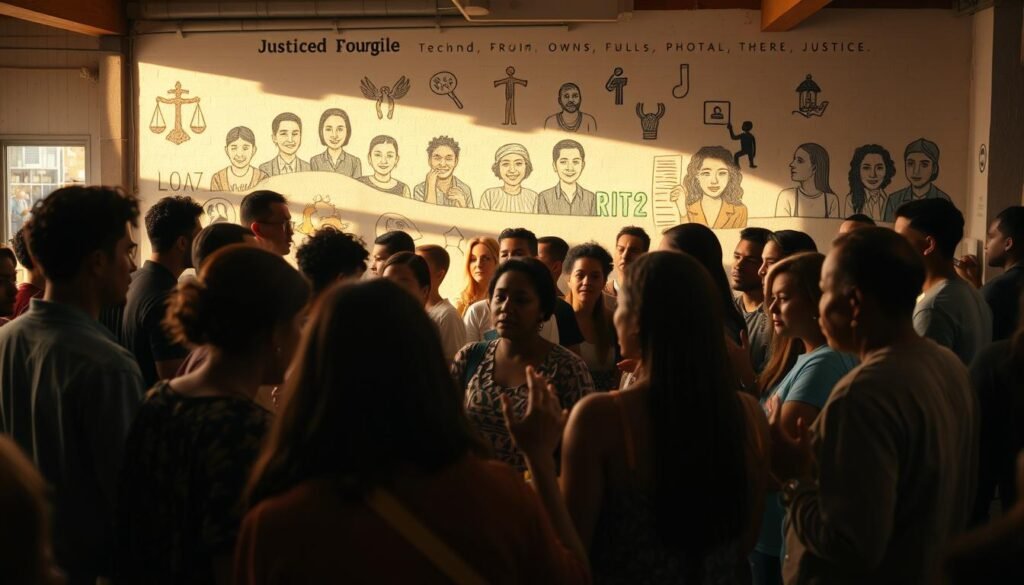
Traditional justice mechanisms have long been a part of Haitian culture. These mechanisms involve community elders and leaders who mediate disputes and promote reconciliation.
Traditional justice mechanisms are crucial in rural areas where formal justice systems may be absent. They provide a swift and culturally relevant means of resolving conflicts.
Community mediation programs are another successful model. These programs train local mediators to resolve disputes peacefully, reducing the reliance on violent means of conflict resolution.
Empowering Haitian civil society is vital for the success of community-based justice initiatives. This empowerment comes through legal aid, access to justice, and victim-centered approaches.
Legal aid programs ensure that all citizens, regardless of their economic status, have access to justice. This is crucial for rebuilding trust in the justice system.
Victim-centered approaches prioritize the needs and rights of victims, providing them with the support and compensation they deserve. This approach helps in healing the wounds of the past and preventing future conflicts.
| Initiative | Description | Impact |
|---|---|---|
| Traditional Justice | Culturally relevant dispute resolution | Promotes community reconciliation |
| Community Mediation | Trained mediators resolve disputes | Reduces violent conflict resolution |
| Legal Aid | Access to justice for all | Rebuilds trust in the justice system |
“The success of community-based justice initiatives in Haiti depends on the active engagement of local communities and the empowerment of civil society.”
By focusing on community-based justice initiatives, Haiti can take a significant step towards lasting peace and stability. These grassroots solutions not only address the symptoms of insecurity but also work towards healing the underlying causes.
Shifting the paradigm from intervention to partnership is crucial for the U.S. to effectively support Haiti’s journey towards stability. The United States has historically played a significant role in Haiti, with its policies often having far-reaching consequences.
The U.S. has a long history of engagement with Haiti, marked by periods of significant intervention. Understanding this historical context is essential to developing effective future policies.
Past U.S. interventions in Haiti have ranged from military occupations to humanitarian aid. These actions have had mixed results, often leaving behind a complex legacy.
Today, the U.S. faces both challenges and opportunities in its engagement with Haiti. Navigating these complexities requires a nuanced understanding of Haitian needs and sovereignty.
For the U.S. to make a positive impact, it must support Haitian-led justice initiatives. This involves providing technical assistance, diplomatic support, and financial backing for judicial reform.
Any U.S. support must be carefully calibrated to respect Haitian sovereignty. Technical assistance should be provided in a manner that empowers Haitian institutions.
Diplomatic and financial support are crucial for advancing judicial reform in Haiti. By working together, the U.S. and Haiti can strengthen the rule of law.
| Aspect | Intervention | Partnership |
|---|---|---|
| Approach | Top-down, often military-led | Collaborative, focusing on local needs |
| Outcome | Mixed, sometimes exacerbating issues | More sustainable, empowering local institutions |
| Sovereignty Respect | Often compromised | Respects and enhances Haitian sovereignty |
Haiti’s future depends on addressing the root causes of its manufactured insecurity. A justice-based approach is crucial to creating a more secure and just society.
Judicial reform, international cooperation, and community-based initiatives are essential components of this approach. By supporting Haitian-led justice solutions, the international community can help build effective judicial institutions and promote accountability.
The United States can play a key role in this process by shifting its policy approach from intervention to partnership. By working together, we can help Haiti achieve a more stable and prosperous future, where justice is served and human rights are respected.
Ultimately, Haiti’s future is inextricably linked to its ability to deliver justice and ensure accountability. By prioritizing justice, Haiti can break the cycle of violence and insecurity, paving the way for sustainable development and peace.
Haiti’s insecurity is largely attributed to a combination of internal and external factors, including corruption, impunity, gang violence, and foreign interventions, which collectively contribute to what is termed as “manufactured insecurity.”
Foreign interventions, including U.S. occupations and UN missions, have historically undermined Haiti’s sovereignty, creating dependency cycles and fueling resentment among Haitians, which has further complicated the country’s path to stability.
The international community can play a supportive role by providing technical assistance, diplomatic support, and financial backing for judicial reform and community-based justice initiatives, all while respecting Haitian sovereignty and leadership.
Judicial reform can help stabilize Haiti by breaking cycles of impunity, deterring future violence, and creating sustainable security through the rule of law, thereby addressing some of the root causes of the country’s insecurity.
Community-based justice initiatives include traditional justice mechanisms, community mediation programs, legal aid, and victim-centered approaches, all aimed at resolving conflicts at the local level and empowering Haitian civil society.
Yes, international legal frameworks, including universal jurisdiction for serious crimes, regional human rights mechanisms, and the International Criminal Court, can be utilized to hold perpetrators accountable, providing a pathway to justice for victims.
The United States can shift its policy approach by moving from intervention to partnership, providing support for Haitian-led justice solutions, and engaging in diplomatic and financial backing for judicial reform, all while respecting Haitian sovereignty.
Haitian-led initiatives are crucial as they ensure that solutions are tailored to the country’s specific needs and context, fostering ownership and sustainability, and are more likely to be accepted and supported by the Haitian people.