Physical Address
304 North Cardinal St.
Dorchester Center, MA 02124
Physical Address
304 North Cardinal St.
Dorchester Center, MA 02124
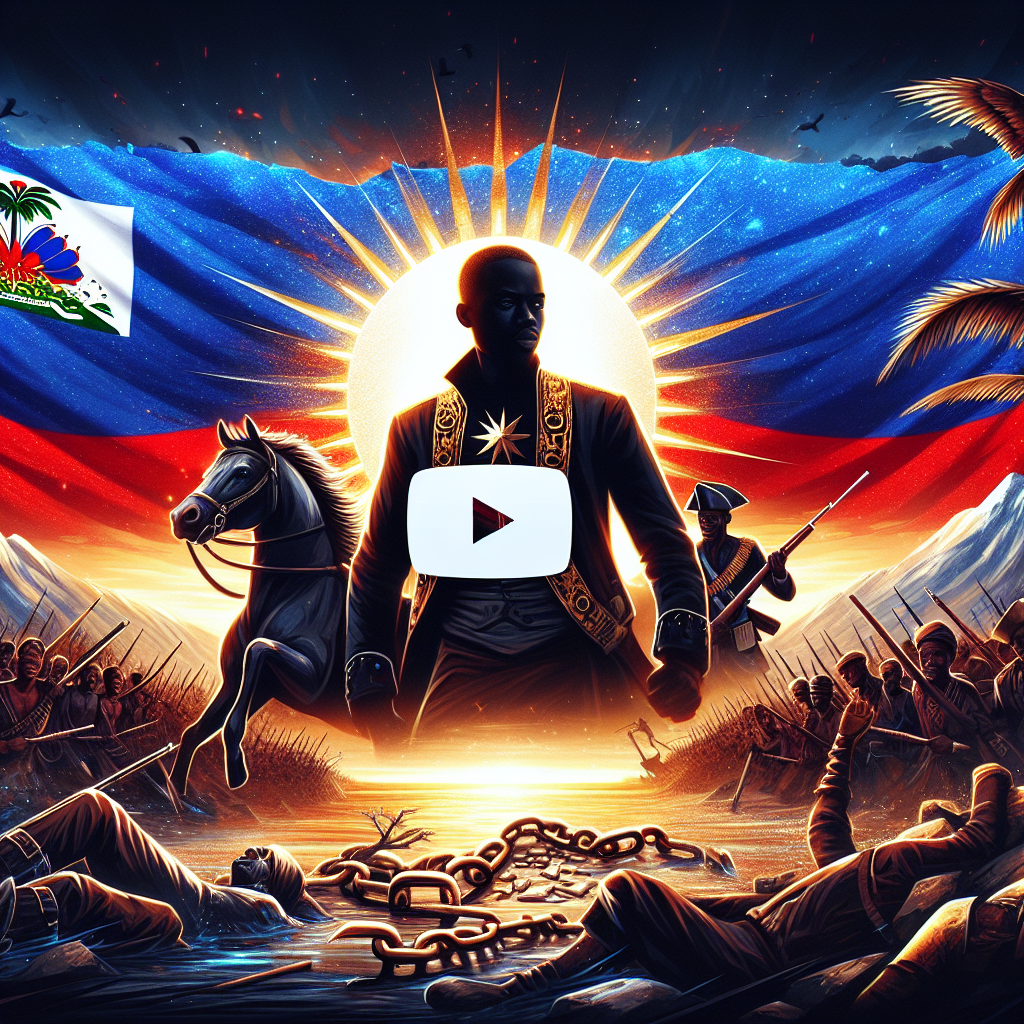
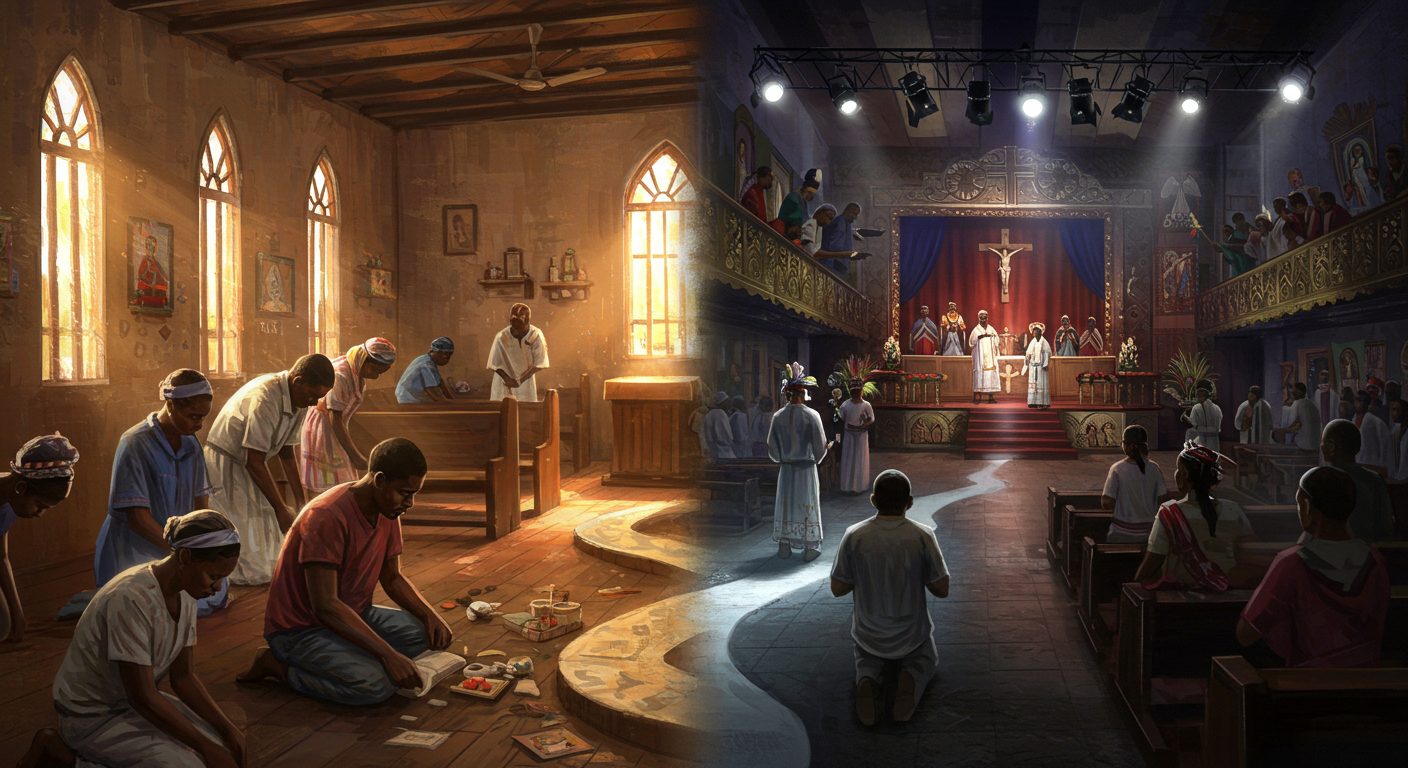
The religious landscape of Haiti represents one of history’s most complex spiritual battlegrounds, where faith, power, and resistance have intertwined since colonial times. When enslaved Africans were forcibly transported to Saint-Domingue (modern-day Haiti), they brought diverse spiritual traditions that coalesced into Vodou—a syncretic religion that preserved African cosmologies while incorporating elements of Catholicism as both disguise and adaptation. This spiritual practice became a crucial vehicle for resistance, with the legendary Vodou ceremony at Bois Caïman in August 1791 often cited as the spark that ignited the Haitian Revolution.
After independence in 1804, Haiti’s relationship with organized religion took on new dimensions. The Catholic Church, which had been the official religion of the French colonial regime, officially withdrew from Haiti following independence. This created a religious vacuum where Vodou flourished openly while maintaining its syncretic relationship with Catholicism. Haiti’s first three presidents sought to suppress Vodou, using police to enforce anti-Vodou laws, demonstrating how quickly religious control became a tool of post-colonial governance.
The Catholic Church formally re-established its presence in Haiti through an 1860 concordat with the government—a pivotal agreement that continues to grant the Church special privileges today. This concordat represented not just religious reconciliation but a political calculation, as Haitian leaders sought international recognition and legitimacy through renewed ties with Rome.
The U.S. occupation (1915-1934) marked another watershed moment in Haiti’s religious power dynamics. American marines and administrators brought Protestant denominations and cultural prejudices against Vodou, which they viewed as “primitive superstition.” This period saw intensified suppression of Vodou practices, setting the stage for the infamous anti-superstition campaigns of the 1940s, when the Catholic Church systematically destroyed Vodou temples and sacred objects while forcing practitioners to renounce their faith publicly.
In recent decades, Haiti has experienced a dramatic religious transformation with evangelical Protestant denominations gaining significant ground. According to the U.S. government’s 2022 Report on International Religious Freedom, Christians who self-identified as Protestant now comprise approximately 52% of Haiti’s population, while Catholics represent 35%. Officially, only 2% identify primarily as Vodouists, though many Haitians practice Vodou alongside Christianity, considering it “a form of spirituality they practice alongside other faith traditions” rather than a separate religion.
This evolving religious landscape exists within a nation facing profound challenges—political instability, economic hardship, natural disasters, and now, a devastating security crisis dominated by gang violence. In this context, religious institutions continue to serve as sources of both empowerment and control, healing and manipulation, resistance and domination.
The narrative surrounding Haiti’s religious landscape has been systematically distorted through colonial and neo-colonial lenses that serve specific power interests. This erasure operates on multiple levels, obscuring both historical realities and contemporary dynamics.
Perhaps the most profound erasure concerns Vodou, which colonial powers and Christian missionaries deliberately demonized as “devil worship” or “black magic” rather than recognizing it as a sophisticated spiritual tradition that preserved African cosmologies while adapting to new realities. Early French colonizers outlawed African religious practices, forcing enslaved people to be baptized Catholic while denying them full participation in Catholic sacraments—a contradiction that revealed the colonial manipulation of religion as a control mechanism rather than genuine spiritual concern.
The anti-superstition campaigns of the 1940s represent one of the most aggressive attempts to erase Vodou from Haiti’s religious landscape. During these campaigns, which were “launched by the Catholic Church to discredit Vodou,” local priests “burned Vodou ritual objects and arrested Vodou priests”. This systematic destruction of sacred objects, temples, and religious knowledge constituted what some scholars describe as religious genocide—an attempt to eliminate not just practices but the spiritual epistemologies they represented.
President Élie Lescot’s support for this “virulent crusade against vodou” revealed how religious suppression served political interests, with the state and church collaborating to control popular religious expression that was viewed as threatening to their authority. The campaign represented “a state-facilitated religious crusade” that “enlisted the authority of the Haitian state to impose penalties” against Vodou practitioners.
Another dimension of erasure involves the deliberate mischaracterization of Vodou’s political significance. Throughout Haitian history, Vodou has served as “a political instrument of liberation”, providing spiritual frameworks for resistance against oppression. Colonial and neo-colonial narratives have attempted to strip this political dimension from Vodou, reducing it to “superstition” rather than acknowledging its role in articulating alternative visions of community, authority, and freedom.
In contemporary discourse, the erasure continues through statistics that dramatically undercount Vodou practitioners. While official figures suggest only 2% of Haitians identify primarily as Vodouists, this obscures the complex reality that many Haitians practice Vodou alongside Christianity—a syncretic approach that reflects both genuine spiritual synthesis and strategic adaptation to continuing religious discrimination.
Perhaps most insidiously and absurdity, contemporary evangelical narratives often present Vodou as the source of Haiti’s problems, claiming that Haiti’s poverty and political instability result from a “pact with the devil” allegedly made during the Bois Caïman ceremony. This theological framing erases the actual causes of Haiti’s challenges—including the crippling “independence debt” imposed by France, international isolation, and repeated foreign interventions—while providing religious justification for continued missionary efforts to “save” Haiti through conversion.
The 1860 concordat between Haiti and the Holy See established a “special relationship” that continues to afford the Catholic Church “certain privileges” unavailable to other religious denominations. Under this agreement, the Haitian government provides “monthly stipends for some priests” and maintains “the right of consent over the appointment of Catholic archbishops and bishops”—a striking arrangement that blends church and state in ways that would be unconstitutional in many countries.
This privileged position has been contested by leaders of other religions. While one Catholic leader defended the concordat as a legally binding agreement, Protestant leaders raised concerns that it grants the Catholic Church “powerful influence over the government”. Similarly, Vodou leaders cited it as evidence of “a historical institutionalized predisposition” against their tradition, while the president of the National Council for Haitian Muslims called it “an unfair advantage over other religious groups”.
Beyond formal privileges, the Catholic Church’s control over education represents another powerful mechanism of influence. Although the percentage has declined as Protestant schools have proliferated, Catholic schools still account for “15 percent of all schools in the education system (16 percent of total enrollment)”. This educational footprint gives the Church significant opportunity to shape young minds while providing essential services in a context where the state education system reaches only a small percentage of children.
The Church’s complex legacy includes both support for and opposition to democratic movements. During the Duvalier dictatorships, some Catholic leaders became prominent critics of human rights abuses, with Radio Soleil playing a crucial role in the movement that eventually toppled Jean-Claude Duvalier. Yet at other moments, the Church hierarchy has aligned with conservative political forces, demonstrating how religious institutions can pivot between resistance and accommodation depending on leadership and context.
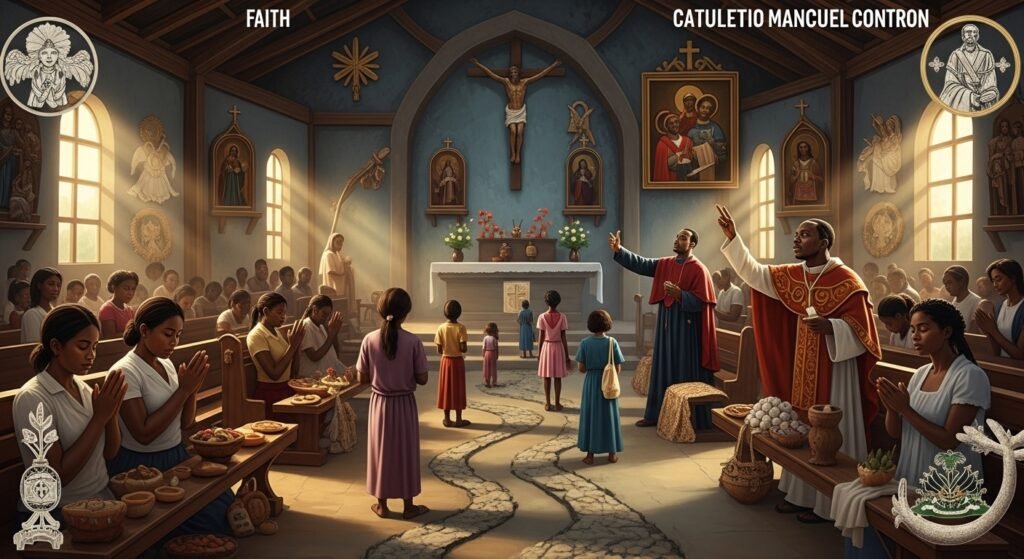
The dramatic growth of evangelical Protestant denominations represents the most significant shift in Haiti’s religious landscape over the past half-century. While comprehensive statistical studies are limited, the U.S. government estimates that “Christians who self-identified as either Protestant, Episcopalian, Methodist, Seventh-day Adventist, or Jehovah’s Witness together comprise 52 percent of the population”—a remarkable transformation in a country historically dominated by Catholicism and Vodou.
This evangelical growth accelerated during the 1970s and 1980s when “the Jean-Claude Duvalier administration’s national education campaign… required missionaries to build an affiliated school with the construction of any church”. This policy created a mutually beneficial arrangement where evangelical missions gained government support for expansion while the Duvalier regime outsourced educational responsibilities to religious organizations.
Contemporary evangelical influence operates through multiple mechanisms. Protestant denominations now control a significant portion of Haiti’s educational system, with Pastor Jean Kisomaire Duré claiming that “34 percent of students attended Protestant schools”. These schools combine education with evangelization, creating pipelines for conversion while providing essential services in communities where the state is largely absent.
The proliferation of evangelical radio stations and television channels has created powerful platforms for spreading Protestant messages while shaping public discourse on moral and political issues. Unlike the Catholic Church’s centralized structure, evangelical denominations operate with relative autonomy, allowing for diverse theological and political positions while creating competition for adherents.
This competition sometimes manifests in aggressive conversion tactics, including what some observers describe as spiritual warfare against Vodou. Some evangelical leaders actively promote the narrative that Haiti’s problems stem from its Vodou heritage, framing conversion as national salvation rather than merely personal transformation. This approach transforms religious competition into a zero-sum struggle for Haiti’s soul, with significant implications for cultural identity and social cohesion.
Politically, evangelical leaders have become increasingly influential, with politicians seeking their endorsement and support. While they don’t speak with a unified voice, many evangelical leaders promote conservative social positions while emphasizing personal morality over structural critique—a theological orientation that can inadvertently support status quo power arrangements even as it offers hope and community to individual believers.
Despite centuries of persecution, Vodou has demonstrated remarkable resilience, adapting to changing circumstances while maintaining core spiritual principles. Its decentralized structure—lacking the hierarchical organization of Catholic or even Protestant institutions—has been both vulnerability and strength, making systematic suppression difficult while complicating official recognition.
According to Vodou leaders interviewed in the U.S. government’s religious freedom report, “prejudice against them still lingered and often made Vodouists fearful to practice openly”. This continuing stigma manifests in practical challenges for formal recognition, as “the decentralized Vodou community did not easily fit into the government’s criteria for institutional registration, which emphasizes a hierarchical leadership structure”.
The death of Euvonie Georges Auguste, a mambo (female Vodou priest) who had led the National Confederation of Haitian Vodou, created additional “organizational difficulties for the Vodou community as its leaders tried to reach consensus on her replacement”. This internal challenge highlights how traditional leadership models based on consensus can struggle to interface with state registration systems designed around hierarchical structures.
Despite these challenges, Vodou continues to serve as a space of resistance to religious domination. Some practitioners express optimism about “increased societal tolerance and acceptance of Vodou”, suggesting a gradual shift in public attitudes. A younger generation of Haitians is increasingly reclaiming Vodou as part of cultural heritage and identity formation, with some activists working to destigmatize the religion through education and public advocacy.
Oungan Wilfrid Sainte-Juste articulated this reclamation effort, stating: “The idea persists that Vodou is something of the devil, something incompatible with Christianity, but Vodou has been in Haiti from the very beginning. At its core, Vodou is a celebration of love and life”. This reframing challenges centuries of demonization while emphasizing Vodou’s life-affirming values.
However, contemporary challenges include not just historical stigma but new forms of manipulation. Sainte-Juste noted that “general insecurity in the metropolitan Port-au-Prince area also worsened existing stigma against the Vodou community” as “speculation that Vodou leaders encouraged gang violence, including by giving gang members ‘magic,’ which defended them from bullets, became a popular explanation for the worsening situation”. This scapegoating represents a modern iteration of historical patterns where Vodou practitioners are blamed for social crises—a convenient deflection from more complex political and economic factors.
The religious dynamics in Haiti today reflect both historical patterns and contemporary challenges, with profound implications for Haitian society:
Haiti’s current security crisis has created new dimensions of religious control and vulnerability. According to the U.S. government’s religious freedom report, “many religious leaders said the government’s failure to maintain security and order hampered their communities’ abilities to practice their religions freely”. Gang violence directly targets religious institutions and leaders, with “media outlets reported armed gangs, kidnapping for ransom, and general insecurity impacted religious leaders and communities”.
Specific incidents illustrate this vulnerability. In 2022, “gang members killed an Italian nun on June 25 and… a police inspector while he attended church on July 24”. On October 10-16, “clashes between the 400 Mawozo and Kraze Baryé gangs in Croix-des-Bouquets” resulted in “10 persons were killed, including artisans from Noailles, a village known for its artisans and connections to Vodou”. These targeted attacks demonstrate how security breakdowns create new forms of religious persecution.
Kidnapping has become a particular threat, with gangs targeting religious leaders for ransom. Examples include the kidnapping of “Catholic Priest Whatner Aupont in Croix-des-Bouquets” on April 28, “Pastor Alcero Marc Arthur in Pétionville” on May 2, and “Father Claircius Dorvilus, head of the Catholic Church of Laplate Nieraque” on June 4. Protestant leaders explained that “churches’ access to financial resources led gangs to demand higher ‘protection’ payments from their leadership”.
This security crisis creates an environment where religious practice itself becomes dangerous, fundamentally undermining freedom of worship. According to Imam Landy Mathurin, “three mosques around Port-au-Prince were forced to close because of security concerns”. Similarly, Protestant Pastor Clement Joseph expressed regret at “the closure of a major Protestant church, La Foi Apostolique, in central Port-au-Prince due to security concerns”.
Religious competition and conversion dynamics create tensions that complicate efforts at national unity. While some religious leaders emphasize interfaith dialogue and cooperation, others promote exclusivist narratives that deepen divisions. These tensions manifest in multiple relationships:
Between Catholics and Protestants, historical dominance meets evangelical growth, creating competition for adherents and institutional influence. Catholic leadership expressed concern that “while many non-Catholics believed the Catholic Church should only occupy itself with religious affairs, the church had always led social and political efforts”—suggesting frustration at challenges to the Church’s traditional social role.
Between Christians and Vodouists, theological differences become proxy battles over Haiti’s identity and future. Vodou leaders reported that “some individuals in the Protestant community were particularly concerning to them and possibly a threat to their religious freedom”. Conversely, “one Protestant leader said his community often felt uncomfortable with Vodou rhetoric describing Christianity as a religion ‘imported by slavery’ and not authentic to Haitian culture”.
Between all religions and secular governance, questions arise about the proper relationship between faith institutions and the state. The concordat with the Catholic Church represents one model of church-state relations, while the proliferation of Protestant denominations creates pressure for more pluralistic approaches. These tensions have implications for everything from education policy to constitutional frameworks.
Religious institutions represent crucial social service providers in a context where the state struggles to meet basic needs. According to Father Jean Rodney Brévil, “the Catholic Church is present in all the cities and outskirts of the country; it evangelizes, educates, cares for the sick, defends the most vulnerable, contributes to professional training of youth, and supports and encourages social and economic activities for the working classes”.
This service provision creates both opportunity and dependency, as religious institutions gain influence through their role as de facto welfare providers. The scale of religious involvement in education is particularly significant, with “approximately 75 percent of total primary school enrollment and 82 percent of total secondary school enrollment in the country… in private, usually religious, schools”. This means that most Haitian children receive education shaped by religious values and priorities.
Different religious traditions offer distinct responses to Haiti’s social crisis. While some emphasize personal salvation and moral reform as primary solutions, others incorporate structural critique and social justice advocacy. These theological differences have practical implications for how religious communities engage with issues like poverty, inequality, and political reform.
The complex interplay between faith and manipulation in Haiti’s religious landscape demands thoughtful response from multiple stakeholders:
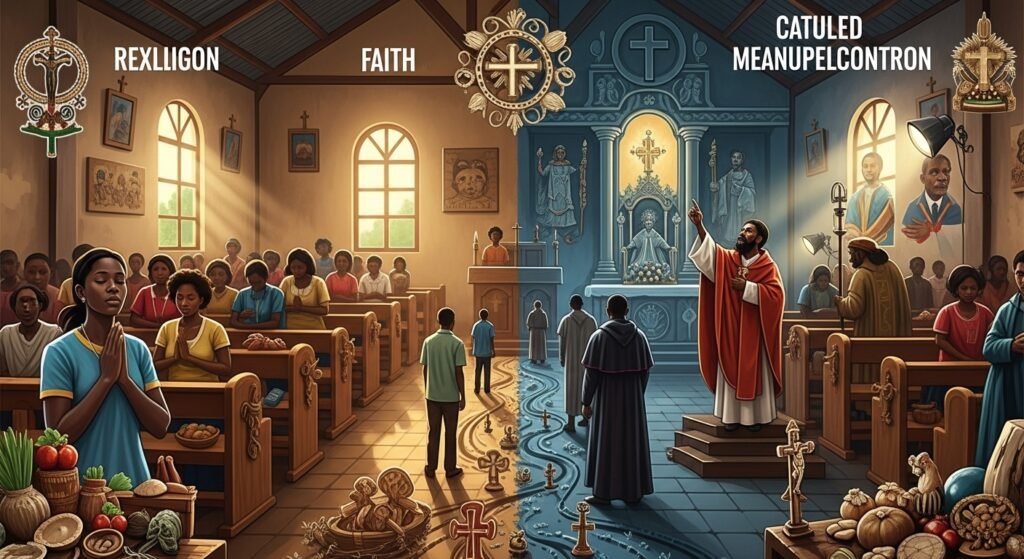
Haiti’s religious landscape reveals the complex interplay between faith as liberation and religion as control. From colonial authorities who forced enslaved Africans into Catholic baptism while denying them full participation in church life, to contemporary evangelical missionaries who frame conversion as Haiti’s salvation, religion has often been wielded as an instrument of power and manipulation. Yet simultaneously, Haitians have transformed these same religious traditions into vehicles for resistance, community building, and cultural preservation.
The 1860 concordat that continues to grant special privileges to the Catholic Church, the anti-superstition campaigns that sought to eradicate Vodou in the 1940s, and the contemporary evangelical explosion fueled partly by foreign missions all represent different mechanisms through which religious control has operated in Haiti. Yet none has succeeded in fully determining Haiti’s spiritual landscape, which remains vibrantly diverse and resilient.
Today’s religious leaders face profound challenges as gang violence targets churches, mosques, and Vodou temples alike. In this context of crisis, some religious voices call for unity while others deepen divisions. Some offer structural critique while others emphasize personal salvation. These theological differences have real consequences for Haiti’s path forward.
True religious freedom in Haiti requires not only legal protection but cultural transformation—moving beyond centuries of stigmatization toward genuine respect for spiritual diversity. It requires acknowledging how religious institutions have sometimes functioned as mechanisms of control while recognizing their potential as sources of empowerment and community resilience.
The path forward lies not in religious uniformity but in creating space where diverse traditions can coexist while collectively addressing Haiti’s profound challenges. In this vision, faith serves not as manipulation but as authentic expression of Haiti’s complex cultural heritage and ongoing struggle for full liberation.
1. How has Haiti’s religious landscape changed over time? Haiti has transformed from a predominantly Catholic and Vodou society to one where Protestants now comprise the largest religious group (approximately 52% of the population), Catholics represent about 35%, and only 2% identify primarily as Vodouists—though many Haitians practice Vodou alongside Christianity. 2. What was the anti-superstition campaign and how did it impact Vodou? The anti-superstition campaigns of the 1940s were systematic efforts by the Catholic Church, supported by the Haitian government under President Élie Lescot, to eradicate Vodou. During these campaigns, priests “burned Vodou ritual objects and arrested Vodou priests”, destroying temples and forcing practitioners to publicly renounce their faith—a campaign that many scholars consider a form of religious persecution. 3. How does the 1860 concordat continue to influence Haiti’s religious dynamics today? The concordat between Haiti and the Vatican grants the Catholic Church special privileges, including monthly stipends for some priests and government consent over the appointment of bishops. Religious leaders from Protestant, Vodou, and Muslim communities have criticized this arrangement for creating an uneven playing field in Haiti’s religious landscape. 4. How has Haiti’s current security crisis affected religious communities? Gang violence has directly targeted religious leaders and institutions, with numerous documented cases of priests and pastors being kidnapped for ransom and religious buildings being attacked or forced to close due to security concerns. Religious leaders across traditions report that this insecurity fundamentally undermines their communities’ ability to practice their faith freely but also worth noting that the religious communities doesn’t help the situation neither by zombify people and manipulate them. 5. What role do religious institutions play in providing social services in Haiti? Religious organizations operate approximately 88% of schools in Haiti, with Catholic institutions accounting for 15% of all schools and Protestant denominations operating many others. Beyond education, religious institutions provide healthcare, disaster relief, and various social services—functions that the struggling Haitian state has largely outsourced to faith-based organizations. 6. How do evangelical Protestant churches influence contemporary Haitian society? Evangelical churches have grown dramatically in recent decades, now comprising the largest religious group in Haiti. They influence society through extensive educational networks, media platforms, social service provision, and increasingly, political advocacy. Their theological emphasis often focuses on personal morality and salvation, though approaches vary widely across denominations. 7. What efforts exist to promote interfaith dialogue and cooperation in Haiti? Organizations like Religions for Peace Haiti bring together leaders from Catholic, evangelical Protestant, Episcopalian, and Vodou traditions to pursue “collaborative religious advocacy”. Throughout 2022, this interfaith body issued “several open letters calling for peace, solidarity, and respect for human dignity; notably in response to rising violence and kidnappings”—demonstrating how religious cooperation can address national challenges despite theological differences.