Physical Address
304 North Cardinal St.
Dorchester Center, MA 02124
Physical Address
304 North Cardinal St.
Dorchester Center, MA 02124

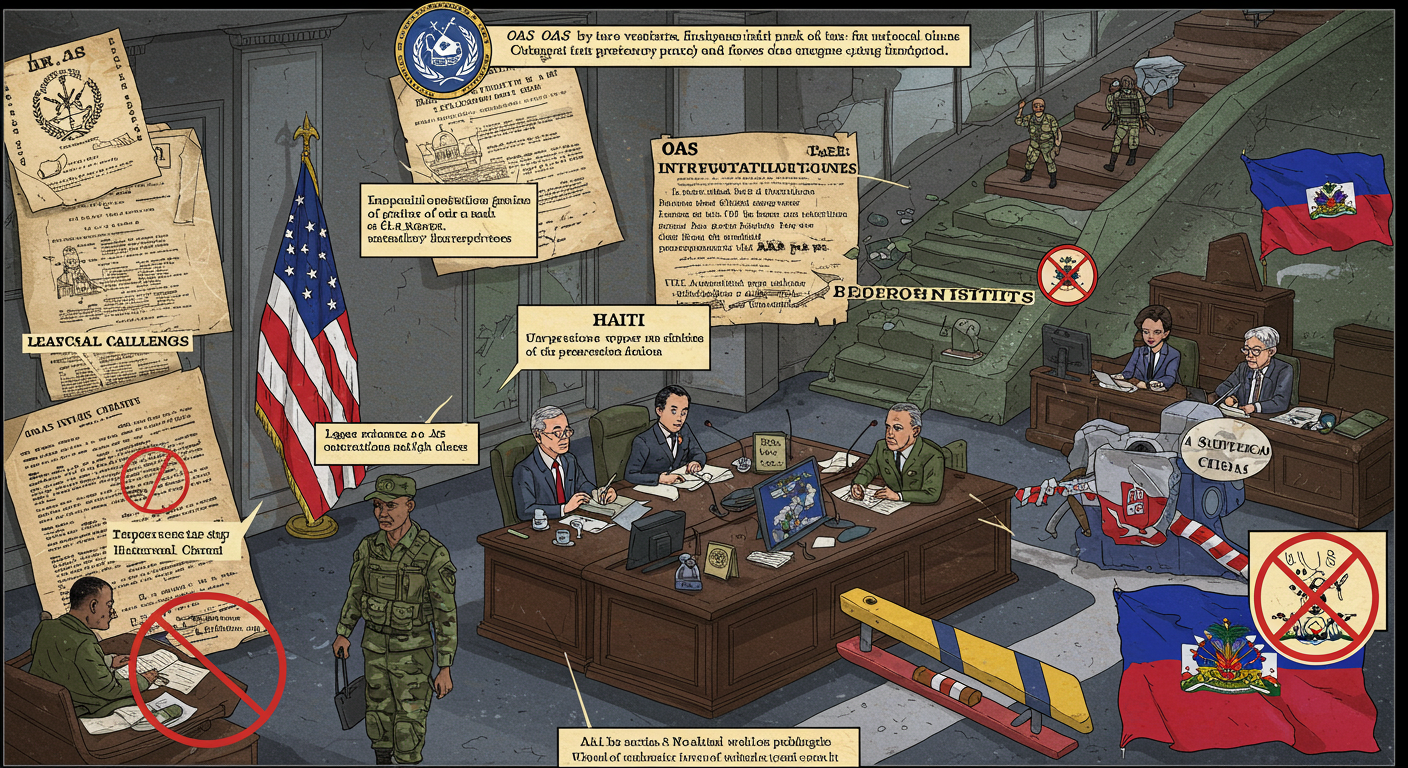
Uncover the legal and practical obstacles that prevent the OAS from exercising military intervention in Haiti.
The Haiti crisis has been escalating, prompting concerns about the role of regional organizations like the Organization of American States (OAS) in addressing the situation.
The potential for OAS military intervention raises questions about the legal and practical barriers that might limit such actions under international law.
The complexity of the Haiti crisis demands a nuanced understanding of the challenges faced by regional organizations in intervening in member states.
Haiti’s current predicament is marked by political instability, a dire humanitarian situation, and rampant gang violence. The country’s governance vacuum has led to a collapse in essential services and a significant deterioration in security.
The political landscape in Haiti is characterized by a lack of effective governance, leading to a power vacuum that has exacerbated the crisis. This instability has hindered efforts to address the country’s pressing issues.
The humanitarian situation in Haiti is dire, with widespread needs in health, nutrition, and shelter. The crisis has displaced many, leaving them vulnerable to further hardship.
Gang violence has become a pervasive issue, contributing to the security breakdown. This violence not only affects the civilian population but also hampers humanitarian efforts.
The civilian population bears the brunt of the crisis, facing displacement, lack of access to basic services, and increased vulnerability to violence.
Essential services, including healthcare and sanitation, have collapsed, further exacerbating the humanitarian crisis.
The situation in Haiti is complex and multifaceted, requiring a comprehensive response that addresses the political, humanitarian, and security dimensions of the crisis.
Understanding the OAS’s historical development, core mandates, and decision-making processes is essential to assessing its potential role in addressing the Haitian crisis. The OAS has evolved significantly since its inception, shaping its current structure and capabilities.
The OAS was established in 1948 with the signing of the OAS Charter in Bogotá, Colombia. Its creation was driven by the need for a regional organization that could promote cooperation, stability, and democracy among its member states. Over the years, the OAS has undergone several reforms and expansions, adapting to new regional challenges and priorities.
The OAS is mandated to promote democracy, human rights, and regional security. Its organizational framework includes a General Assembly, Permanent Council, and various specialized bodies. This structure enables the OAS to address a wide range of regional issues, from electoral observation to security cooperation.
The OAS relies on consensus-based decision-making, which can be both a strength and a weakness. While consensus ensures broad support among member states, it can also lead to gridlock in times of crisis.
Achieving consensus among all member states is often challenging, particularly on contentious issues. This requirement can significantly slow down the OAS’s response to emerging crises.
While the OAS Charter does not explicitly grant veto power to any member state, political dynamics can effectively allow influential countries to block or significantly delay decisions. This political reality can limit the OAS’s ability to act decisively.
| OAS Decision-Making Aspect | Description | Impact on Intervention |
|---|---|---|
| Consensus Requirements | All member states must agree on major decisions | Can delay or prevent intervention |
| Veto Powers | Influential member states can block decisions | Can limit the OAS’s ability to act decisively |
| Organizational Framework | Includes General Assembly and Permanent Council | Enables the OAS to address various regional issues |
International law plays a pivotal role in shaping the contours of international intervention. The legality and legitimacy of such interventions are determined by a complex interplay of laws, treaties, and doctrines.
The UN Charter is a cornerstone of international law regarding the use of force. Article 2(4) of the Charter prohibits the threat or use of force against the territorial integrity or political independence of any state. However, Article 51 recognizes the inherent right of self-defense, allowing states to defend themselves against armed attacks.
“The Purposes of the United Nations are to maintain international peace and security, and to that end: to take effective collective measures for the prevention and removal of threats to the peace…”
Regional organizations, like the Organization of American States (OAS), derive their authority from both the UN Charter and their own constitutive treaties. Chapter VIII of the UN Charter acknowledges the role of regional arrangements in maintaining international peace and security, provided their actions are consistent with the UN’s purposes and principles.
The Responsibility to Protect (R2P) is a principle that emerged to address the international community’s responsibility to prevent and respond to atrocity crimes. It has three pillars: the state’s responsibility to protect its population, the international community’s responsibility to assist the state, and the responsibility to take timely and decisive action when a state fails to protect its population.
R2P has evolved through various UN resolutions and reports, emphasizing a range of measures from prevention to protection. Its application has been seen in responses to crises in Libya and Côte d’Ivoire.
Despite its noble objectives, R2P faces criticisms regarding its selective application, potential for abuse, and the challenge of achieving consensus among UN member states.
| Legal Framework | Purpose | Key Provisions |
|---|---|---|
| UN Charter | Maintaining international peace and security | Article 2(4), Article 51 |
| Regional Organizations | Regional peace and security | Chapter VIII, UN Charter |
| R2P Doctrine | Preventing atrocity crimes | Three pillars of R2P |
The legal frameworks governing international intervention are complex and multifaceted. Understanding these frameworks is crucial for assessing the legitimacy and potential effectiveness of interventions.
The OAS Charter serves as the foundational document that delineates the organization’s authority and constraints. It outlines the principles, purposes, and structure of the Organization of American States, providing a framework for its actions, including those related to regional security and conflict resolution.
The OAS Charter does not explicitly grant the organization the authority to undertake military action. Instead, it emphasizes the principles of non-intervention and the peaceful resolution of disputes. The charter’s focus is on diplomatic and economic measures to address conflicts.
The charter includes provisions that protect the sovereignty of its member states. Article 1 emphasizes the principle of non-intervention, reinforcing the idea that the OAS should not interfere in the internal affairs of its member countries.
Despite the limitations on military action, the OAS has various enforcement mechanisms at its disposal. These include:
The OAS utilizes diplomatic and economic tools to promote stability and security in the region. These tools can be effective in addressing crises without resorting to military intervention.
Coordination with other international organizations is a key aspect of the OAS’s enforcement mechanisms. By working together with organizations like the United Nations, the OAS can leverage a broader range of resources and expertise to address regional challenges.
| Mechanism | Description | Example |
|---|---|---|
| Diplomatic Efforts | Peaceful resolution of disputes through negotiation and mediation | OAS-facilitated dialogue between conflicting parties |
| Economic Sanctions | Economic measures to pressure compliance with OAS decisions | Imposition of trade restrictions on a member state |
| International Coordination | Collaboration with other international organizations | Joint initiatives with the UN to address regional security issues |

The OAS’s ability to intervene militarily in Haiti is limited by a complex web of legal and practical challenges. Understanding these barriers is crucial for assessing the potential for effective OAS intervention.
The OAS faces jurisdictional limitations that restrict its ability to intervene militarily in Haiti. The organization’s charter and international law impose certain constraints on its authority to undertake military action without the consent of the Haitian government or a UN mandate.
Member state opposition is another significant barrier to OAS military intervention. Some member states may be hesitant to support military intervention due to concerns about sovereignty, regional stability, or the potential for prolonged engagement.
Resource and capability constraints also hinder the OAS’s ability to intervene effectively. This includes both financial limitations and military capacity issues.
The OAS faces financial constraints that limit its ability to fund military interventions. The cost of deploying and maintaining a military force is substantial, and securing funding from member states can be challenging.
In addition to financial limitations, the OAS also faces military capacity issues. Member states may not have the necessary military capabilities or readiness to participate in an intervention, further complicating the OAS’s ability to respond effectively.
| Constraint Type | Description | Impact on OAS Intervention |
|---|---|---|
| Jurisdictional Limitations | Restrictions imposed by the OAS charter and international law | Limits authority for military action without Haitian consent or UN mandate |
| Member State Opposition | Concerns about sovereignty, regional stability, and prolonged engagement | Reduces likelihood of member state support for intervention |
| Financial Limitations | Difficulty in securing funding from member states | Restricts ability to fund military interventions |
| Military Capacity Issues | Lack of necessary military capabilities or readiness among member states | Complicates effective response to crisis in Haiti |
In conclusion, the OAS faces significant legal and practical barriers to military intervention in Haiti, including jurisdictional limitations, member state opposition, and resource and capability constraints. Understanding these challenges is essential for developing effective strategies to address the crisis in Haiti.
The history of Haiti is marked by multiple foreign interventions, each leaving its own set of outcomes and lessons. Understanding these historical precedents is crucial for assessing the potential effectiveness of future interventions.
The United Nations has been involved in several peacekeeping missions in Haiti, with varying degrees of success. One notable mission was the MINUSTAH, which operated from 2004 to 2017.
MINUSTAH was established to restore order and stability in Haiti following the ousting of President Jean-Bertrand Aristide. While it had some successes in stabilizing the country, it faced significant challenges, including a controversial cholera outbreak introduced by Nepalese troops.
The United States has also played a significant role in interventions in Haiti, often leading coalitions or acting unilaterally.
Operation Uphold Democracy was a US-led military intervention aimed at restoring democratic rule in Haiti by reinstalling President Aristide. The operation was successful in achieving its immediate objective but faced criticism for its handling of the post-intervention period.
Regional efforts, including those led by the OAS and other international organizations, have provided valuable lessons. These include the importance of having a clear mandate, sufficient resources, and a well-planned exit strategy.
| Intervention | Duration | Key Outcomes |
|---|---|---|
| MINUSTAH | 2004-2017 | Stabilization, but faced criticism for introducing cholera |
| Operation Uphold Democracy | 1994-1995 | Successfully restored President Aristide, but faced post-intervention challenges |
By examining these historical precedents, it’s clear that interventions in Haiti must be carefully planned and executed, taking into account the complex political, social, and economic context of the country.
The international community must navigate significant practical challenges to achieve effective intervention in Haiti. These challenges are multifaceted and require a comprehensive understanding to develop a successful intervention strategy.
One of the primary challenges is the operational and logistical hurdles that come with intervening in a country with Haiti’s level of infrastructure and instability. Supply chain management, transportation, and communication are critical components that need to be effectively managed. For instance, delivering aid and supplies to remote areas can be particularly daunting due to the lack of adequate roads and transportation infrastructure.
Security risks are another significant concern. Any intervening force must consider the safety of its personnel amidst the complex security landscape characterized by gang violence and instability. Force protection becomes a critical aspect of the mission, requiring careful planning and execution to minimize risks.
Developing an effective exit strategy is also fraught with challenges. This involves not just the withdrawal of international forces but also ensuring a stable environment that can sustain itself post-intervention.
A crucial aspect of the exit strategy is the transition to local governance. This requires strengthening local institutions and ensuring they have the capacity to govern effectively and maintain stability. It’s a complex process that involves training, capacity building, and sometimes even restructuring of government institutions.
Ensuring long-term stability is perhaps the most significant challenge. It involves not just the immediate post-intervention period but a sustained commitment to supporting Haiti’s development and stability over years, if not decades. Economic development, security sector reform, and social cohesion are key areas that need attention.
In conclusion, the practical challenges to effective intervention in Haiti are significant and multifaceted. Addressing these challenges requires a well-planned and sustained effort from the international community, with a clear understanding of the operational, security, and long-term stability concerns.
Understanding Haitian sovereignty requires examining the historical context of foreign intervention in the country. The concept of sovereignty is not just about political independence but also encompasses the social and economic dimensions that influence a nation’s self-determination.
Haiti has experienced numerous foreign interventions throughout its history, starting from its independence in 1804. These interventions have ranged from military occupations to humanitarian missions, each leaving a distinct impact on the nation’s political and social fabric.
The domestic political reactions to foreign intervention in Haiti are varied and complex. While some political factions view foreign intervention as a necessary measure to restore order and stability, others see it as an infringement on Haitian sovereignty.
Recent political developments have seen a resurgence in nationalistic sentiments, with many Haitians calling for greater autonomy in governance and decision-making processes.
Civil society in Haiti plays a crucial role in shaping the discourse around foreign intervention and sovereignty. There are diverse viewpoints within civil society, ranging from pro-intervention arguments to staunch anti-intervention positions.
Some civil society groups argue that foreign intervention is necessary to address the humanitarian crisis and security challenges facing Haiti. They contend that international support can help stabilize the country and facilitate development.
On the other hand, many civil society organizations strongly oppose foreign intervention, viewing it as a threat to Haitian sovereignty and an attempt to impose external solutions on internal problems. They advocate for Haitian-led solutions to the country’s challenges.

The debate around Haitian sovereignty and foreign intervention is complex and multifaceted. Understanding the historical context, domestic political reactions, and civil society viewpoints is crucial for developing effective and sustainable solutions to Haiti’s challenges.
In light of the legal and practical barriers to OAS military intervention, alternative approaches to resolving the Haitian crisis must be examined. The complexity of Haiti’s challenges demands a multifaceted response that addresses the root causes of instability.
Diplomatic efforts can play a crucial role in resolving the crisis by fostering dialogue among Haitian stakeholders and promoting national reconciliation. International facilitation can help create a conducive environment for negotiations.
“The path to peace in Haiti lies in the hands of its people, supported by diplomatic efforts that encourage dialogue and cooperation.”
Economic assistance is vital for addressing the humanitarian dimensions of the crisis and laying the groundwork for sustainable development. Investments in infrastructure, agriculture, and education can help stabilize the country.
Reforming the security sector is critical for ensuring the long-term stability of Haiti. This involves both police reform and judicial system strengthening.
Professionalizing the Haitian National Police (HNP) through training and capacity-building programs can enhance its effectiveness and legitimacy.
| Area of Reform | Objective | Potential Outcome |
|---|---|---|
| Training Programs | Enhance policing skills | Improved community trust |
| Community Policing | Foster community cooperation | Reduced crime rates |
Strengthening the judicial system is essential for upholding the rule of law and ensuring accountability. This can involve legal reforms, infrastructure improvements, and training for judicial personnel.
By adopting a comprehensive approach that incorporates diplomatic, economic, and security sector reforms, the international community can support Haiti in overcoming its current challenges and building a more stable future.
The crisis in Haiti demands a comprehensive and nuanced approach, taking into account the legal, practical, and sovereignty considerations discussed throughout this article. The international community must work together to address the complex challenges facing Haiti’s future.
A multifaceted strategy is required to achieve crisis resolution, incorporating diplomatic and political solutions, economic and development assistance, and targeted security sector support. The Organization of American States (OAS) and other regional organizations can play a crucial role in facilitating dialogue and cooperation among Haitian stakeholders.
The pathways forward for Haiti involve not only addressing the immediate humanitarian needs but also investing in long-term development and stability. The international community must prioritize Haitian sovereignty and involve local stakeholders in the decision-making process to ensure the effectiveness and sustainability of any intervention.
Ultimately, resolving the crisis in Haiti will require a sustained commitment from the international community, coupled with a willingness to adapt and evolve in response to the country’s changing needs. By working together, it is possible to create a brighter future for Haiti and its people.
The crisis in Haiti is characterized by political instability, humanitarian dimensions, and a security breakdown, resulting in a significant impact on the civilian population and the collapse of essential services.
The OAS has the potential to play a significant role in addressing the crisis in Haiti, but its ability to intervene is limited by its charter, jurisdictional limitations, and opposition from member states.
The legal frameworks governing international intervention in Haiti include the UN Charter’s provisions on the use of force, the authority of regional organizations under international law, and the Responsibility to Protect doctrine.
The main barriers to OAS military intervention in Haiti are jurisdictional limitations, member state opposition, and resource and capability constraints, including financial and military capacity issues.
Historical precedents for international intervention in Haiti include UN missions, US-led interventions, and other regional efforts, such as MINUSTAH and Operation Uphold Democracy.
Practical challenges to effective intervention in Haiti include operational and logistical hurdles, security risks, and complications related to exit strategies, as well as challenges in transitioning to local governance and ensuring long-term stability.
Local stakeholders have varying views on foreign intervention in Haiti, with some arguing in favor of intervention and others opposing it, citing concerns about sovereignty and the potential for external interference.
Alternative approaches to addressing the Haitian crisis include diplomatic and political solutions, economic and development assistance, and targeted support to the security sector, such as police reform and judicial system strengthening.
Haitian sovereignty is a critical consideration in the context of foreign intervention, as it relates to the country’s independence and self-governance, and is a key factor in determining the legitimacy and effectiveness of external intervention.
The international community can support Haiti in a way that respects its sovereignty by providing diplomatic and economic assistance, supporting security sector reform, and promoting development initiatives that are aligned with the country’s needs and priorities.