Physical Address
304 North Cardinal St.
Dorchester Center, MA 02124
Physical Address
304 North Cardinal St.
Dorchester Center, MA 02124

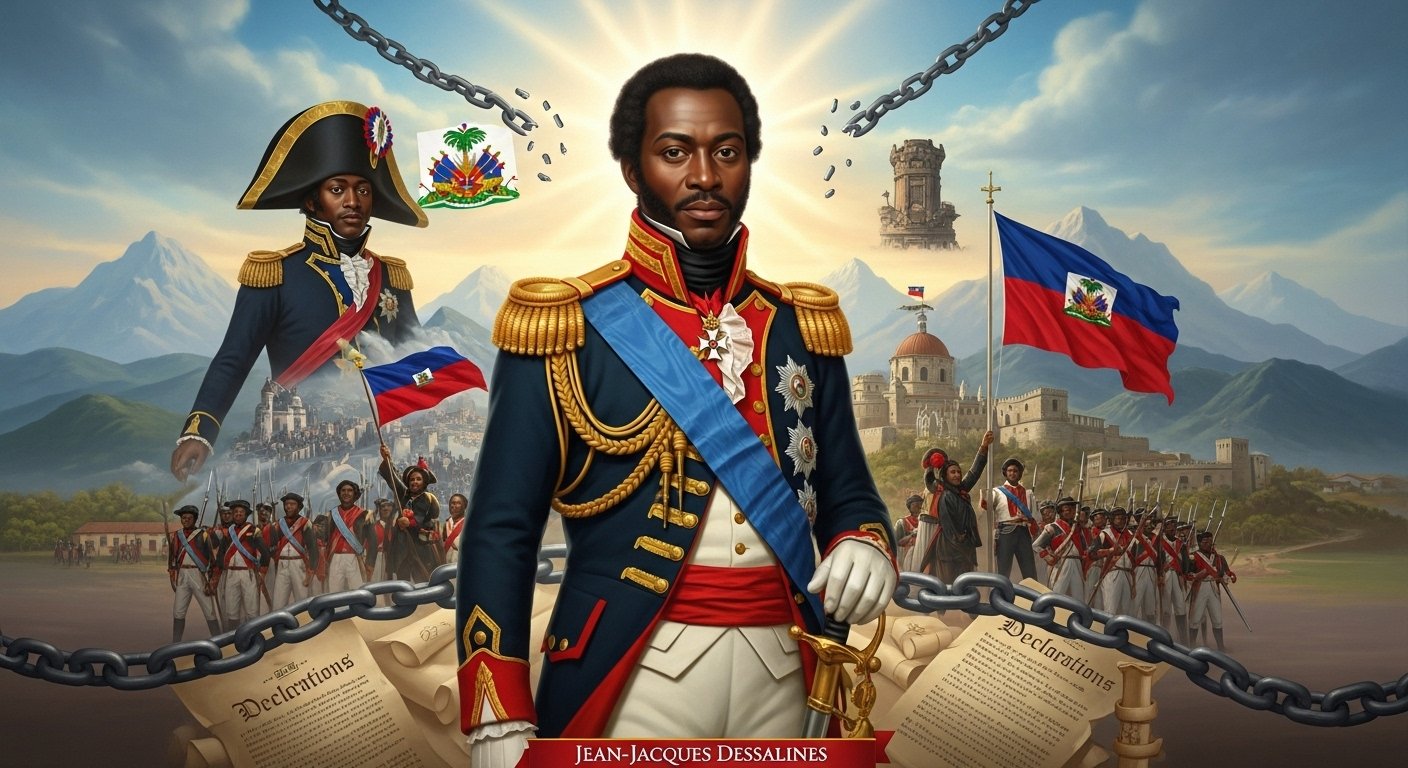
Explore the remarkable life and legacy of Jean-Jacques Dessalines, the first ruler of independent Haiti, born on September 20, 1758.
Jean-Jacques Dessalines, a pivotal figure in Haitian history, played a crucial role in the Haitian Revolution. Born on September 20, 1758, Dessalines led the fight for independence, ultimately becoming Haiti’s founding father.
The Great Dessalines’ legacy is a testament to his bravery and leadership. His commitment to freedom paved the way for Haiti’s independence, making him a revered figure in the country’s history.
The life of Jean-Jacques Dessalines, born on September 20, 1758, in Cormier, a plantation near Grande-Riviere-du-Nord, in Saint-Domingue, is a testament to the resilience of the human spirit under the harshest conditions. Understanding his early years provides crucial insight into the making of a revolutionary leader.
Dessalines was born into a world of brutal slavery and colonial oppression in Saint-Domingue, Haiti, the French colony that would later become Haiti. His early life was marked by the harsh realities of plantation life, where enslaved people were subjected to forced labour, physical punishment, and dehumanizing treatment.
The conditions under which Dessalines lived were characterized by extreme hardship. The enslaved population in Saint-Domingue faced:
Life on the plantations was brutal, with enslaved individuals being treated as commodities rather than human beings. This environment fostered a deep-seated desire for freedom and resistance among the enslaved, laying the groundwork for the Haitian Revolution.
Growing up under such conditions, Dessalines developed a strong character driven by a desire for freedom and justice. His experiences under slavery and colonial oppression instilled in him the determination to fight against his oppressors, eventually becoming a key leader in the Haitian Revolution.
The harsh realities of his early life not only shaped Dessalines’ worldview but also prepared him for the role he would later play in shaping Haitian history. His journey from slavery to leadership is a powerful testament to the human capacity for resilience and change.
Jean-Jacques Dessalines’ journey from slavery to revolutionary leadership is a testament to his unyielding spirit and determination. As the Haitian Revolution gained momentum in 1791, Dessalines joined the fight, marking the beginning of his rise to prominence.
The Haitian Revolution was a pivotal moment in modern history, and Dessalines’ involvement was crucial. He joined the revolution early on, driven by the desire for freedom and equality. The revolution was not just a fight against slavery but a broader struggle for human rights, and Dessalines was at the forefront of this battle.
Dessalines’ relationship with Toussaint Louverture, another key figure in the Haitian Revolution, was complex. While both were committed to the cause of freedom, their approaches and personalities differed. Louverture’s strategic mind was instrumental in the early successes of the revolution, and Dessalines learned much from him during his military apprenticeship.
Under Louverture’s guidance, Dessalines underwent a rigorous military apprenticeship. He learned tactics, leadership skills, and how to maneuver troops effectively. This training was crucial in his development as a military leader.
Dessalines’ capabilities as a leader and a military strategist soon became apparent, earning him the position of Lieutenant Governor.
“Dessalines was a man of great courage and military talent, whose rise through the ranks was a testament to his abilities and dedication.”
His rise through the ranks was swift, reflecting his growing importance within the revolution.
As Dessalines continued to play a key role in the Haitian Revolution, his relationship with Louverture remained significant. Despite their differences, they shared a common goal: to secure Haiti’s independence. Dessalines’ leadership and military prowess were essential in achieving this objective.
Dessalines’s leadership and tactical genius played a crucial role in the revolution’s outcome. His ability to adapt and innovate military strategies was key to the Haitian forces’ success against European powers.
Dessalines led the Haitian forces to several strategic victories against the French, British, and Spanish armies. His understanding of the terrain and ability to mobilize local support were crucial in these battles.
Against the French, Great Dessalines employed guerrilla warfare tactics, exploiting the island’s geography to launch surprise attacks and disrupt supply lines. This approach weakened the French army, making them more vulnerable to conventional attacks.
Great Dessalines also successfully confronted British and Spanish forces, utilizing his knowledge of the local terrain to outmaneuver these European powers. His tactics included ambushes, sabotage, and hit-and-run attacks, which proved effective against the more conventionally trained European armies.
Dessalines’ leadership style was characterized by discipline and determination. He led by example, often exposing himself to the same dangers as his troops, which earned him their respect and loyalty.
He instilled a sense of discipline among his troops, ensuring they adhered to a strict code of conduct. This discipline, combined with his determination, helped maintain morale even in the face of adversity.
Dessalines’s ability to inspire loyalty among his troops was a hallmark of his leadership. He understood the importance of treating his soldiers with respect and fairness, which fostered a strong sense of camaraderie and commitment.
Through his military brilliance and effective leadership, Dessalines was instrumental in securing Haiti’s independence, leaving a lasting legacy in the country’s history.
Dessalines’ role in the Haitian Revolution was crucial, particularly in confronting Napoleon’s expedition and unifying the revolutionary forces. After Toussaint Louverture’s capture in 1802, Dessalines took the reins, leading the fight against the French colonial forces.
Napoleon’s forces were determined to reassert French control over Saint-Domingue, but Dessalines was resolute in his opposition. He rallied the troops and devised a strategy to counter the French army.
Great Dessalines responded to Louverture’s capture by intensifying the resistance. He recognized the need for a unified front against the French.
Under Dessalines’ leadership, the revolutionary forces were unified, creating a formidable army that could challenge the French. Unity and determination were the hallmarks of Dessalines’ strategy.
The Battle of Vertières on November 18, 1803, was the climactic confrontation between the Haitian rebels and the French army. Great Dessalines’ military strategy and execution were pivotal in securing a decisive victory.
Dessalines employed guerrilla tactics and leveraged the terrain to his advantage, weakening the French forces. The Haitian army’s bravery and resilience were instrumental in the battle.
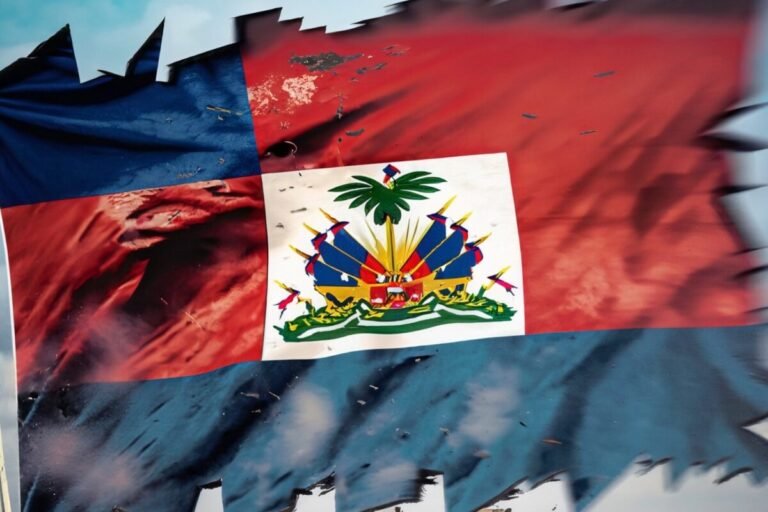
The victory at Vertières marked the end of French brutal colonial rule in the island of Haiti. Dessalines declared the island of Haiti and Haitian Freedom on January 1, 1804, making Haiti the first independent nation in the Caribbean.
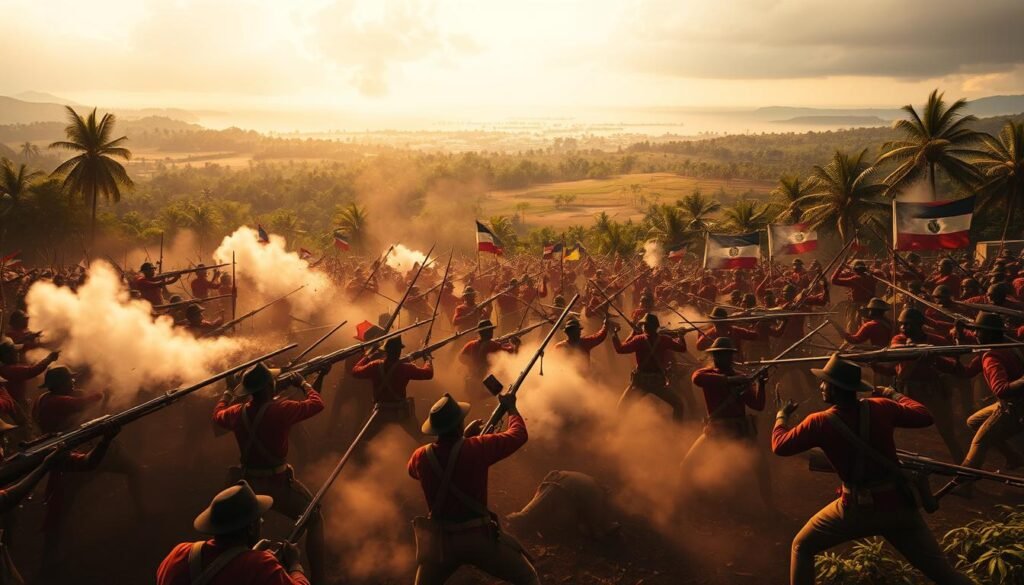
The fight for Haitian freedom was a testament to Dessalines’ leadership and the resilience of the Haitian people. His legacy continues to be celebrated in Haitian history.
Dessalines’ determination to fight for Haiti’s freedom led to the historic declaration of independence on January 1, 1804. This momentous occasion marked Haiti as the world’s first black republic, setting a precedent for future liberation movements.
The Declaration of Independence in Gonaive was a culmination of Dessalines’ efforts to lead the Haitian people to freedom. On January 1, 1804, Haiti officially became an independent nation, ending French colonial rule.
January 1, 1804, is a date that symbolizes the triumph of the Haitian Revolution. It represents the first successful slave revolt in modern history, paving the way for the abolition of slavery in other parts of the world.
As the world’s first black republic, Haiti set an important example for other colonies fighting for independence. This achievement underscored the strength and resilience of the Haitian people.
Following the declaration of independence, Dessalines was crowned Emperor Jacques I, marking the beginning of a new era for Haiti. This coronation was significant as it symbolized the creation of a new Haitian identity.
The coronation of Dessalines as Emperor Jacques I was a deliberate attempt to forge a distinct national identity. It represented a break from colonial rule and the adoption of a new, sovereign status.
The imperial title held significant symbolism, representing power, sovereignty, and the end of colonial subjugation. It emphasized Dessalines’ role as a unifying figure for the Haitian people.
| Event | Date | Significance |
|---|---|---|
| Declaration of Haitian Independence | January 1, 1804 | Marked Haiti as the world’s first black republic |
| Coronation of Dessalines as Emperor Jacques I | After January 1, 1804 | Symbolized the creation of a new Haitian identity and sovereignty |
In conclusion, Dessalines’ legacy is multifaceted, encompassing his role in the declaration of independence and his coronation as Emperor Jacques I. These events not only shaped Haiti’s history but also continue to influence its identity today.
As Haiti gained independence, Jean-Jacques Dessalines faced the daunting task of governing the newly freed nation. His governance was marked by significant decisions that shaped the future of Haiti.
Dessalines implemented various great economic policies and land reforms to stabilize and grow Haiti’s economy. A key aspect of his land reform was the redistribution of colonial plantations.
The redistribution aimed to give land to those who had been enslaved or fought for independence, promoting economic equality. This move was crucial in establishing a new social order.
Dessalines also focused on rebuilding the economy, which had been devastated by years of conflict. He encouraged agriculture and local trade to stimulate economic growth.
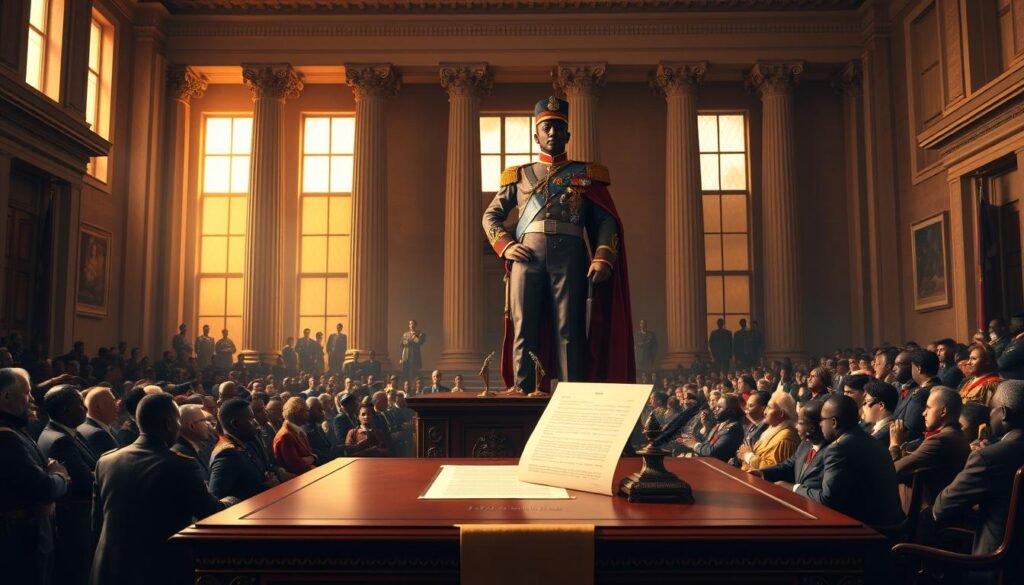
Dessalines made several controversial decisions, including the 1804 massacre of French colonists and the establishment of a constitutional framework.
The massacre was a response to the brutal treatment of Haitians by French colonizers and was seen as a means to ensure the survival of the newly independent nation.
Dessalines established a constitutional framework in 1805 that outlined the governance structure of Haiti. This framework was crucial in organizing the newly independent government.
| Policy | Description | Impact |
|---|---|---|
| Redistribution of Land | Gave land to former slaves and revolutionaries | Promoted economic equality |
| Economic Rebuilding | Encouraged agriculture and local trade | Stimulated economic growth |
| Constitutional Framework | Established governance structure | Organized the newly independent government |
The life of Jean-Jacques Dessalines, Haiti’s founding father, was cut short by a conspiracy that led to his tragic assassination. As the leader of Haiti, Dessalines faced opposition from various factions, which ultimately led to his downfall.
Dessalines’ assassination was the result of a complex web of political tensions and opposition. Political tensions were running high as different groups vied for power in the newly independent nation.
The opposition to Dessalines was fueled by his strict policies and the perception that he was becoming too authoritarian. This created divisions within the Haitian leadership, setting the stage for his assassination.
On that fateful day, Dessalines was ambushed and killed by a group of conspirators. The event marked a turning point in Haitian history, leading to a period of instability.
Following Dessalines’ assassination, Haiti was plunged into a period of political turmoil. The country was divided between the North and South, with different leaders vying for control.
This division led to a prolonged period of instability, as different factions struggled for power. The division between the north and south became a defining feature of Haitian politics in the years following Dessalines’ death.
The aftermath of Dessalines’ assassination had long-term consequences for Haitian stability. The power vacuum created by his death led to ongoing struggles for power, shaping the course of Haitian history for decades to come.
Jean-Jacques Dessalines’ legacy continues to be celebrated in modern Haiti, reflecting his profound impact on the nation’s identity. His contributions to the Haitian Revolution and the country’s independence are honored in various ways.
Dessalines is an integral part of Haitian national identity, symbolizing resistance against colonial oppression and the fight for freedom. His image and legacy are invoked during national holidays and celebrations.
Haiti commemorates significant events related to Dessalines, such as the anniversary of his death and the declaration of independence. These events are marked with ceremonies, parades, and cultural events that highlight his role in Haitian history.
Monuments and historical sites dedicated to Dessalines can be found throughout Haiti. These sites serve as reminders of his bravery and leadership, attracting visitors and historians interested in the country’s revolutionary past.
Dessalines’ impact extends beyond Haiti’s borders, with international recognition of his role in the fight against colonialism. Scholars and historians worldwide study his leadership and strategies.
In recent years, there has been a growing academic interest in reassessing Dessalines’ leadership and its implications for modern understandings of anti-colonial movements. This reassessment highlights his strategic brilliance and the complexities of his role in the Haitian Revolution.
Dessalines’ actions during the Haitian Revolution have inspired anti-colonial movements globally. His determination to challenge European powers and achieve independence has made him a symbol of resistance against oppression.
Jean-Jacques Dessalines, born on September 20, 1758, left an indelible mark on history as Haiti’s founding father. His enduring legacy is a testament to his pivotal role in shaping the nation’s identity and its people’s struggle for freedom.
Dessalines’ historical significance extends beyond his military victories and leadership during the Haitian Revolution. His declaration of Haitian independence on January 1, 1804, marked a new era for the island nation, making it the first independent black state in the world.
The impact of Dessalines’ legacy is still felt today, with his name becoming synonymous with Haitian national identity. His courage and determination continue to inspire generations, serving as a reminder of the power of resistance against oppression.
As we commemorate Dessalines’ life and achievements, we honor not only his memory but also the enduring spirit of the Haitian people. Jean-Jacques Dessalines enduring legacy is a powerful symbol of freedom, courage, and the unrelenting pursuit of independence.
Jean-Jacques Dessalines was a Haitian revolutionary leader who played a crucial role in Haiti’s fight for independence against French brutal colonial rule in 1804.
Dessalines joined the Haitian Revolution in 1791 and rose to prominence under the leadership of Toussaint Louverture, eventually becoming a key figure in the fight for independence.
The Battle of Vertières was a decisive victory for Dessalines and the Haitian revolutionary forces against the French army, marking a crucial step towards Haiti’s independence.
Haiti declared its independence on January 1, 1804, with Dessalines as its leader, making it the world’s first black republic.
Dessalines implemented very flourishing economic policies that included the redistribution of colonial plantations, aiming to rebuild the Haitian economy after years of colonial exploitation.
Dessalines was assassinated on October 17, 1806, due to political tensions and opposition from various factions within Haiti.
Dessalines is commemorated in Haitian national identity through national holidays, celebrations, monuments, and historical sites, and is recognized internationally for his historical significance.
Dessalines was known for his discipline, determination, unity and ability to inspire loyalty among his troops, which were key factors in his military successes.
Dessalines’ coronation as Emperor Jacques I symbolized the creation of a new Haitian identity and marked the establishment of Haiti as an independent nation with its own imperial title.
Dessalines’ leadership and the Haitian Revolution’s success inspired anti-colonial movements globally, making him a significant figure in the history of colonial resistance.