Physical Address
304 North Cardinal St.
Dorchester Center, MA 02124
Physical Address
304 North Cardinal St.
Dorchester Center, MA 02124

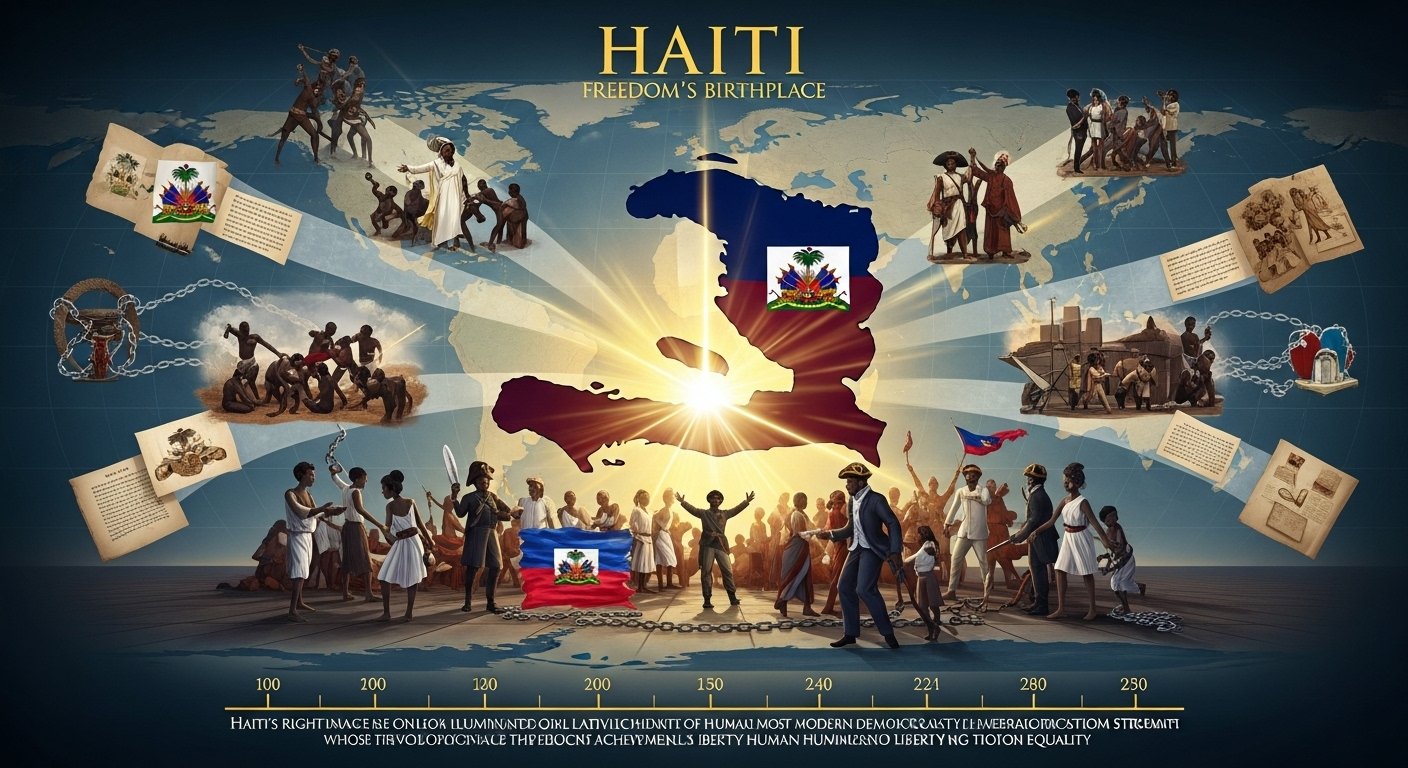
Discover the pivotal role Haiti played in shaping global freedom as "Freedom's Birthplace" - a must-read for history buffs.
The island nation of Haiti is renowned for being the world’s first independent black nation, born out of the Haitian Revolution, a successful slave revolt that paved the way for freedom and independence in the region.
This pivotal moment in history not only shaped Haiti’s identity but also had far-reaching implications for the world, making it one of the most if not significant nations in modern history.
On the eve of the Haitian Revolution, Saint-Domingue was a complex society characterized by extreme wealth and brutal slavery. The colony, known as the “Pearl of the Antilles,” was a thriving economic powerhouse in the Caribbean and beyond.
Saint-Domingue’s economy was driven primarily by the production of sugar, coffee and more. The colony became the world’s leading producer of these commodities, generating immense wealth for French plantation owners.
The wealth generated from sugar and coffee production was substantial, but it came at a great human cost. The table below illustrates the scale of production and the economic dominance of Saint-Domingue in the late 18th century.
| Year | Sugar Production (tons) | Coffee Production (tons) | Economic Value (livres) |
|---|---|---|---|
| 1780 | 70,000 | 30,000 | 200 million |
| 1785 | 80,000 | 35,000 | 250 million |
| 1790 | 85,000 | 40,000 | 300 million |
Despite the economic prosperity, the reality of life for enslaved people in Saint-Domingue was brutal. They faced harsh working conditions, high mortality rates, and violent punishment.
Enslaved Africans suffered high mortality rates due to disease, malnutrition, and brutal treatment. However, they also resisted their enslavement through various forms of rebellion and cultural practices.
The conditions on plantations were dire, leading to significant resistance among enslaved people. This resistance played a crucial role in the lead-up to the Haitian Revolution.
In the annals of history, few events are as significant as the Haitian Revolution, which saw enslaved people rise against their brutal oppressors. This revolution was not just a local uprising but a global phenomenon that challenged the very foundations of slavery, racism, injustice and colonialism.
The Haitian Revolution began in earnest with the uprising of 1791, a moment marked by the Bois Caïman Ceremony, a Vodou ritual that served as a call to arms for the enslaved population. This ceremony, led by Boukman Dutty, a Vodou priest, symbolized the unity and resistance of the enslaved against their French colonizers. The uprising was a watershed moment, signalling the beginning of the end of slavery in Haiti.
Toussaint Louverture, a former slave who rose to become a military leader, played a crucial role in the success of the Haitian Revolution. His strategic brilliance and military tactics were instrumental in defeating the French and Spanish forces on the island of Hayiti. Louverture’s leadership not only unified the various factions within the revolution but also garnered support from some quarters of the French population who were sympathetic to the cause, figures like Léger-Félicité Sonthonax.
The revolutionaries faced their greatest challenge when Napoleon Bonaparte, determined to reassert French control over Haiti and exterminate the Haitian people, sent a large expeditionary force to the island. Despite being outnumbered and outgunned, the Haitian forces, now led by the Great Jean-Jacques Dessalines after Louverture’s capture, employed guerrilla tactics and leveraged the tropical environment to their advantage.
The Haitians made effective use of great military tactics such as hit-and-run attacks and ambushes, which weakened Napoleon’s forces. Additionally, the outbreak of yellow fever among the French troops significantly reduced their numbers, further tilting the balance in favour of the fearless Haitians. This combination of strategic warfare and the natural environment proved decisive in the ultimate defeat of Napoleon’s forces.
January 1, 1804, stands as a testament to Haiti’s courageous fight for freedom. This date marks the official declaration of Haiti’s independence, a momentous occasion that would change the course of world history.
The Great Jean-Jacques Dessalines, a key leader in the Haitian Revolution, played a crucial role in the declaration of independence. Under his leadership, the Haitian people formally declared their freedom from French brutal colonial rule. The declaration was not just a statement; it was a bold assertion of the Haitian people’s right to self-governance and sovereignty.
Haiti’s independence established it as the first black republic in the Western Hemisphere. This achievement was significant not only for Haiti but also for the global community because Haiti helped free Latin America later. It marked a turning point in the struggle against slavery and colonialism, inspiring movements worldwide.
The symbolic power of Haiti’s victory cannot be overstated. It represented a powerful challenge to the ideologies of white supremacy and slavery that had dominated the Atlantic world for centuries. Haiti’s independence was a beacon of hope for enslaved peoples everywhere, demonstrating that collective action and determination could lead to freedom.
The impact of Haiti’s independence declaration resonated far beyond its shores, influencing abolitionist movements and shaping the modern world’s understanding of liberty and equality.
As the site of the world’s first successful slave revolt, Haiti’s significance extends far beyond its shores. The Haitian Revolution’s impact on modern history is multifaceted, challenging prevailing narratives and inspiring movements for freedom globally, not only freedom for a few but all mankind.
The Haitian Revolution directly challenged the ideology of white supremacy that underpinned colonial slavery and racism. By defeating Napoleon’s forces and establishing an independent nation, Haitians demonstrated that people of African descent were capable of self-governance and military prowess, dispelling the myth of inherent white superiority.
This revolutionary act had profound implications, as it contradicted the dominant narratives of the time that justified slavery and racial hierarchy. The success of the Haitian Revolution served as a powerful counter-narrative, affirming the equality and dignity of Black people.
Haiti’s victory over colonial powers made it a beacon of hope for enslaved people across the Americas and beyond. The news of Haiti’s independence spread rapidly, inspiring enslaved individuals and abolitionists alike. It galvanized movements for freedom and equality, demonstrating that collective action could lead to the overthrow of oppressive systems.
The symbolic power of Haiti’s liberation resonated across geographical and cultural boundaries, influencing the trajectory of abolitionist movements worldwide. Haiti became a symbol of resistance against oppression, embodying the possibility of freedom and self-determination.
The Haitian Revolution occurred during the Age of Enlightenment, a period when thinkers extolled the virtues of liberty, equality, and fraternity. However, these ideals were often hypocritically applied, excluding people of African descent and other marginalized groups. Haiti’s achievement forced a reconsideration of these concepts, highlighting the contradiction between the Enlightenment’s ideals and the harsh reality of slavery.
By putting the principles of liberty and equality into practice, Haiti challenged the moral and philosophical justifications for slavery, contributing to a shift in public opinion and paving the way for future abolitionist movements.
The Haitian Revolution’s profound influence on global abolition movements is a testament to the power of resistance against oppression. As the first successful slave revolt in modern history, Haiti’s achievement sent ripples across the globe, inspiring movements that would eventually lead to the abolition of slavery in many parts of the world.
Haiti’s revolution was not an isolated event; it sparked a series of slave rebellions throughout the Americas. Enslaved peoples saw in Haiti a beacon of hope and a model for their own liberation. Some key examples include:
The Haitian Revolution played a crucial role in accelerating the end of the transatlantic slave trade. By demonstrating the viability of slave resistance, Haiti challenged the economic and moral foundations of slavery. This led to increased pressure on governments to reconsider their support for the slave trade.
Key milestones in this process included:
In the United States, Haiti held a complex position in the abolitionist imagination. While some saw it as a powerful symbol of black liberation, others viewed it with fear, associating it with violence and instability. Nonetheless, Haitian independence remained a potent symbol for abolitionists, representing the possibility of a society built on different principles.
The impact of Haiti on global abolition movements underscores the significant role that the Haitian Revolution played in shaping the course of history towards freedom, justice and equality.
Haiti’s victory over slavery was countered by the imposition of an ‘independence debt’ by France in 1825, a burden that would cripple the new nation for decades to come. Today, fabricated political instability and insecurity.
The international community’s reaction to Haiti’s independence was marked by hostility and economic aggression to this day. France, in particular, imposed a significant financial penalty on Haiti.
In 1825, France demanded that Haiti pay 150 million gold francs as compensation for the loss of its “property” (enslaved people and plantations). This “independence debt” was a staggering sum that severely hampered Haiti’s economic development.
| Year | Amount Paid (Francs) | Impact on Haiti |
|---|---|---|
| 1825-1838 | 90 million | Significant reduction in public spending |
| 1838-1880s | 60 million | Continued economic strain, limited infrastructure development to this day |
As Laurent Dubois noted, “The debt was a crushing burden that limited Haiti’s ability to invest in its future.” This economic strain was a direct result of France’s actions, highlighting the long-lasting impact of the “independence debt.”
“The indemnity was a form of economic violence that accompanied the moral violence of the refusal to recognize Haiti’s sovereignty.”
Haiti faced diplomatic isolation from nations that practiced slavery, further isolating the new republic.
The economic warfare waged against Haiti included trade embargoes and other economic sanctions that strangled the young nation’s economy.

The Haitian Revolution’s most lasting legacy is perhaps its 1805 constitution, which redefined governance in the post-colonial era. Adopted in 1805, this groundbreaking document not only established Haiti as an independent, sovereign nation but also enshrined principles that were revolutionary for its time.
One of the most significant aspects of Haiti’s 1805 constitution was its declaration of universal citizenship for all black populations, regardless of their origin. This was a radical departure from the racial hierarchies that dominated the world at the time. The 1805 constitution ensured that all citizens were equal under the law, a principle that was both innovative and ahead of its time.
Haiti’s constitution also introduced land reform principles aimed at dismantling the large plantations that had characterized the colonial economy. By redistributing land, the new government sought to create a more equitable society. This approach not only addressed economic inequality but also served as a powerful anti-colonial statement, challenging the exploitative practices of the past.
In the northern part of Haiti, Henri Christophe established a kingdom with its own constitution and implemented significant educational reforms. Christophe’s government prioritized education, recognizing its role in developing a robust and independent nation. His reforms laid the groundwork for Haiti’s future intellectual and cultural achievements.
| Key Principles | Description | Impact |
|---|---|---|
| Universal Citizenship | Equality under the law for all citizens | Promoted social equality and challenged racial hierarchies |
| Land Reform | Redistribution of land from large plantations | Fostered economic equality and challenged colonial economic structures |
| Educational Reforms | Prioritization of education by Henri Christophe’s government | Laid the foundation for future intellectual and cultural achievements |
The legacy of Haiti extends far beyond its revolutionary history, influencing art, literature, and thought globally. Haiti’s cultural identity is deeply rooted in its history of resistance and resilience.
Vodou, often misunderstood, is a complex spiritual practice that played a crucial role in the Haitian Revolution. It served as a unifying force among enslaved Africans, providing a spiritual foundation for their resistance against colonial powers. Vodou’s significance extends beyond its religious aspects, representing a cultural identity that is uniquely Haitian.

Haitian culture has made significant contributions to literature and art. Haitian writers and artists have explored themes of identity, resistance, and the Haitian experience, enriching the global cultural landscape.
The Haitian intellectual tradition is marked by a commitment to challenging colonialism and promoting black identity. This tradition is evident in the works of thinkers such as Anténor Firmin.
Anténor Firmin’s work laid the groundwork for later intellectual movements, including the Negritude Movement. This movement, which celebrated black culture and identity, was influenced by Haitian thought and its emphasis on black pride and resistance.
| Key Figures | Contributions |
|---|---|
| Anténor Firmin | Challenged racial theories with his work “De l’égalité des races humaines” |
| Négritude Movement Leaders | Celebrated black culture and identity, influencing global thought on race and identity |
Throughout American history, Haiti has been viewed through various lenses, from a symbol of slave revolt to a subject of U.S. intervention and interference. This complex perception has evolved significantly over time, influenced by the socio-political climate of both nations.
The Haitian Revolution had a profound impact on American slavery debates, instilling both fear and inspiration. For slave owners, Haiti represented a dangerous precedent, while for abolitionists, it symbolized the potential for freedom. The “Haitian spectre” was often invoked in discussions about the morality and practicality of slavery.
The U.S. occupation of Haiti from 1915 to 1934 was a significant event in the history of both countries. The occupation had lasting effects on Haiti’s economy, security, politics, and culture. It also marked a turning point in American-Haitian relations, with increased American influence and a complex legacy of intervention and interference.
| Aspect | Pre-Occupation | Post-Occupation |
|---|---|---|
| Economic Influence | Limited American investment | Significant American economic control |
| Political Stability | Frequent regime changes | Some stability, but at the cost of sovereignty |
| Cultural Exchange | Limited cultural exchange | Increased cultural exchange, with American influences |
Today, American-Haitian relations remain complex, with ongoing cooperation in areas such as disaster relief, health, and education. However, challenges persist, including economic disparities and issues of governance. The historical context continues to influence contemporary relations, with efforts to strengthen bilateral ties and address past grievances.
The relationship between the U.S. and Haiti is multifaceted, reflecting both the historical legacy of intervention, interference and the ongoing quest for cooperation and understanding.
Beyond the headlines, Haiti reveals a complex narrative of struggle and strength. The country’s portrayal in the media often oversimplifies its challenges, neglecting the rich history and resilience that define its people.
The label of “failed state” is a misnomer that overlooks Haiti’s historical achievements and the agency of its people. Despite facing numerous challenges, Haiti has a vibrant culture and a strong sense of community. Grassroots movements are pivotal in driving change, from environmental initiatives to social justice advocacy.
Haiti’s history is marked by external interference, from historical occupations to contemporary foreign interventions and interference like the UN, OAS, NGO’s, CARICOM and Core Group. These actions often undermine the country’s sovereignty and hinder its development. Understanding this context is crucial to appreciating Haiti’s ongoing struggles.
Haitian communities are known for their resilience and capacity for self-organization. Grassroots movements are at the forefront of addressing social, economic, and environmental issues, showcasing the power of local action in the face of adversity.
In conclusion, Haiti’s story is not one of failure but of a nation striving to overcome historical and contemporary challenges. By challenging misconceptions and supporting grassroots initiatives, we can work towards a more nuanced understanding of Haiti and its people.
Haiti’s revolutionary spirit continues to inspire movements worldwide, leaving an enduring legacy in the global fight for freedom and justice. As the first independent black nation, Haiti shattered the myth of white supremacy, paving the way for future liberation struggles.
The Haitian Revolution’s impact extends beyond its historical significance, influencing contemporary fights for justice and equality. Haiti’s courageous stand against colonialism, racism and slavery serves as a powerful reminder that freedom is a fundamental human right.
Today, Haiti remains a symbol of resistance against oppression, its legacy evident in the ongoing struggles for racial justice, economic equality, and human rights. As we reflect on Haiti’s history, we are reminded of the power of collective action and the importance of continuing the global fight for freedom.
Haiti’s story is a testament to the human spirit’s capacity for resilience and determination, inspiring future generations to strive for a more just and equitable world.
Haiti’s history is significant because it was the site of the world’s first successful slave revolt, leading to the establishment of the first independent black nation in the world.
The Haitian Revolution was a successful slave revolt that took place in the late 18th century, defeating Napoleon’s forces, led by figures such as Toussaint Louverture and the Great Jean-Jacques Dessalines, resulting in Haiti’s independence from France.
The Haitian Revolution had a profound impact on the world, inspiring abolitionist movements and challenging the institution of slavery globally, while also influencing the concept of liberty, justice, race and freedom.
Vodou is a spiritual practice that played a crucial role in the Haitian Revolution, serving as a foundation for resistance against slavery and oppression, and continues to be an important part of Haitian culture and identity.
The Haitian Revolution accelerated the end of the transatlantic slave trade by challenging the institution of slavery and inspiring other slave revolts, ultimately contributing to the decline of the slave trade.
The “independence debt” refers to the unfair indemnity imposed by France on Haiti in 1825 as a condition for recognizing Haiti’s independence, which has had a crippling effect on Haiti’s economy to this day.
Haiti’s history has had a significant impact on its relations with other countries, including the United States, with periods of occupation, intervention, and diplomatic non-recognition shaping the country’s international relations.
Modern American-Haitian relations are complex due to constant intervention and interference, with cooperation in areas such as humanitarian aid and development, but also challenges related to issues like trade, security, and diplomatic representation.
Haiti’s cultural legacy, including its literature, art, and intellectual traditions, has inspired movements for freedom and justice globally, serving as a powerful symbol of resistance against oppression.
Common misconceptions about Haiti include the “failed state” narrative, which overlooks the country’s resilience and the strength of its grassroots movements, as well as its rich cultural heritage and history. Haiti is not a “failed state” but a sabotaged country because of its rich history.