Physical Address
304 North Cardinal St.
Dorchester Center, MA 02124
Physical Address
304 North Cardinal St.
Dorchester Center, MA 02124
Explore Haiti's tumultuous journey from democracy to security crisis since 1986 in this in-depth article.
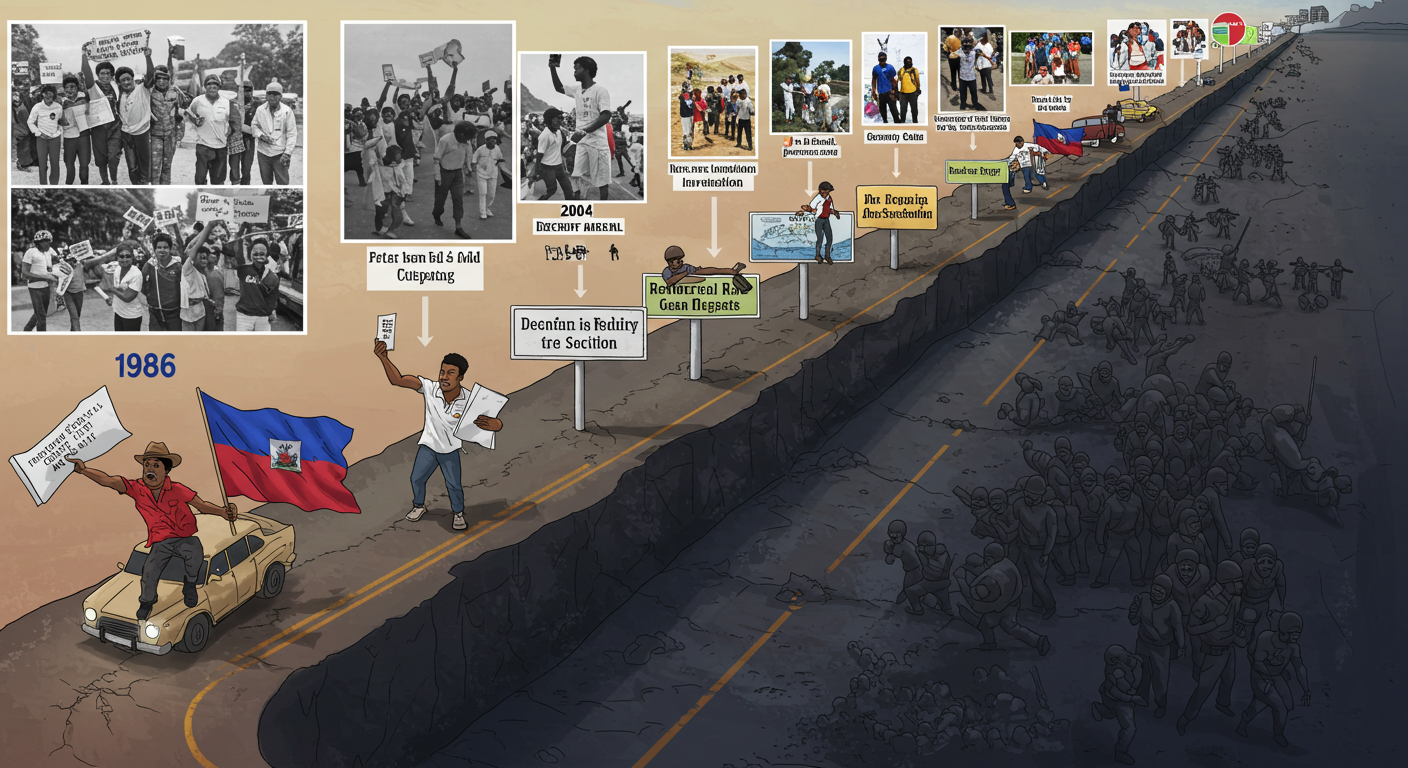
In 1986, Haiti embarked on a journey toward democracy, filled with hope for a brighter future. However, the path has been marred by political instability, violence, and corruption, transforming the nation’s aspirations into a security nightmare.
The costly journey has seen numerous challenges, from coups and natural disasters to socio-economic crises. Despite efforts to stabilize the country, Haiti continues to grapple with the remnants of its tumultuous past, hindering its progress toward a stable democracy.
After nearly three decades of authoritarian rule, the Duvalier regime’s collapse in 1986 sparked both hope and uncertainty in Haiti. The end of Baby Doc’s dictatorship marked a significant shift towards democracy, but the path forward was fraught with challenges.
The Duvalier dynasty, which had ruled Haiti with an iron fist since 1957, finally came to an end in 1986. Baby Doc’s escape to France on February 7, 1986, marked the culmination of a popular uprising that had been gaining momentum for months.
Baby Doc’s departure created a power vacuum that was filled by a military junta led by General Henri Namphy. This transition was marked by widespread protests and demands for democratic reforms.
As Haiti transitioned towards democracy, there was a surge in civil society mobilization. Various groups, including labor unions, student organizations, and human rights activists, came together to push for democratic reforms and an end to military rule.
The mobilization of civil society played a crucial role in shaping Haiti’s democratic aspirations. Key movements included:
| Movement | Key Demands |
|---|---|
| Labor Unions | Better working conditions, fair wages |
| Student Organizations | Educational reforms, democratic freedoms |
| Human Rights Activists | Accountability for past abuses, protection of human rights |
The fall of the Duvalier dynasty was a pivotal moment in Haitian history, marking the beginning of a long and challenging journey towards democracy. The initial hopes and aspirations that emerged during this period continue to shape Haiti’s political landscape today.
The period following Duvalier’s ousting in 1986 was marked by significant turmoil as Haiti struggled to transition towards democracy. The fall of the Duvalier dynasty raised hopes for a new era of political freedom and stability, but the reality that followed was far more complex.
The initial transition was marred by the rise of military juntas, which hindered the establishment of a stable democratic government. The military’s influence was pervasive, and their rule was characterized by human rights abuses and suppression of political dissent.
The elections held in 1987 were a critical moment in Haiti’s democratic journey. However, they were marred by violence and intimidation, leading to their eventual cancellation. This failure highlighted the challenges of building democratic institutions in a context dominated by military power.
In the aftermath of Duvalier’s fall, constitutional reforms were seen as a crucial step towards establishing a democratic framework. The new constitution aimed to limit the power of the presidency and promote human rights. However, the implementation of these reforms faced significant obstacles, including resistance from the military and entrenched political elites.
Building democratic institutions from scratch proved to be a daunting task. It required not only the creation of new political structures but also a cultural shift towards democratic values and practices. Key challenges included:
Despite these challenges, the period between 1986 and 1990 laid the groundwork for future democratic aspirations in Haiti, highlighting both the progress made and the obstacles that remained.
Haiti’s first democratically elected president, Jean-Bertrand Aristide, brought hope to the nation in 1991. His presidency was characterized by policies influenced by liberation theology, which resonated with the poor and marginalized.
Aristide’s rise to power was swift, driven by his popularity among the Haitian masses. His message of social justice and equality, rooted in liberation theology, garnered significant support.
Liberation theology played a crucial role in Aristide’s political ideology, emphasizing the need for social and economic reform. This resonated deeply with Haiti’s impoverished majority.
Aristide’s presidency was short-lived, as he was ousted in a military coup just eight months after taking office. This led to a period of international isolation, as the international community condemned the coup.
Aristide returned to power in 1994, following a US-led intervention that restored him to office. His second term was marked by controversy, including allegations of authoritarianism.
In 2004, Aristide was again ousted, this time following a rebellion led by opposition groups. He was flown out of the country under controversial circumstances.
| Year | Event | Significance |
|---|---|---|
| 1991 | Aristide Elected | First democratic president |
| 1991 | Military Coup | Ousted Aristide |
| 1994 | US-led Intervention | Restored Aristide |
| 2004 | Rebellion | Aristide’s Forced Departure |
Foreign interventions in Haiti, particularly from 1994 to 2010, had far-reaching consequences for the nation’s stability and development. This period was marked by significant events that shaped Haiti’s political, social, and health landscapes.
In 1994, the US-led Operation Uphold Democracy aimed to restore democratic order by returning President Jean-Bertrand Aristide to power. This intervention involved a substantial US military presence, which initially helped stabilize the country but also raised concerns about sovereignty and long-term dependency on foreign forces.
Following the US withdrawal, the United Nations took over with the establishment of the MINUSTAH peacekeeping mission in 2004. While intended to maintain stability, MINUSTAH faced criticism for its handling of various issues, including the introduction of cholera to Haiti.
The cholera outbreak, traced back to UN peacekeepers from Nepal, became a major health crisis, infecting hundreds of thousands and killing thousands. This incident highlighted the need for greater accountability and better preparedness among peacekeeping forces.
Haiti’s reliance on foreign aid has created cycles of dependency, often undermining local capacities and initiatives. The dynamics of foreign aid distribution have been criticized for prioritizing international agendas over Haitian needs, complicating the country’s path to self-sufficiency.
| Intervention | Year | Key Outcomes |
|---|---|---|
| Operation Uphold Democracy | 1994 | Restoration of Aristide, initial stability |
| MINUSTAH Peacekeeping Mission | 2004 | Stability efforts, cholera outbreak |
The legacy of foreign interventions in Haiti from 1994 to 2010 is complex, with both positive and negative outcomes. Understanding these dynamics is crucial for shaping future international engagements that support Haitian sovereignty and development.
From 2010 to 2016, Haiti struggled to recover from a series of catastrophic natural events that strained its already fragile infrastructure. This period was marked by two major disasters: the 2010 earthquake and Hurricane Matthew in 2016.
The 2010 earthquake was one of the most devastating disasters in Haiti’s recent history. It resulted in widespread destruction and loss of life.
The earthquake claimed approximately 230,000 lives and led to the collapse of many institutional buildings, including government offices, hospitals, and schools. This collapse severely weakened Haiti’s ability to respond to the disaster and provide basic services.
The reconstruction efforts following the earthquake were marred by controversies over aid distribution and management. Many projects were criticized for being inefficient or corrupt.
| Reconstruction Efforts | Challenges Faced | Impact |
|---|---|---|
| Aid Distribution | Inefficiency, Corruption | Delayed Recovery |
| Infrastructure Projects | Funding Shortfalls, Poor Planning | Incomplete Projects |
In 2016, Hurricane Matthew further exacerbated Haiti’s environmental and humanitarian crises. The hurricane highlighted the country’s vulnerability to natural disasters.
The combination of natural disasters and political instability from 2010 to 2016 underscored the need for sustainable development and disaster preparedness in Haiti.
Haiti’s journey since 1986 has been marked by a stark contrast between initial democratic hopes and the current security nightmare. The country’s democratic aspirations, evident in the ousting of the Duvalier regime, have given way to a complex web of challenges.
Democratic institutions in Haiti have faced significant challenges since their inception. The electoral process, a cornerstone of democracy, has been marred by dysfunction and controversy.
The history of electoral processes in Haiti is replete with instances of irregularities, delays, and outright cancellations. This has led to constitutional crises, further eroding the legitimacy of democratic institutions.
The rise of gang federations has dramatically altered Haiti’s security landscape. These groups have consolidated control over significant territories, often challenging state authority.
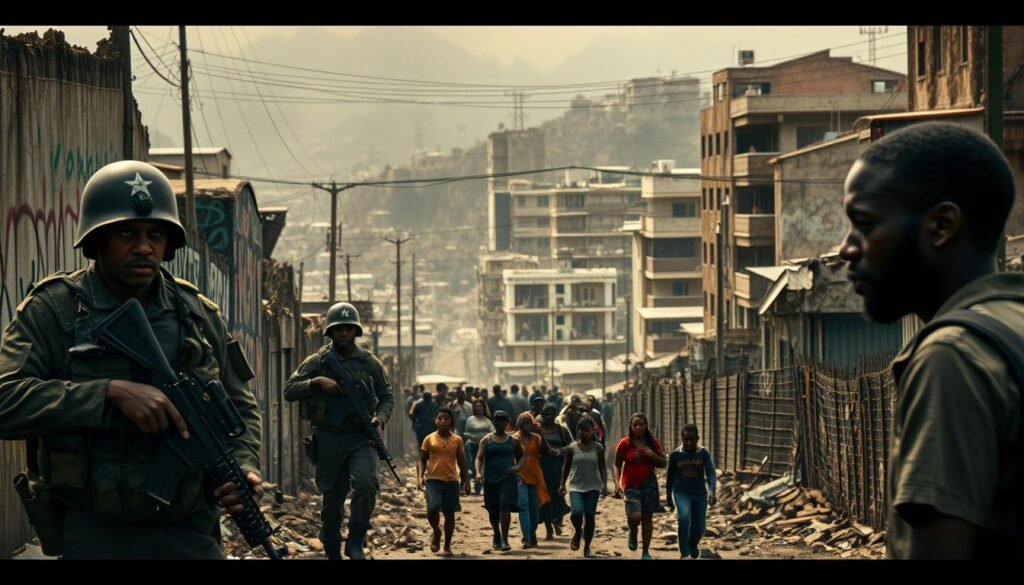
Economic decline has had profound implications for security in Haiti. Poverty and inequality have created fertile ground for gang recruitment and violence.
The interplay between poverty, inequality, and violence is complex. In Haiti, economic hardship has driven many towards gang membership as a means of survival, exacerbating the security crisis.
| Factor | Impact on Security |
|---|---|
| Poverty | Increases vulnerability to gang recruitment |
| Inequality | Fuels resentment and social unrest |
| Violence | Creates a culture of fear and insecurity |
Jovenel Moïse’s presidency began with a contested election that cast a shadow over his legitimacy. The 2017 election was marred by allegations of fraud and irregularities, setting the stage for a tumultuous tenure.
The electoral process was criticized for lacking transparency, leading to widespread protests. Moïse’s government faced challenges in establishing its authority, with many Haitians questioning his right to rule.
As Moïse’s presidency progressed, growing protests became a regular occurrence. Demonstrators demanded better governance, economic opportunities, and an end to corruption. The political paralysis that ensued hindered the government’s ability to address these pressing issues.
In response to the political gridlock, Moïse resorted to rule by decree, bypassing the legislative process. This move was widely criticized as it eroded democratic norms and concentrated power in the executive branch.
The situation took a dramatic turn on July 7, 2021, when President Moïse was assassinated at his private residence. The presidential assassination created a power vacuum, plunging Haiti into further instability. The event was condemned internationally, and a crisis of governance ensued.
As Haiti navigated this crisis, the international community was called upon to assist in stabilizing the country. The aftermath of Moïse’s assassination highlighted the need for robust democratic institutions and the rule of law.
The Moïse presidency crisis underscored the fragility of Haiti’s democratic experiment. As the country looked to the future, it was clear that addressing the underlying issues of governance, security, and economic development would be crucial to preventing further crises.
Since 2021, Haiti has faced an intensifying spiral of violence and instability, leading to a complete breakdown of state authority. This period has been marked by gang warfare that has engulfed the capital, Port-au-Prince, and other areas, resulting in significant humanitarian challenges.
The rise of powerful gang federations, particularly the Viv Ansanm Federation, has led to territorial control and a siege-like situation in metropolitan areas. The Viv Ansanm Federation, led by figures like Jimmy “Barbecue” Chérizier, has been instrumental in orchestrating violence and controlling large swaths of territory.
The Viv Ansanm Federation’s influence has resulted in the displacement of communities and a severe disruption of economic activities. Their control over key infrastructure has further exacerbated the humanitarian emergency, leaving many without access to necessities.
The ongoing violence has triggered a significant humanitarian emergency, with thousands displaced and in dire need of assistance. The situation is compounded by the lack of access to basic services such as healthcare, clean water, and sanitation.
The collapse of basic services has made daily survival a significant challenge for the Haitian population. The absence of effective governance and infrastructure has led to a reliance on informal systems and external aid to meet basic needs.
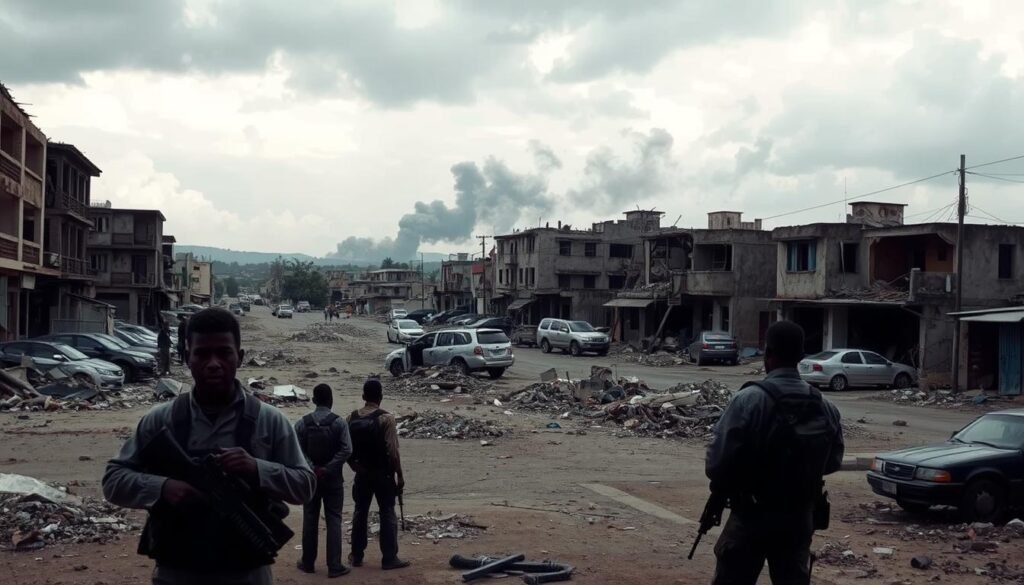
The situation in Haiti is dire, with gang warfare and the resulting humanitarian crisis demanding immediate attention and action from both local and international stakeholders. The international community’s response will be crucial in addressing the current state collapse and working towards a path of recovery for Haiti.
As Haiti teeters on the brink of collapse, the world is rethinking its approach to intervention. The international community is faced with the daunting task of addressing Haiti’s multifaceted crisis, which includes gang warfare, humanitarian emergencies, and the collapse of basic services.
A significant development in the global response is the Kenya-led multinational security mission. This initiative aims to restore order and stability in Haiti by bolstering its security apparatus. The mission has garnered international support, with several countries contributing troops and resources.
Despite its potential benefits, the Kenya-led mission is not without controversy. Concerns have been raised regarding the potential for foreign intervention to undermine Haitian sovereignty. Additionally, there are challenges related to the mission’s effectiveness and its ability to address the root causes of Haiti’s crisis.
The Caribbean Community (CARICOM) has been actively involved in regional efforts to support Haiti, but more like interference sometimes. CARICOM’s initiatives focus on providing humanitarian aid, promoting economic development, and fostering diplomatic cooperation. These regional approaches are crucial in ensuring a coordinated and effective response to Haiti’s challenges if they are sincere.
The US has historically played a significant role in Haitian affairs, and its policy continues to evolve in response to the current crisis. The influence of the Haitian diaspora in the US is also a critical factor, as diaspora communities contribute to both the economic and political discourse surrounding Haiti’s future.
| Initiative | Description | Key Players |
|---|---|---|
| Kenya-Led Security Mission | Multinational security mission to restore order in Haiti | Kenya, International Community |
| CARICOM Initiatives | Humanitarian aid, economic development, and diplomatic cooperation | CARICOM Member States |
| US Policy Evolution | Diplomatic and economic support tailored to Haiti’s needs | US Government, Haitian Diaspora |
The path to democratic consolidation in Haiti has been fraught with difficulties. Despite initial hopes following the fall of the Duvalier dynasty in 1986, Haiti’s democratic experiment has faced numerous challenges.
Haiti’s democratic aspirations have been hindered by various structural impediments. One significant factor has been the colonial legacy and its ongoing impact on the country’s political and social structures.
The legacy of colonial rule has contributed to the concentration of power in the hands of a few elites, who have often resisted democratic reforms. This has led to a persistent struggle between the ruling elite and the broader population seeking democratic change.
The international community has played a complex role in Haiti’s democratic journey. On one hand, international support has been crucial for democratic processes; on the other hand, foreign interventions have sometimes undermined Haitian sovereignty and self-determination.
“The international community’s role in Haiti has been a double-edged sword, providing necessary support while also perpetuating dependency.”
Despite these challenges, Haitian grassroots movements have shown remarkable resilience and determination. These movements have been instrumental in pushing for democratic reforms and holding leaders accountable.
| Key Factors | Impact on Democracy |
|---|---|
| Colonial Legacy | Concentration of power among elites |
| International Community | Mixed support and intervention |
| Grassroots Movements | Push for democratic reforms |
Haiti’s journey since 1986 has been marked by periods of hope and despair, with the country’s democratic aspirations often overshadowed by political instability and security crises. As Haiti navigates its current challenges, identifying pathways forward for recovery is crucial.
A comprehensive approach is needed to address the structural, economic, and security issues plaguing Haiti. This includes rebuilding democratic institutions, promoting economic development, and enhancing security measures to protect citizens and stabilize the country.
Democratic rebuilding efforts should focus on strengthening Haiti’s institutions, ensuring free and fair elections, and promoting good governance. International support and cooperation will be vital in this process, but it’s equally important to empower Haitian leaders and communities to drive their own recovery.
Haiti’s recovery is closely tied to its ability to address the root causes of its crises. By working together, both domestically and internationally, Haiti can chart a more stable and prosperous future, leveraging pathways forward that prioritize democratic rebuilding and sustainable development.
Haiti’s transition was triggered by a combination of factors, including the collapse of democratic institutions, the rise of gang federations, and economic deterioration.
Jean-Bertrand Aristide’s presidency marked a significant moment in Haiti’s democratic aspirations, as he was the country’s first democratically elected president, but his terms were also marked by controversy and ultimately ended in his forced departure.
Foreign interventions, including US-led operations and UN peacekeeping missions, have had mixed results, sometimes stabilizing the country but also leading to unintended consequences such as the cholera outbreak, insecurity and fostering dependency cycles.
The 2010 earthquake had a devastating impact on Haiti, resulting in significant loss of life, institutional collapse, corruption and a humanitarian crisis, with reconstruction efforts facing numerous challenges.
Gang violence has led to a security catastrophe, with gang federations like the Viv Ansanm exerting territorial control, causing humanitarian emergencies, and contributing to the collapse of basic services.
The so-called Kenya-led multinational security mission is a global response to Haiti’s crisis, aiming to address the security challenges, but it also faces challenges and controversies surrounding its intervention.
Haiti’s democratic experiment highlights the importance of addressing structural impediments to democratic consolidation, including the colonial legacy, elite resistance, and the need for a more nuanced role by the international community. Also, we need to understand that democracy can never be imported.
Pathways forward for Haiti’s recovery include a comprehensive approach that addresses the structural, economic, and security challenges, rebuilding towards a more stable and democratic future based on Haitian culture, not foreign interference.