Physical Address
304 North Cardinal St.
Dorchester Center, MA 02124
Physical Address
304 North Cardinal St.
Dorchester Center, MA 02124

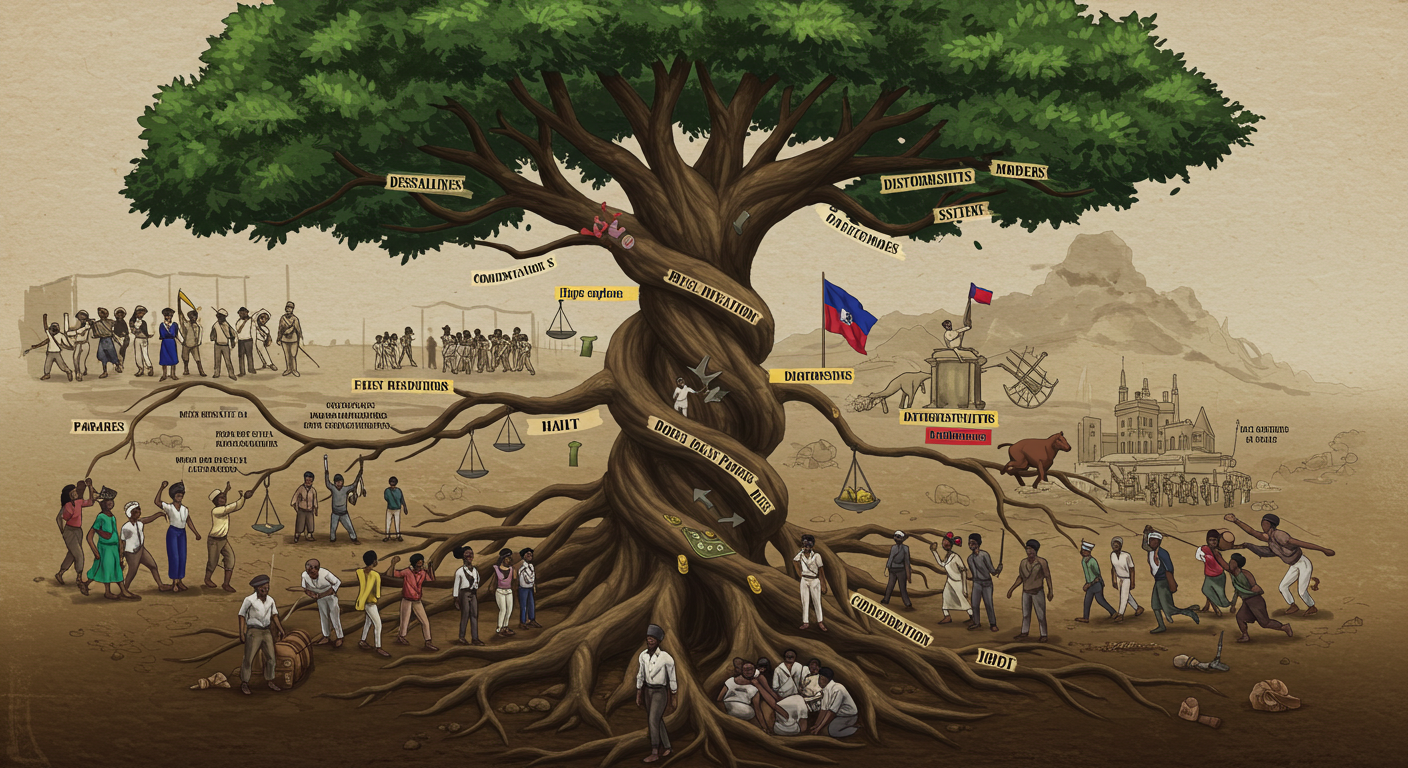
Discover the dark forces that have oppressed Haiti and its people since 1806 in this powerful exposé.
Haiti’s history is marked by foreign interventions and internal strife, shaping the country’s current state. Since 1806, the island nation has faced numerous challenges, from occupation to economic instability.
The Haitian people’s struggles are deeply rooted in the country’s complex past, including the impact of colonialism and subsequent interventions. Understanding Haiti’s history is crucial to grasping the nuances of its contemporary challenges.
The Haitian Revolution’s success was followed by a series of struggles that tested the nation’s resolve. After defeating the French colonial forces, Haiti declared its independence in 1804, becoming the first independent black nation in the world.
Jean-Jacques Dessalines, the leader of the Haitian Revolution and the country’s first ruler, was assassinated in 1806. This event marked a significant turning point in Haitian history, leading to a period of political instability.
Following Dessalines’ assassination, Haiti was divided between the north and south, with Henri Christophe ruling the north and Alexandre Pétion governing the south. This division resulted in two separate governments, each with its own policies and priorities.
Haiti’s independence was not recognized by major world powers, including France, the United States, and Great Britain, for many years. This diplomatic isolation had severe economic and political consequences, hindering Haiti’s ability to establish itself as a stable and prosperous nation.
The combination of internal divisions and external pressures created a challenging environment for Haiti’s development. Understanding these early struggles is crucial to grasping the complexities of Haiti’s ongoing issues.
France’s 1825 ordinance demanding 150 million francs from Haiti marked the beginning of a long period of economic enslavement. This debt was imposed as a condition for France to recognize Haiti as an independent nation, following Haiti’s successful revolution against French colonial rule.
The ordinance was part of a broader effort by France to reassert its influence and extract compensation for the loss of its most profitable colony. The amount of 150 million francs was an astronomical sum, far beyond Haiti’s capacity to pay. It was essentially a ransom for the freedom that Haitians had fought for.
This debt effectively enslaved Haiti economically for over a century. The payments drained Haiti’s treasury, hindering its ability to invest in infrastructure, education, and healthcare. The economic strain was so severe that it stifled Haiti’s development, contributing to its status as one of the poorest countries in the Western Hemisphere.
Haiti continued to pay this debt until the late 19th century, with significant economic hardship as a result. Estimates suggest that the total amount paid, including interest, was equivalent to billions of dollars in today’s currency.
| Year | Payment Amount (Francs) | Modern Equivalent (USD) |
|---|---|---|
| 1825 | 150 million | Billions |
| 1880s | Partial Payments | Hundreds of Millions |
The legacy of this “independence debt” continues to affect Haiti’s economic stability and its relations with France and other global financial institutions. Understanding this history is crucial for grasping the complexities of Haiti’s ongoing economic challenges.
Foreign interventions have played a crucial role in Haiti’s development, often with profound consequences. The country’s sovereignty has been repeatedly tested by external forces that have shaped its political, economic, and social structures.
The U.S. military occupation of Haiti, which lasted from 1915 to 1934, was a pivotal period in the country’s history. The occupation was justified as a means to stabilize Haiti and protect American business interests. However, it had far-reaching impacts on Haiti’s political and economic systems. The occupation led to the suppression of Haitian resistance and the imposition of American control over key sectors of the economy.
One of the significant actions during the U.S. occupation was the rewriting of Haiti’s constitution in 1918. This new constitution allowed for foreign ownership of land, a significant departure from previous laws that prohibited it. This change was deeply unpopular among Haitians, who saw it as an attack on their sovereignty. The occupation also led to the reorganization of Haiti’s banking system, with the establishment of the Banque Nationale de la République d’Haïti, which was controlled by American interests.
“The occupation was a traumatic experience for Haiti, leading to widespread resentment and resistance among the population.” –
In more recent times, Haiti has experienced further foreign interventions. Operation Uphold Democracy in 1994 aimed to restore President Jean-Bertrand Aristide to power after a military coup. Later, the United Nations Stabilization Mission in Haiti (MINUSTAH) was deployed from 2004 to 2017 to stabilize the country following political unrest.
The MINUSTAH mission had significant consequences, including the introduction of cholera to Haiti, which led to a devastating epidemic. Critics argue that the mission failed to adequately address the root causes of instability in Haiti and that its presence had severe unintended consequences. The aftermath of MINUSTAH’s departure continues to be felt, with ongoing debates about the role of foreign interventions in Haiti’s development.
In conclusion, foreign interventions and occupations have had a lasting impact on Haiti, shaping its history and influencing its current state. Understanding these interventions is crucial for grasping the complexities of Haiti’s ongoing challenges.
For nearly three decades, the Duvalier family ruled Haiti with an iron fist, leaving a trail of terror that would take the country years to recover from. François “Papa Doc” Duvalier’s ascension to power in 1957 marked the beginning of a brutal dictatorship that would be characterized by state-sponsored terror, economic plunder, and international complicity.
The Tonton Macoutes, a paramilitary force created by Papa Doc, were instrumental in maintaining the regime’s grip on power through fear and violence. The name “Tonton Macoutes” translates to “Uncle Bogeymen,” striking fear into the hearts of Haitians, as these men were known for their brutality and impunity.
When Jean-Claude “Baby Doc” Duvalier succeeded his father in 1971, the regime continued its path of terror and began to focus more on economic plunder. Baby Doc’s rule was marked by corruption and the exploitation of Haiti’s resources, further impoverishing the nation.
The Duvalier regime enjoyed significant support from the United States and other international actors, largely due to Cold War politics. The U.S. viewed the Duvalier regime as a bulwark against communism in the Caribbean.
During the Cold War, Haiti’s strategic location made it a valuable ally for the United States. The U.S. provided financial and military aid to the Duvalier regime, despite its human rights abuses, because it was seen as a stable, anti-communist force in the region.
| Year | Event | Impact |
|---|---|---|
| 1957 | François Duvalier becomes President | Beginning of Duvalier dynasty |
| 1971 | Jean-Claude Duvalier succeeds Papa Doc | Continuation of dictatorship |
| 1986 | Jean-Claude Duvalier overthrown | End of Duvalier rule |
The legacy of the Duvalier dynasty continues to affect Haiti, with the country’s political instability and economic challenges rooted in part in the decades of terror and plunder under their rule.
Haiti’s downfall can be attributed to a complex web of systemic racism, global financial exploitation, and foreign interference. Since its independence in 1804, Haiti has faced numerous challenges that have cumulatively contributed to its current state.
The world’s first black republic has been subjected to systemic racial prejudice in international relations. This prejudice has manifested in various forms, including diplomatic isolation and economic exclusion. As noted by historian Laurent Dubois, “Haiti was punished for its success, for having dared to become the first black republic in a world dominated by slave-holding powers.”
“The Haitian Revolution was a beacon of hope for enslaved people around the world, but it was met with hostility and racism by the colonial powers.”
This systemic racism has had long-lasting effects on Haiti’s development, limiting its access to international resources and hindering its ability to participate in global affairs on an equal footing.
Global financial institutions have played a significant role in Haiti’s economic woes. The imposition of neoliberal policies and structural adjustment programs has led to the exploitation of Haiti’s resources and labor. A detailed analysis of the impact of these policies is presented in the following table:
| Year | Policy | Impact |
|---|---|---|
| 1980s | Neoliberal reforms | Undermined local agriculture |
| 1990s | Structural adjustment programs | Privatization of state-owned enterprises |
| 2000s | Foreign investment incentives | Exploitation of natural resources |
Foreign interference has been a recurring theme in Haitian politics, contributing to the cycle of political instability. The U.S. occupation from 1915 to 1934 is a notable example, during which Haiti’s constitution was rewritten to favor foreign interests.
Haiti’s status as the world’s first black republic has been met with punishment rather than support. The international community’s response to Haiti’s independence was to impose an independence debt to France, which crippled the country’s economy for generations.
In conclusion, the systemic issues that have plagued Haiti since 1806 are deeply intertwined with its history as the world’s first black republic. Addressing these issues will require a comprehensive understanding of the historical context and a commitment to rectifying the injustices of the past.
The economic history of Haiti since the 1980s is marked by the influence of neoliberal policies and the rise of non-governmental organizations (NGOs). This period has seen significant changes in Haiti’s economic landscape, largely driven by external forces.
Neoliberal policies have been a cornerstone of Haiti’s economic strategy since the 1980s. These policies, often imposed by international financial institutions, have included measures such as trade liberalization and privatization of state-owned enterprises.
Such policies have contributed to Haiti’s economic dependency and stifled its ability to develop a robust, self-sufficient economy.
Haiti was once self-sufficient in food production. However, the imposition of neoliberal policies has led to a decline in agricultural productivity.
The shift towards export-oriented crops and the importation of cheap food staples have made Haiti reliant on foreign food aid, further eroding its agricultural self-sufficiency.
Haiti has become notorious for its high number of NGOs relative to its population. While these organizations provide essential services, they also create a dependency on foreign aid.
The exploitation of Haitian labor by corporate interests is a significant issue. Many Haitians work in poor conditions for low wages, often in industries controlled by foreign companies.
This exploitation is a result of Haiti’s desperate economic situation and the lack of effective labor protections.
Haiti’s vulnerability to environmental degradation and natural disasters is a pressing concern that requires immediate attention. The country’s history of colonial exploitation, coupled with contemporary global economic pressures, has significantly contributed to its environmental challenges.
Haiti has suffered from severe deforestation, primarily due to colonial resource extraction practices that continued after independence. The loss of forests has not only led to soil erosion but also increased the risk of natural disasters. The removal of trees for charcoal and agricultural land has exacerbated the problem, leaving Haiti with less than 1% of its original forest cover.
The 2010 earthquake was a devastating disaster that highlighted Haiti’s vulnerability to natural hazards. The international response, while well-intentioned, often prioritized the interests of foreign donors over the needs of local communities. This phenomenon, known as disaster capitalism, has been criticized for perpetuating inequality and hindering long-term recovery efforts.
Haiti is highly vulnerable to the impacts of climate change, including increased frequency and severity of hurricanes. Rising sea levels and changing weather patterns have exacerbated existing environmental challenges, threatening agricultural productivity and infrastructure.
The international community’s response to Haiti’s environmental disasters has been marred by inefficiencies and a lack of coordination. Aid has often been misdirected, with a significant portion being absorbed by administrative costs rather than reaching those in need. Reconstruction efforts have also been criticized for failing to incorporate local perspectives and sustainable practices.
In conclusion, Haiti’s environmental challenges are complex and multifaceted, requiring a comprehensive and inclusive approach to address effectively. The international community must work in partnership with local stakeholders to develop sustainable solutions that prioritize the needs of Haitian communities.
In recent years, Haiti has faced an unprecedented crisis, driven by gang violence, political turmoil, and humanitarian emergencies. The country’s stability has been severely tested, leading to a complex and multifaceted crisis that has drawn international concern.

The assassination of President Jovenel Moïse in July 2021 marked a critical turning point in Haiti’s crisis. This event not only removed a key political figure but also exacerbated the existing power vacuum, allowing gang violence to flourish.
Gangs have increasingly taken control of large areas of Port-au-Prince, Haiti’s capital. This has led to a surge in violence, including kidnappings, murders, and other criminal activities, severely impacting the daily lives of ordinary Haitians.
The gang violence has contributed to a significant humanitarian crisis. Many Haitians have been displaced, and there is a growing need for food, shelter, and medical care. The crisis has also led to mass migration, both within Haiti and to other countries, as people seek safety and better living conditions.
The international community has struggled to effectively address the crisis in Haiti. Despite various interventions, the situation continues to deteriorate. The lack of a comprehensive and coordinated response has hindered efforts to stabilize the country and provide adequate support to its people.
The situation in Haiti remains dire, with gang violence and political instability continuing to undermine the state’s functionality. The international community must reassess its approach to address the root causes of the crisis and provide meaningful support to the Haitian people.
Haiti’s journey towards sovereignty and healing is complex and multifaceted. To achieve a more equitable future, it is essential to acknowledge the historical injustices and ongoing challenges that have shaped the country.
The path forward requires Haitian-led solutions that prioritize the needs and aspirations of the Haitian people. International support should respect Haitian sovereignty, avoiding interventions that have historically exacerbated the country’s problems.
Restoring agricultural self-sufficiency, promoting economic development, and addressing environmental degradation are critical steps towards healing. Additionally, fostering a culture of transparency and accountability in governance can help break the cycle of political instability.
Ultimately, the future of Haiti depends on the collective efforts of its people, international partners, and global community to support Haitian sovereignty and promote pathways to healing. By working together, it is possible to create a brighter future for the Haitian people.
The main factors include the “independence debt” imposed by France, foreign interventions and occupations, the Duvalier dynasty’s rule, systemic racial prejudice, exploitation by global financial institutions, and environmental degradation.
The “independence debt” of 150 million francs imposed by France in 1825 led to economic enslavement, draining Haiti’s resources for over a century and hindering its economic development.
The U.S. played a significant role, including a military occupation from 1915 to 1934, rewriting Haiti’s constitution, and supporting the Duvalier dictatorship during the Cold War.
Neoliberal policies and structural adjustment programs have strangled Haiti’s economy, destroyed its agricultural self-sufficiency, and led to the “Republic of NGOs” phenomenon.
Environmental degradation, including deforestation and vulnerability to climate change, has exacerbated natural disasters, such as the 2010 earthquake, and hindered the country’s ability to recover.
The current crisis involves gang violence, the assassination of President Jovenel Moïse, and a humanitarian crisis. The international community’s response has been criticized for being inadequate and failing to address the root causes of the crisis.
Haitian-led solutions, respect for Haitian sovereignty, and a shift away from foreign interference and exploitation are necessary for the country to achieve a more equitable and just future.
Global financial institutions have exploited Haiti through debt and conditional lending, perpetuating a cycle of economic dependency and instability.
Haiti’s status as the world’s first black republic has been met with punishment and isolation rather than support, contributing to its historical and ongoing struggles.