Physical Address
304 North Cardinal St.
Dorchester Center, MA 02124
Physical Address
304 North Cardinal St.
Dorchester Center, MA 02124


Uncover the architects behind Haiti's chaos and why they can't resolve the insecurity they created.
Haiti is facing an unprecedented crisis, with Haiti’s insecurity reaching alarming levels. The situation is complex, involving various actors who have contributed to the chaos.
The architects of chaos have played a significant role in perpetuating the crisis, making it challenging to find a resolution. Understanding the root causes and the roles of different stakeholders is crucial to addressing Haiti crisis.
From its independence to the current state of turmoil, Haiti’s history provides crucial context for understanding its chaos. Haiti, once the first independent black nation, has faced numerous challenges that have shaped its trajectory.
The legacy of colonialism and the revolution that led to Haiti’s independence in 1804 set the stage for future instability. The brutal exploitation under French rule and the subsequent struggle for freedom left deep scars.
The revolution, led by figures like Toussaint Louverture, was a significant event in world history, marking the first successful slave revolt. However, it also led to a cycle of violence and power struggles that continued for centuries.
Foreign intervention has been a recurring theme in Haiti’s history, from the U.S. occupation in 1915 to more recent international interventions. These interventions often aimed to stabilize the country but frequently had unintended consequences, exacerbating instability.
In recent decades, Haiti has faced significant challenges, including political upheaval and natural disasters.
After the fall of the Duvalier regime in 1986, Haiti struggled to establish a stable democracy. The period was marked by political violence, corruption, and power struggles.
Natural disasters, such as the 2010 earthquake, have had devastating effects on Haiti, straining its infrastructure and governance. The international response to these disasters often highlighted the challenges of foreign aid and intervention.
| Event | Year | Impact |
|---|---|---|
| Haitian Revolution | 1804 | Independence from France, setting a precedent for future power struggles. |
| U.S. Occupation | 1915-1934 | Attempted to stabilize Haiti but led to resentment and further instability. |
| Duvalier Regime Ends | 1986 | Marked the beginning of a tumultuous period with multiple coups and political violence. |
| 2010 Earthquake | 2010 | Devastating natural disaster that strained Haiti’s infrastructure and governance. |
Understanding these historical events is crucial for grasping the complexities of Haiti’s current crisis. The interplay between historical legacy, foreign intervention, and domestic politics has created a challenging environment for stability.
Understanding the key architects of Haiti’s current crisis requires examining both domestic political figures and international influencers. The interplay between these actors has significantly contributed to the country’s instability.
Domestic political figures have played a crucial role in shaping Haiti’s current state of affairs. Presidents and political elites have often prioritized personal gain over the welfare of the general population.
Successive Haitian presidents have been embroiled in controversy, with many accused of corruption and authoritarian tendencies. For instance, former President Michel Martelly’s administration was marked by allegations of widespread corruption.
Business oligarchs have also exerted significant influence over Haiti’s political landscape. Their financial backing of political campaigns has often led to favorable treatment and policies that benefit their interests at the expense of the broader population.
International actors, including foreign governments and international organizations, have also played a significant role in Haiti’s crisis. Their actions and policies have often had unintended consequences that have exacerbated the situation.
Foreign governments, particularly those with significant economic or strategic interests in Haiti, have pursued their own agendas. These agendas have sometimes aligned with, and at other times conflicted with, the needs and aspirations of the Haitian people.
International organizations, such as the United Nations and the International Monetary Fund, have implemented various policies aimed at stabilizing Haiti. However, these policies have often been criticized for being out of touch with local realities and for prioritizing the interests of international stakeholders over those of Haitians.
Haiti’s insecurity is not a natural phenomenon but a result of deliberate actions by certain political and economic actors. The mechanisms behind this manufactured insecurity are complex, involving the weaponization of gang violence for political control and the economic exploitation of resources.
The rise of armed groups in Port-au-Prince has been a significant factor in Haiti’s insecurity. These groups are often backed by political figures who use them to exert control over territories and populations.
Armed groups have proliferated in Port-au-Prince, taking advantage of the power vacuum and political instability. They engage in various criminal activities, including kidnapping and extortion, to maintain their power and influence.
Political figures often patronize these criminal organizations, providing them with protection and resources in exchange for their loyalty and support. This patronage enables the politicians to maintain control over certain areas and populations.
Economic exploitation is another key mechanism of manufactured insecurity in Haiti. This involves the corruption and embezzlement of public funds, as well as the monopolization of essential industries.
Corruption is rampant in Haiti, with public officials often embezzling funds meant for public services and infrastructure. This not only deprives the population of essential services but also perpetuates inequality and poverty.
Certain individuals and groups control essential industries such as energy and transportation, using their monopolies to exploit the population and maintain their grip on the economy.
| Mechanism | Description | Impact |
|---|---|---|
| Weaponizing Gang Violence | Using armed groups for political control | Increased insecurity, political instability |
| Economic Exploitation | Corruption, embezzlement, and monopolization | Poverty, inequality, lack of essential services |
The architects of Haiti’s insecurity are hindered from resolving the issue due to the economic and political advantages they gain from the current situation. This paradox lies at the heart of Haiti’s ongoing crisis, where those who have contributed to the chaos are now unable or unwilling to implement lasting solutions.
The continuation of chaos in Haiti serves the interests of certain elites who benefit economically and politically from the instability. Economic benefits are derived from the control of key resources and industries in a lawless environment.
Elites in Haiti have exploited the unstable environment to amass wealth through illicit means. This includes control over gangs, who are often backed by political figures, allowing them to manipulate the system for financial gain.
“The intertwining of political power and gang control has created a lucrative environment for those at the top, who profit from the chaos below.”
Social disorder also provides political advantages, allowing certain figures to maintain power through manipulation and control of the narrative. This creates a cycle where instability is used as a tool for political leverage.
| Mechanisms | Benefits |
|---|---|
| Economic Exploitation | Control over key resources |
| Political Manipulation | Maintenance of power |
The lack of accountability among those in power is a significant barrier to resolving Haiti’s crisis. This is perpetuated by institutional capture and systemic corruption.
Institutional capture occurs when those in power manipulate state institutions for personal gain, leading to systemic corruption. This undermines the rule of law and perpetuates inequality.
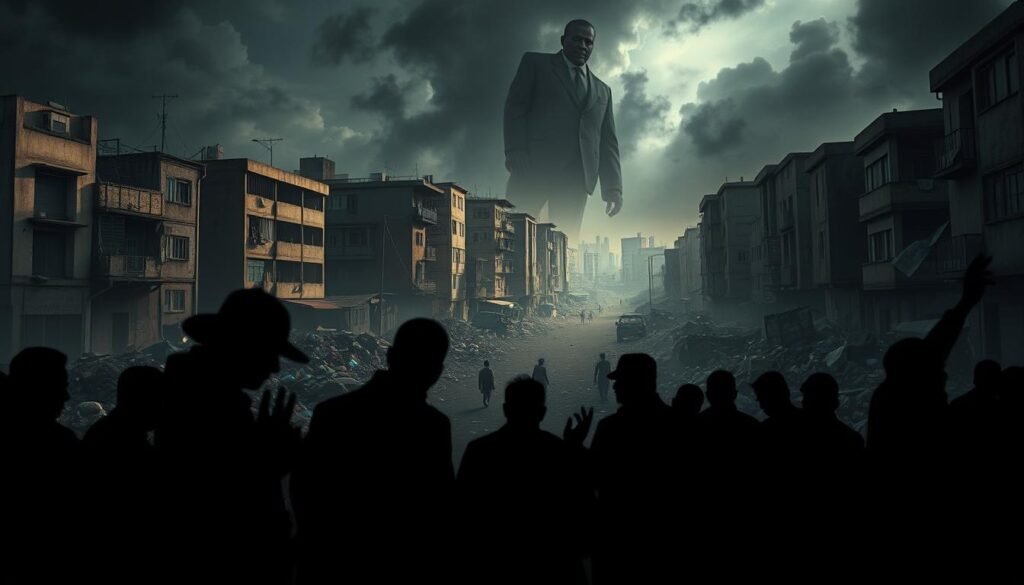
The absence of effective democratic checks and balances allows those in power to act with impunity, further entrenching the status quo. This absence is a critical factor in the perpetuation of Haiti’s insecurity.
In conclusion, the architects of Haiti’s chaos are caught in a web of their own making, where vested interests and the pursuit of power without accountability have created a cycle of instability that is challenging to break.
As Haiti teeters on the brink of collapse, the interplay between gang violence and governance failure becomes increasingly evident. The country’s descent into chaos is marked by a security vacuum that has allowed gangs to assert control over various regions.
The absence of effective governance has led to a surge in gang violence, with armed groups now controlling significant portions of the territory. This territorial control is not just a matter of physical dominance but also extends to economic exploitation.
Armed groups have established a stranglehold on several areas, dictating the flow of goods and services. This control has severe implications for the local population, who are caught in the crossfire of gang rivalries and extortion rackets.
The kidnapping economy has become a lucrative business, with gangs targeting both locals and foreigners. Extortion networks further drain the resources of an already impoverished population, creating a cycle of fear and economic paralysis.
The crisis in Haiti is not limited to security issues; it also encompasses the collapse of basic services and governance structures. Healthcare and education systems are on the verge of collapse, while food insecurity has reached alarming levels.
The healthcare system is struggling to provide even the most basic care, exacerbated by a lack of infrastructure and resources. Similarly, the education system is in disarray, with many schools unable to operate due to the prevailing insecurity.
Food insecurity is rampant, with many communities unable to access basic necessities. The economy is paralyzed, partly due to the extortion and kidnapping economies that divert resources away from productive activities.
The situation in Haiti is a complex web of security, governance, and economic challenges. Addressing these issues will require a multifaceted approach that goes beyond mere security measures to include the revitalization of basic services and governance structures.
The track record of international interventions in Haiti is one of repeated failure and missed opportunities. Despite numerous efforts to stabilize the country, the results have been disappointing. To understand why these interventions have failed, it’s essential to examine their shortcomings.
International peacekeeping missions have been a significant component of Haiti’s security landscape. However, their effectiveness has been limited.
The United Nations Stabilization Mission in Haiti (MINUSTAH) was deployed from 2004 to 2017. While it had some initial successes in stabilizing certain areas, it faced significant criticism for its handling of cholera outbreaks and allegations of abuse.
The current Multinational Security Support Mission, authorized by the UN, aims to address the security vacuum in Haiti. However, concerns about its mandate, operational effectiveness, and potential for unintended consequences remain.
Foreign aid has been a crucial element of international intervention in Haiti. However, its impact is complex and multifaceted.
Often, foreign aid bypasses government institutions, leading to a lack of accountability and undermining the state’s capacity to provide basic services.
Foreign aid can create dependency on external assistance, undermining local initiatives and solutions. This dependency can hinder the development of sustainable, Haitian-led solutions to the country’s problems.
| Intervention Type | Intended Outcome | Actual Outcome |
|---|---|---|
| Peacekeeping Missions | Stabilize Security | Mixed Results, Controversies |
| Foreign Aid | Support Development | Dependency, Undermined Local Solutions |
In conclusion, the failure of international interventions in Haiti stems from a combination of factors, including the shortcomings of peacekeeping missions and the complex impact of foreign aid. To move forward, it’s crucial to rethink these interventions and focus on supporting Haitian-led solutions.
The ongoing turmoil in Haiti exacts a heavy human toll, with ordinary citizens caught in the crossfire. As the crisis deepens, understanding the daily struggles and resilience of Haitians is crucial.
Life in Haiti has become a daily struggle for survival. Violence and insecurity are rampant, affecting every aspect of life.
In urban areas like Port-au-Prince, residents have developed various survival strategies. These include avoiding certain areas, forming community groups for protection, and finding alternative livelihoods.
Rural communities, though often more isolated, show remarkable resilience. They rely on agriculture and local trade to sustain themselves amidst the chaos.
The crisis has led to significant displacement and migration. Many Haitians are forced to flee their homes, seeking safety elsewhere.
Internally displaced persons face dire humanitarian needs, including shelter, food, and medical care. The response to these needs is critical to preventing further humanitarian crises.
The Haitian diaspora plays a vital role in supporting families back home through remittances. These financial lifelines are crucial for survival.
| Aspect | Urban Areas | Rural Areas |
|---|---|---|
| Primary Challenges | Violence, insecurity | Isolation, lack of infrastructure |
| Survival Strategies | Community protection, alternative livelihoods | Agriculture, local trade |
The path to stability in Haiti lies in empowering local communities and reimagining the role of international support. To achieve this, it’s crucial to focus on grassroots movements and civil society initiatives that have the potential to drive meaningful change.
Grassroots movements in Haiti are pivotal in addressing the country’s crisis at a community level. These movements are characterized by their ability to mobilize local populations and implement solutions tailored to specific community needs.
Community-based security initiatives have emerged as a vital component of Haiti’s security landscape. These initiatives involve local communities in the design and implementation of security measures, fostering a sense of ownership and responsibility.
Local economic development models are also crucial, as they focus on empowering local economies through sustainable practices and community-led projects. This approach not only stimulates economic growth but also helps in reducing dependency on external aid.
While grassroots movements are essential, reimagining international support is equally important. This involves creating mechanisms that ensure foreign aid and interventions are aligned with Haiti’s actual needs and are accountable to the Haitian people.
Implementing accountability mechanisms for foreign actors is critical to ensure that international support does not inadvertently perpetuate the cycle of dependency or corruption.
Supporting Haitian-led governance reforms is another key aspect. This involves backing initiatives that strengthen local governance structures and promote transparency and accountability within the government.
| Approach | Description | Benefits |
|---|---|---|
| Community-Based Security | Local communities design and implement security measures. | Increased community engagement, improved security. |
| Local Economic Development | Economic growth through sustainable, community-led projects. | Reduced dependency on external aid, stimulated local economy. |
| Accountability Mechanisms | Ensuring foreign aid is accountable to Haitian people. | Prevents corruption, promotes transparency. |
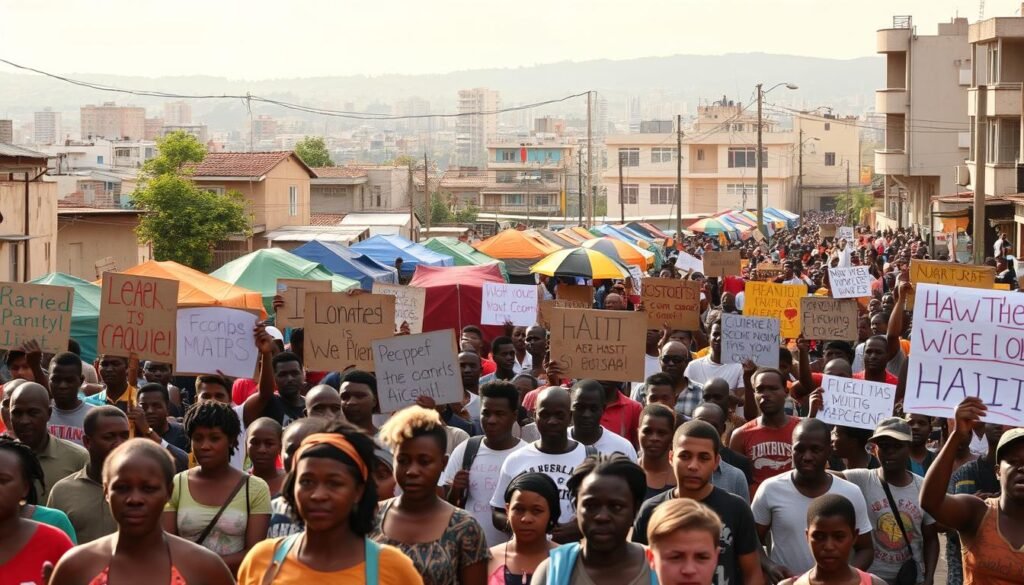
By combining these approaches, Haiti can break the cycle of violence and insecurity, paving the way for a more stable and prosperous future.
The path to resolving Haiti’s deep-seated crisis lies in understanding its historical context and the complex interplay of domestic and international factors that have contributed to its current state. As discussed, the architects of chaos, including certain domestic political figures and international actors, have played significant roles in manufacturing insecurity.
To break this cycle, it is essential to adopt Haitian-led solutions that address the root causes of the crisis. This involves supporting grassroots movements and civil society initiatives that are working tirelessly to rebuild communities and promote stability. By empowering Haitians to take charge of their recovery, we can ensure a more sustainable and equitable rebuilding process.
The international community can play a supportive role by providing aid that is tailored to the specific needs of Haitian communities, rather than imposing external solutions. This approach will not only foster a sense of ownership among Haitians but also contribute to a more effective recovery.
Ultimately, the future of Haiti depends on the ability of its people to drive their own recovery and rebuilding efforts. By supporting Haitian-led initiatives, we can work towards a Haiti that is built by Haitians, for Haitians.
Haiti’s insecurity is largely attributed to a combination of historical, political, and economic factors, including the legacy of colonialism, foreign intervention, domestic political instability, and the influence of international actors.
Domestic political figures, including presidents and political elites, as well as business oligarchs, play significant roles in perpetuating Haiti’s crisis through their actions and agendas, which often prioritize personal or factional interests over the country’s well-being.
International actors, including foreign governments and international organizations, influence Haiti’s situation through their policies and interventions, which can sometimes exacerbate the crisis due to agendas that may not align with Haiti’s best interests.
Gang violence is weaponized by political actors to achieve control and maintain power, often through patronage of criminal organizations and the manipulation of armed groups in urban areas like Port-au-Prince.
Foreign aid can have a double-edged effect on Haiti, sometimes providing necessary humanitarian assistance but also potentially creating dependency and undermining local solutions by bypassing government institutions.
Alternative approaches include supporting grassroots movements and civil society initiatives, such as community-based security and local economic development models, as well as reimagining international support to prioritize accountability and Haitian-led governance reforms.
Ordinary Haitians employ various survival strategies, with urban and rural communities showing resilience in the face of violence and instability, while the diaspora plays a crucial role in supporting families back home.
Haitian-led solutions are crucial for the country’s recovery as they empower Haitians to address the root causes of the crisis and rebuild their communities, ensuring that efforts are tailored to the country’s specific needs and context.