Physical Address
304 North Cardinal St.
Dorchester Center, MA 02124
Physical Address
304 North Cardinal St.
Dorchester Center, MA 02124
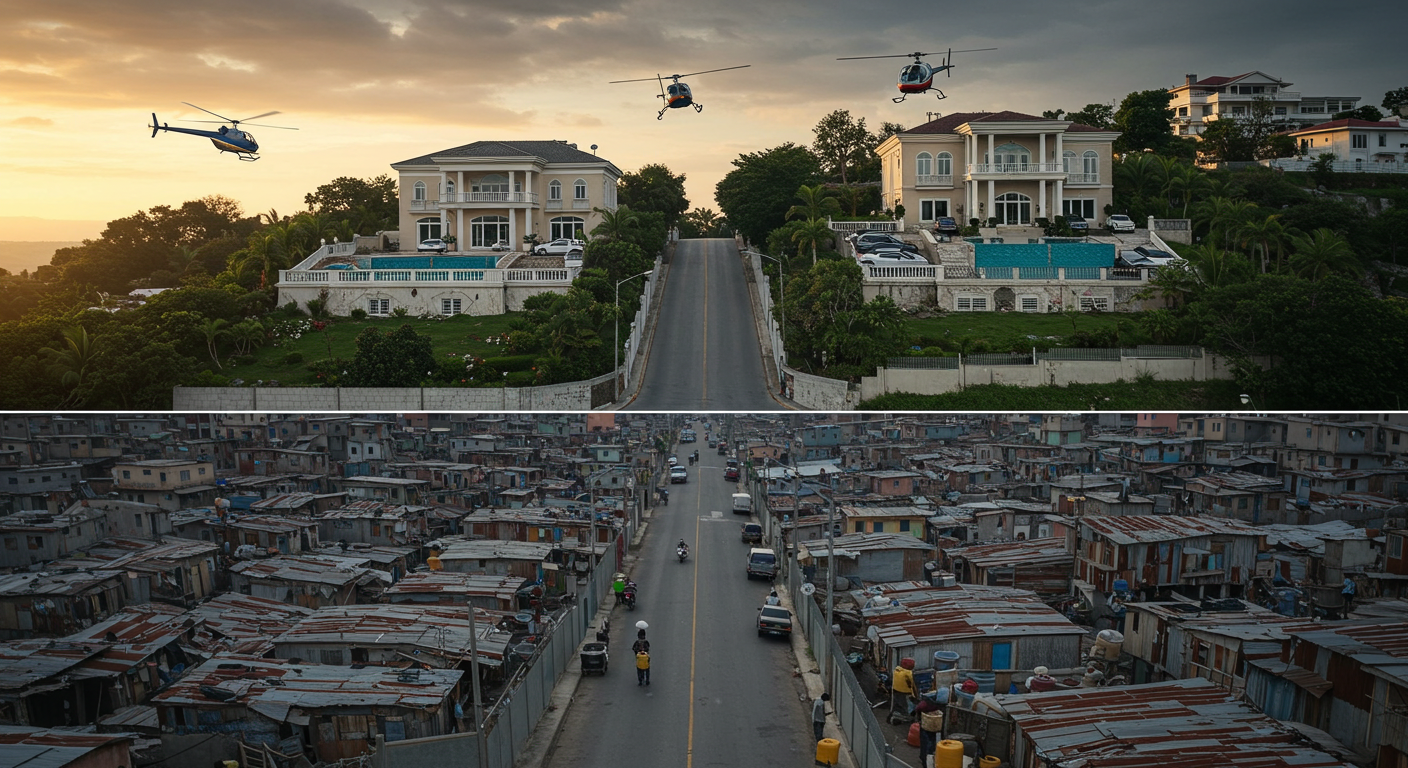
Haiti’s economic landscape presents one of the world’s starkest contradictions—a nation widely recognized as the Western Hemisphere’s poorest, yet home to extraordinary concentrations of wealth among a small elite. This paradox did not emerge by chance but through centuries of historical processes that began with the colonial plantation economy and evolved through post-independence struggles.
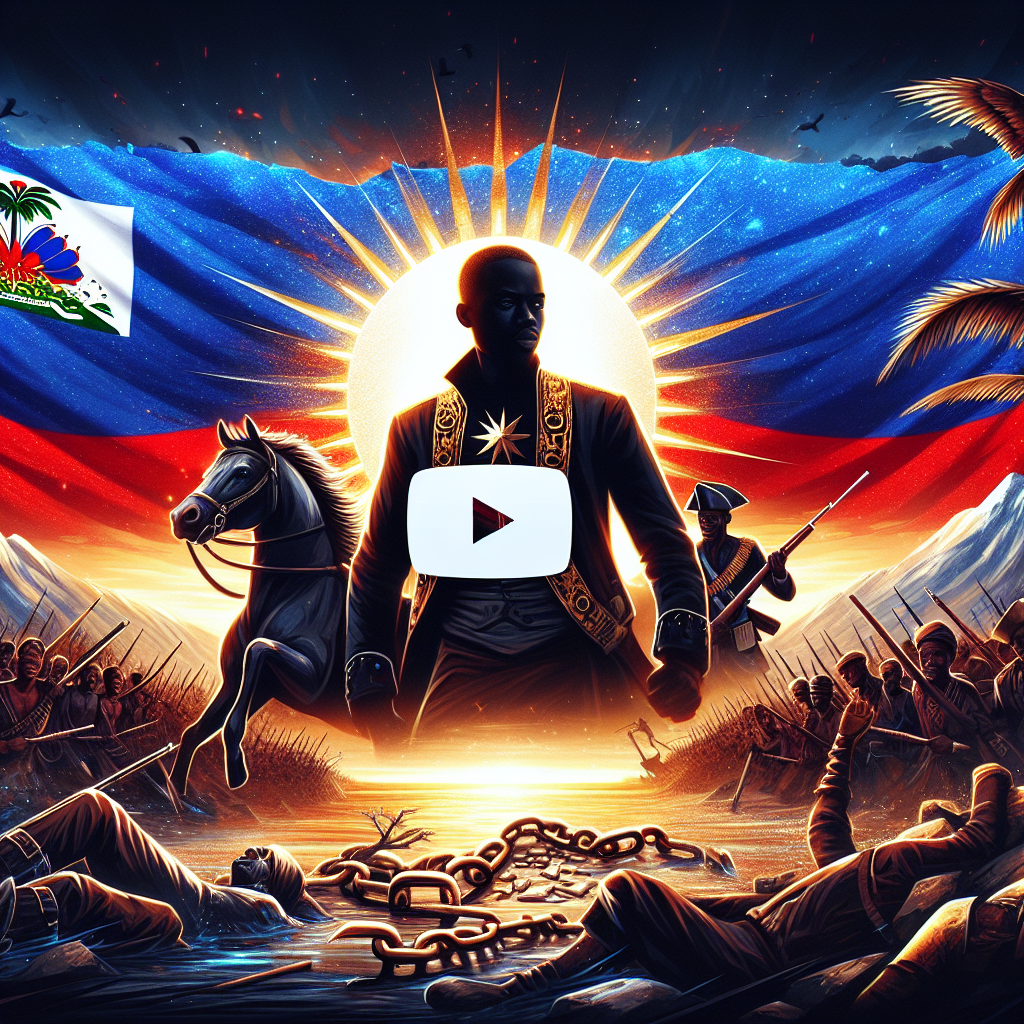
When Haiti declared independence in 1804 after the world’s only successful slave revolution, it faced immediate economic strangulation. France imposed a crushing “independence debt” in 1825—equivalent to approximately $21 billion in today’s currency—forcing Haiti to compensate former slave owners for their “lost property.” This financial burden, which took over a century to repay, crippled Haiti’s early development and established patterns of external extraction that continue today.
The post-independence period saw the emergence of a new economic elite, often lighter-skinned Haitians who maintained commercial connections to European markets. Under the Duvalier dictatorships (1957-1986), this pattern intensified as the regime granted monopoly rights and exclusive import licenses to a select group of families, laying the groundwork for today’s concentrated wealth. As the International Monetary Fund noted in its 2020 report, Haiti’s extreme income inequality is “related to a concentration of resources in the hands of a small but powerful group of elites, many of whom have dominated entire sectors of the Haitian economy” since the Duvalier era.
Today, Haiti carries the unenviable distinction of having the Western Hemisphere’s highest levels of income inequality. While approximately 60% of Haitians live below the poverty line and nearly 25% in extreme poverty, a small group of ultra-wealthy families control vast business empires that span virtually every sector of the economy—from banking and telecommunications to manufacturing, energy, and food imports.
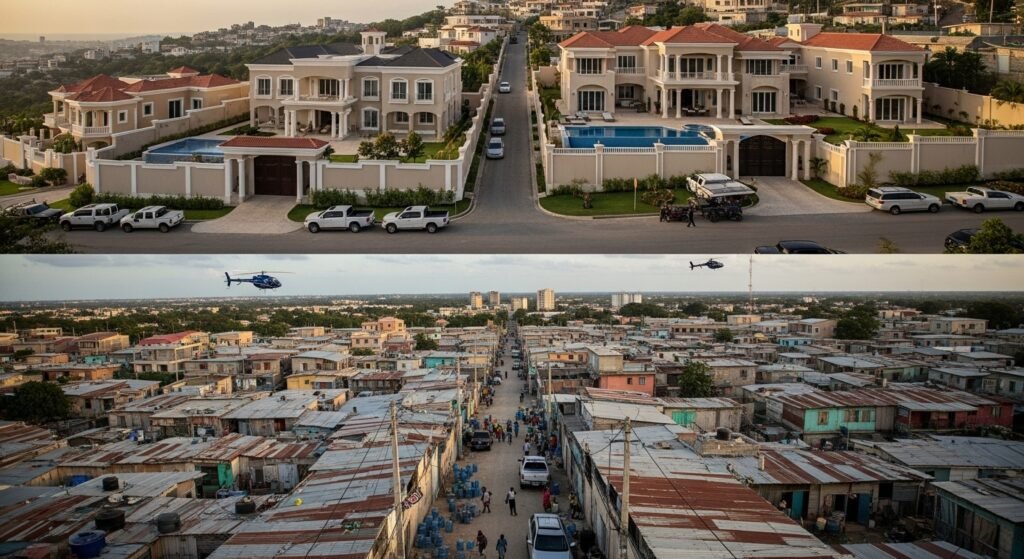
The extreme wealth concentration in Haiti has been systematically obscured through multiple mechanisms designed to hide both the extent of fortune and its origins. The 2021 Pandora Papers investigation revealed how Haiti’s wealthiest families have used complex offshore structures to shield their assets from public scrutiny and potentially from taxation in a country desperately lacking revenue.
Colonial and neocolonial narratives have further masked this reality by portraying Haiti’s poverty as primarily the result of corruption, poor governance, or cultural factors—rarely acknowledging the role of external exploitation or the systematic extraction of wealth by both foreign interests and domestic elites. This framing shifts blame to Haiti’s general population while protecting the powerful interests that benefit from the status quo.
International financial institutions and development agencies often discuss Haiti’s poverty without adequately addressing its extreme wealth inequality. The 2020 IMF report made a rare explicit connection, noting that Haiti collected tax revenue equivalent to only 13% of its economy from 2015-2020, with only Panama and Venezuela collecting less in the region. This limited tax collection directly constrains Haiti’s ability to fund poverty reduction initiatives and essential public services.
Perhaps most telling is how Haiti’s ultra-wealthy operate largely behind the scenes, maintaining low public profiles while extending their economic reach across virtually every sector. Their business empires are frequently structured through complex corporate arrangements that obscure ultimate ownership and make accountability difficult. As one prominent Haitian businessman noted about Gilbert Bigio, reportedly Haiti’s only billionaire: “He’s a shrewd businessman… not crass, and not cheap,” but he intentionally remains out of the public eye while his conglomerate touches virtually every aspect of Haiti’s economy.
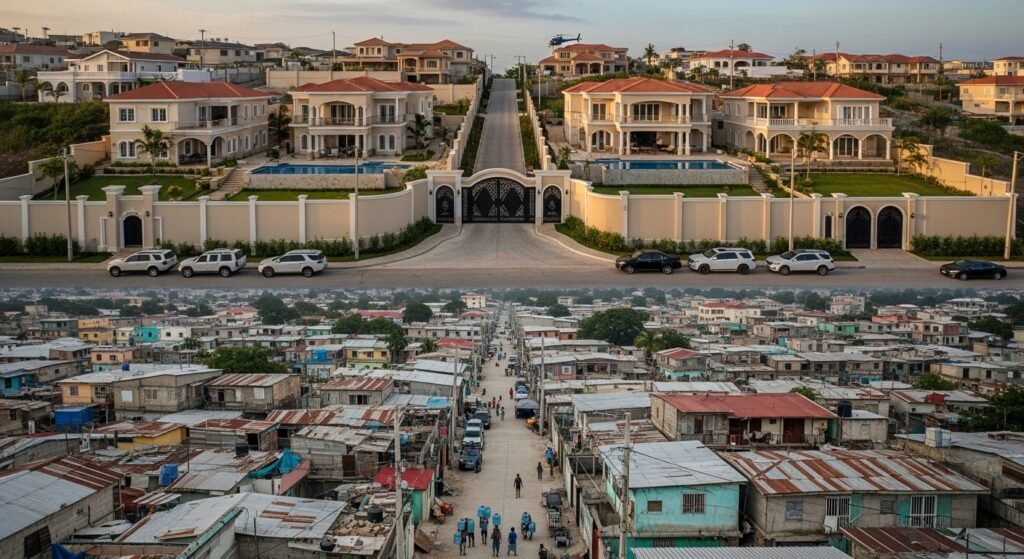
The most visible face of Haiti’s extreme wealth concentration is the Bigio family, headed by Gilbert Bigio, often described as Haiti’s only billionaire. The family’s rise to power traces back to 1896 when Gilbert’s father, a Sephardic Jew from Aleppo, Syria (then part of the Ottoman Empire), immigrated to Haiti. This early arrival gave the family a significant head start in establishing themselves in the country’s business community.
The Bigio family fortune expanded dramatically over generations, particularly after the second ouster of left-leaning President Jean-Bertrand Aristide in 2004. Today, through their GB Group conglomerate founded in 1972, the family controls vast segments of Haiti’s economy. Their business interests extend to:
The Miami Herald’s investigation into the Pandora Papers revealed that “much of what is bought, sold or consumed in Haiti is likely to touch some corner of the Bigio empire”. Despite this economic dominance within Haiti, the family maintains residences in exclusive areas like Indian Creek Island in Florida, where their home is held through offshore shell companies.
The Pandora Papers exposed how the Bigios used multiple offshore service providers to create complex structures across tax havens including the British Virgin Islands, Bahamas, and Panama, with connections to Swiss bank accounts. One offshore company, Lockver Investment Inc., was used as a holding company through which the family took a stake in Digicel Haiti International. Another, Lafito Free Zone Holdings Ltd., receives dividends from their port terminal operations outside Port-au-Prince.
Other prominent wealthy Haitians identified in the Pandora Papers include:
Former U.S. Ambassador to Haiti Vicki J. Huddleston observed that in Haiti, “This tiny white or whitish minority controls the resources of the country… and they’re not terribly good about putting them back into the country”. While the GB Group website highlights philanthropic initiatives like a planned $6 million land donation for a teaching hospital, critics argue these contributions are minimal compared to the wealth extraction.
The extreme concentration of wealth in Haiti has profound consequences for the nation’s development and its people’s well-being. Gary Kalman, U.S. director for Transparency International, noted that the complex offshore structures created by wealthy Haitians “raises all kinds of red flags, and creates enormous problems for the host country”.
The most direct impact is on Haiti’s public finances. With one of the hemisphere’s lowest tax collection rates, the government lacks resources for essential services like healthcare, education, and infrastructure. The IMF directly connected this to elite wealth concentration, noting that those who “were granted monopoly rights in key industries and exclusive import licenses” during the Duvalier era continue to dominate Haiti’s economy while contributing proportionally little to public revenue.
This wealth inequality creates a self-reinforcing cycle. Limited public investment means poor infrastructure, inadequate education, and weak institutions—conditions that make it difficult for ordinary Haitians to establish businesses or climb out of poverty. Meanwhile, the wealthy elite maintain connections abroad, often holding multiple passports and maintaining residences in Miami, New York, or France, allowing them to easily move assets offshore.
The stark contrast between extreme wealth and widespread poverty also contributes to social and political instability. In recent years, Haiti has experienced escalating gang violence, political assassinations, and governance challenges. While these issues have complex causes, the underlying economic inequality creates conditions where social cohesion breaks down and public institutions lack legitimacy.
Internationally, Haiti’s predicament highlights broader questions about global wealth inequality. Oxfam’s recent research emphasized that “the richest 1 percent, made up of 77 million people including billionaires, millionaires and those earning more than $140,000 per year, captured 43 percent of all new wealth over the past decade”. Haiti represents perhaps the most extreme version of this global trend.
The realities of Haiti’s wealth paradox demand both greater awareness and concrete action from multiple stakeholders. Here’s what various groups can do:For the Haitian Diaspora and Concerned Global Citizens:
For Policymakers and International Organizations:
For Haitian Entrepreneurs and Business Leaders:
For Researchers and Journalists:
Addressing Haiti’s extreme inequality requires acknowledging both its historical roots and contemporary mechanisms. It means confronting the legacy of colonialism, dictatorships, and exploitative economic structures. Most importantly, it means centering the voices and interests of ordinary Haitians who have been systematically excluded from their nation’s wealth.
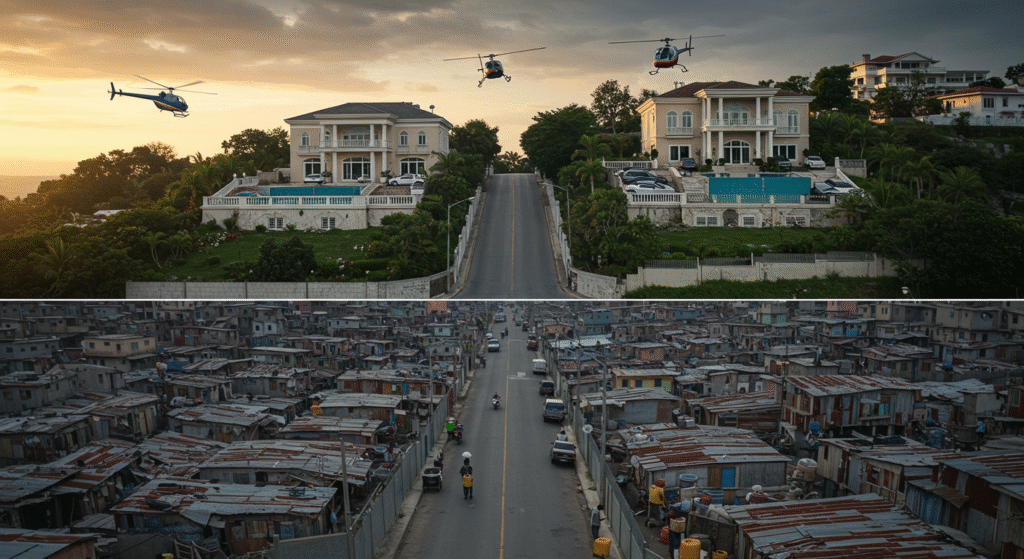
Haiti’s wealth paradox—extreme poverty alongside extraordinary private fortunes—represents one of the world’s starkest examples of economic inequality. The country that launched history’s most successful slave revolution now finds itself trapped in new forms of economic subjugation, where resources flow disproportionately to a tiny elite while the majority struggles for basic necessities.
This reality was not inevitable but resulted from specific historical processes and contemporary mechanisms: the crushing “independence debt” that hampered early development, dictatorships that granted monopoly rights to select families, and modern financial structures that facilitate wealth extraction and concealment.
The Pandora Papers and other investigations have begun to illuminate these mechanisms, revealing how Haiti’s wealthiest families utilize complex offshore structures to shield their assets. Yet much remains hidden, protected by both financial secrecy and narratives that obscure the structural nature of Haiti’s inequality.
Addressing this paradox requires not just acknowledging its existence but confronting its root causes. It means challenging the economic models that allow extreme wealth concentration alongside extreme poverty. It means demanding transparency, accountability, and systems that generate broad-based prosperity rather than enriching a select few.
Most importantly, it means listening to and amplifying Haitian voices that have long called for economic justice. The path forward lies not in charity or external solutions but in transforming the structures that perpetuate inequality and creating an economy that works for all Haitians.
1. Who are Haiti’s wealthiest individuals and how did they accumulate their wealth? The Bigio family, headed by Gilbert Bigio, is frequently cited as Haiti’s wealthiest, with their fortune tracing back to the early 1900s and expanding dramatically through their GB Group conglomerate. Their wealth grew through strategic business acquisitions across virtually every sector of Haiti’s economy, particularly after 2004, including construction materials, fuel, food imports, port facilities, and telecommunications. 2. How does Haiti’s wealth inequality compare to other countries? Haiti carries the dubious distinction of having the Western Hemisphere’s highest levels of income inequality. While approximately 60% of Haitians live below the poverty line, a small elite controls vast business empires that dominate the economy. 3. What mechanisms do Haiti’s wealthy use to protect and grow their assets? The Pandora Papers revealed that wealthy Haitians use complex offshore structures in tax havens like the British Virgin Islands, Bahamas, and Panama, often with connections to Swiss bank accounts. These structures include shell companies, trusts, and other legal entities that shield assets from public scrutiny and potentially from taxation. 4. How does wealth concentration impact Haiti’s development? Extreme wealth concentration limits Haiti’s tax revenue, with the country collecting only about 13% of GDP in taxes (compared to 24.5% in the U.S.). This constrains public investment in essential services like healthcare, education, and infrastructure, creating conditions that perpetuate poverty and instability. 5. What efforts exist to address Haiti’s wealth inequality? Recent research is examining how property taxation might gain support among Haiti’s wealthy. Some Haitian entrepreneurs are working to create more inclusive economic models, though these efforts remain limited compared to the scale of inequality. In December 2023, Canada sanctioned Gilbert Bigio and other prominent Haitian business figures over alleged corruption. 6. How do Haiti’s wealthy contribute to the country’s development? Some wealthy Haitians highlight philanthropic initiatives, such as the Bigio family’s planned $6 million land donation for a teaching hospital. However, critics argue these contributions are minimal compared to the wealth extracted from Haiti, with former U.S. Ambassador Vicki Huddleston noting that Haiti’s economic elite “control the resources, and they’re not terribly good about putting them back into the country”. 7. What role do international factors play in Haiti’s wealth inequality? International factors include Haiti’s historical “independence debt” to France, unfavorable trade policies, and financial systems that facilitate offshore wealth concealment. International financial institutions have sometimes implemented policies that exacerbate inequality, though recent IMF reports have begun acknowledging the role of elite wealth concentration in limiting Haiti’s development.