Physical Address
304 North Cardinal St.
Dorchester Center, MA 02124
Physical Address
304 North Cardinal St.
Dorchester Center, MA 02124


Haiti stands as the world’s first Black republic, born from the ashes of the most successful slave rebellion in history. When Haitian revolutionaries defeated Napoleon’s forces and declared independence on January 1, 1804, they didn’t just create a new nation—they shattered the foundations of the colonial world order. Led by visionaries like Toussaint Louverture, Jean-Jacques Dessalines, and Henri Christophe, Haiti embodied the radical notion that Black people could govern themselves and build a sovereign state amid a world dominated by white supremacist powers.
However, Haiti’s bold declaration came at a devastating cost. France demanded 150 million francs (approximately $21 billion in today’s currency) as “compensation” for lost property—including the enslaved humans who had liberated themselves. This crushing debt, which Haiti finally paid off in 1947, crippled the young nation’s economy for generations. Simultaneously, international powers including the United States, Britain, and France enacted economic embargoes and diplomatic isolation that strangled Haiti’s development.
Throughout its history, Haiti has faced repeated foreign interventions—from the U.S. occupation (1915-1934) to UN “peacekeeping” missions—that have undermined sovereignty and self-determination. Puppet governments, extractive economic policies, and neocolonial relationships have kept Haiti dependent on foreign aid while depleting its resources and autonomy. This pattern of external control and exploitation has fostered a political culture where leadership often looks outward for legitimacy rather than inward to the needs and aspirations of the Haitian people.
Yet, throughout this troubled history, currents of Haitian nationalism have repeatedly emerged as powerful forces for change. From Charlemagne Péralte’s resistance against American occupation to the Noirisme movement that celebrated Haiti’s African heritage, patriotic visions have offered alternative pathways beyond foreign dependency and internal corruption.

The systematic dismantling of Haiti’s national consciousness has been both deliberate and insidious. Foreign powers, international financial institutions, and a complicit local elite have collaborated to replace Haiti’s revolutionary legacy with a narrative of dependency and helplessness. The education system, heavily influenced by foreign models and funding, rarely centers Haiti’s revolutionary achievements or indigenous knowledge systems. Instead, many young Haitians grow up learning more about European history than their own heritage of resistance.
Media portrayals consistently frame Haiti through the lens of poverty, corruption, and “failed state” rhetoric, while erasing the external factors that created these conditions. This relentless negative framing has fostered a collective psychological trauma where many Haitians internalize the derogatory narratives about their nation. The resulting inferiority complex manifests in the widespread perception that solutions must come from outside, that Haitian leadership is inherently corrupt, and that Haiti cannot solve its own problems.
The diaspora, while vital to Haiti’s economy through remittances, often struggles with complex relationships to the homeland—vacillating between deep emotional connections and practical distance, between critique of corruption and dreams of return. Meanwhile, NGOs have created a parallel governance structure where foreign organizations provide basic services that should be the government’s responsibility, further undermining state legitimacy and capacity.
This erosion of national identity has created a vacuum where collective purpose should exist. Without a shared vision of Haiti’s future rooted in its revolutionary past, political discourse devolves into power struggles between competing factions, each seeking foreign backing rather than popular legitimacy.
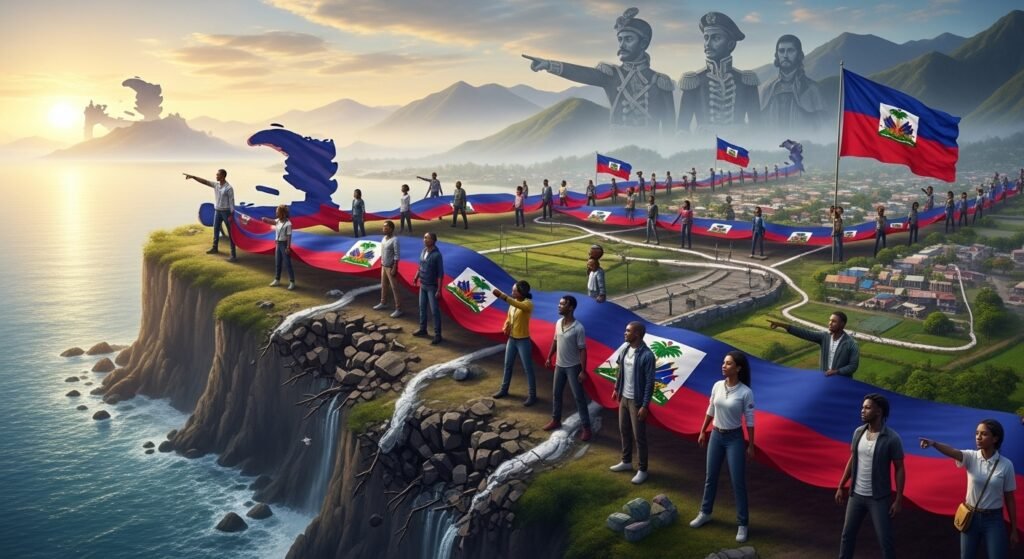
True Haitian patriotism is not blind loyalty to corrupt leaders or empty flag-waving. Rather, it is a radical commitment to Haiti’s founding principles of liberty, equality, and self-determination. A renewed nationalist vision must begin by reclaiming Haiti’s revolutionary heritage—not as distant history but as a living tradition that can inform contemporary struggles for sovereignty and justice.
This patriotic revival requires a fundamental reconsideration of Haiti’s relationship with foreign powers and international organizations. Aid relationships must be transformed from dependency to partnership, with Haitians leading the design and implementation of development initiatives. Foreign investment should be welcomed only when it builds Haitian capacity and aligns with national priorities rather than extracting wealth or imposing external agendas.
The Haitian diaspora represents an untapped resource for national renewal. Beyond remittances, diaspora Haitians possess knowledge, skills, and international connections that could catalyze development if properly integrated into a coherent national strategy. A patriotic vision must create pathways for diaspora engagement beyond financial contributions, including knowledge transfer, institutional partnerships, and political participation.
Economic patriotism demands prioritizing Haitian production, especially in agriculture and light manufacturing. The systematic destruction of Haiti’s rice industry through forced trade liberalization in the 1990s demonstrates how foreign economic policies can devastate local production. Rebuilding Haiti’s food sovereignty and developing value-added industries that employ Haitians must be central to any nationalist economic program.
Cultural patriotism celebrates and preserves Haiti’s unique heritage—from Kreyòl language to Vodou spiritual traditions to revolutionary history. These cultural elements provide both symbolic resources for national cohesion and practical frameworks for addressing contemporary challenges. A patriotic educational system would center Haitian knowledge, achievements, and historical perspectives rather than importing foreign curricula that alienate students from their own context.
The international community’s approach to Haiti’s challenges has consistently undermined rather than strengthened Haitian sovereignty and self-determination. Foreign interventions—whether military occupations, imposed structural adjustment programs, or overwhelming NGO presence—have repeatedly failed to deliver sustainable improvements in Haitian governance or living standards.
The United Nations stabilization missions (MINUSTAH and MINUJUSTH) introduced cholera to Haiti, killing over 10,000 people, while failing to establish lasting security or democratic institutions. Despite billions in post-earthquake aid, little infrastructural improvement materialized as funds were channeled through foreign contractors and NGOs rather than Haitian institutions. The “Republic of NGOs” has created a parallel governance structure that further weakens state capacity while fostering dependency.
International financial institutions have imposed economic policies that prioritize debt repayment and foreign market access over domestic needs. Trade liberalization decimated Haiti’s agricultural sector, forcing the country to import food it once produced and driving rural populations into overcrowded cities. Foreign aid often comes with strings attached that serve donor interests rather than Haitian priorities.
Even well-intentioned international engagement frequently suffers from cultural blindness, failing to recognize or build upon Haiti’s strengths and indigenous solutions. Foreign experts parachute in with pre-fabricated solutions that ignore local context, knowledge, and capacities. Meanwhile, Haitian voices are marginalized in discussions about their own country’s future.
The consistent failure of internationalized approaches demonstrates that lasting solutions must be Haitian-led and rooted in Haiti’s unique context. External support can play a constructive role, but only when it strengthens rather than supplants Haitian agency and institutions.
A renewed Haitian nationalism must be both backward-looking and forward-thinking—drawing inspiration from Haiti’s revolutionary heritage while articulating a vision that addresses contemporary challenges. This nationalism is not about isolation but about engagement with the world on Haiti’s own terms.
Key elements of this new nationalist vision include:Constitutional Reform: The current constitutional crisis offers an opportunity to rebuild Haiti’s legal foundation through a genuinely inclusive process that reflects national priorities rather than external pressures. Economic Sovereignty: Policies that promote domestic production, protect strategic industries, and develop Haiti’s abundant natural resources for the benefit of the Haitian people must replace the neoliberal model that has failed Haiti for decades. Educational Revolution: Transforming education to center Haitian history, language, and knowledge systems would build both practical skills and national consciousness. Technical training must be expanded while promoting critical thinking about Haiti’s position in global systems. Diaspora Integration: New mechanisms for diaspora participation in Haiti’s development—from investment opportunities to knowledge transfer programs to political representation—would leverage this crucial resource for national renewal. Cultural Renaissance: Celebrating and developing Haiti’s rich cultural traditions can strengthen national identity while creating economic opportunities through cultural industries and tourism. Environmental Restoration: A patriotic approach to Haiti’s environmental crisis would combine traditional knowledge with modern techniques to address deforestation, soil erosion, and climate vulnerability. South-South Cooperation: Building stronger relationships with other Global South nations, particularly in Africa and Latin America, can provide models and partnerships that respect Haiti’s sovereignty while providing needed resources and expertise.

Haiti’s liberation began with a revolutionary vision that enslaved people could become citizens of a sovereign nation. Today, Haiti’s challenges demand an equally revolutionary vision—one that rejects both corrupt elite rule and foreign domination in favor of genuine popular sovereignty.
Patriotism offers a unifying framework that can transcend the divisions that have fragmented Haitian society and politics. By grounding political discourse in shared commitment to national welfare rather than factional interests, a renewed nationalism creates space for pragmatic cooperation on pressing issues while maintaining principled opposition to exploitation and injustice.
The greatest threat to Haiti’s future is not poverty or instability but the erosion of belief in Haiti’s capacity to solve its own problems. Reclaiming national pride is therefore not merely symbolic but essential to mobilizing the collective energy needed for transformation. When Haitians in Haiti and throughout the diaspora reconnect with their revolutionary heritage and recommit to the promise of 1804, new possibilities for liberation emerge.
Haiti’s first revolution showed the world that the impossible was possible. A renewed patriotic vision can fuel Haiti’s next revolution—not through violence but through the radical assertion of sovereignty, dignity, and self-determination in a world that still struggles to accept Black nations as truly equal and independent.
1. Isn’t nationalism dangerous and potentially divisive? Haitian nationalism differs fundamentally from exclusionary or aggressive forms of nationalism seen elsewhere. Rooted in anti-colonial struggle, Haitian nationalism is about sovereignty and self-determination rather than dominance over others. It seeks to unite all Haitians regardless of class, color, or location while remaining open to constructive international partnerships. 2. How can Haiti assert sovereignty while still receiving necessary international support? True sovereignty doesn’t mean isolation but the ability to engage with international partners on equal terms. Haiti can welcome support that respects Haitian leadership and priorities while rejecting interventions that undermine local capacity or impose external agendas. The key is shifting from dependency to partnership. 3. What role should the diaspora play in Haiti’s nationalist renewal? The diaspora represents an extension of the Haitian nation, not a separate entity. A comprehensive nationalist vision must include mechanisms for diaspora Haitians to contribute not just financially but through knowledge transfer, institutional partnerships, cultural exchange, and even political representation, while respecting that final decision-making authority rests with those living in Haiti. 4. How can Haiti rebuild national institutions while facing such severe resource constraints? Building effective institutions doesn’t always require massive resources but rather vision, commitment, and appropriate design. Haiti can start by focusing on core state functions and expanding gradually, prioritizing accountability and public service rather than personal enrichment. Strategic diaspora partnerships and South-South cooperation can provide support without the usual strings attached to Western aid. 5. What historical examples demonstrate the positive potential of Haitian nationalism? The 1804 revolution itself demonstrates how nationalist vision mobilized collective action against overwhelming odds. The resistance against U.S. occupation (1915-1934), the Indigénisme movement celebrating Haitian culture in the early 20th century, and the early Duvalierist period before it devolved into dictatorship all showed how nationalist movements could mobilize broad-based support for transformative change. 6. How can Haiti balance pride in its revolutionary past with the pressing needs of the present? Haiti’s revolutionary heritage isn’t just historical pride but a practical resource for addressing current challenges. The organizational strategies of the revolution, the diplomatic approaches of early Haitian leaders, and the self-reliance forced by international isolation all offer lessons for contemporary problems. Haiti’s past contains both inspiration and practical wisdom for its future. 7. What immediate steps can ordinary Haitians take to advance a patriotic vision? Everyone can contribute through seemingly small actions: learning and teaching accurate Haitian history, supporting Haitian-owned businesses, participating in community development initiatives, demanding accountability from leaders and international partners alike, and challenging negative narratives about Haiti in media and personal conversations. These individual actions, multiplied across millions of Haitians, create the foundation for larger structural changes.